
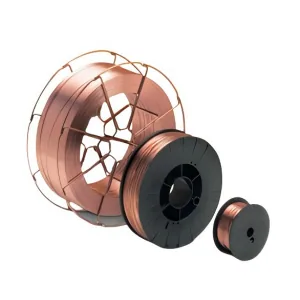
AK-ER309LSi Low Carbon High Silicon Stainless Steel Welding Wire.
A super low carbon, high silicon stainless steel wire designed for high-speed welding with excellent fluidity and resistance to intergranular corrosion.
Product Overview
AK-ER309LSi is a super low carbon and high silicon stainless steel welding wire used for joining 309L-type alloys or for dissimilar welding between 300 series stainless steels and carbon or low alloy steels.
The low carbon content minimizes the risk of intergranular corrosion, while the elevated silicon improves weld pool fluidity, enabling high-speed welding with consistent bead appearance and good fusion.
Application: Used to weld super low carbon 24%Cr13%Ni and similar stainless steels, like ASTM 309S etc.
Key Benefits
Low Carbon for Corrosion Resistance.
With carbon content at 0.03 percent, AK-ER309LSi reduces the likelihood of sensitization and intergranular corrosion in the heat-affected zone.
High Silicon for Improved Fluidity.
Silicon content between 0.65 and 1.0 percent enhances weld pool fluidity, supporting high-speed welding and consistent bead formation.
High Deposition Efficiency
The wire is formulated for high deposition efficiency, reducing the need for multiple passes and minimizing weld metal dilution.
Suitable for Dissimilar Welding.
It is effective for joining 300 series stainless steels to carbon or low alloy steels, providing stable weld metal chemistry and good mechanical properties.
Where It Is Used
- Welding of super low carbon 24% Cr 13% Ni stainless steels, such as ASTM 309S.
- Dissimilar welding between 300 series stainless steels and carbon or low alloy steels.
- High-speed welding applications requiring good bead appearance and minimal spatter.
- Fabrication of components exposed to corrosive environments where intergranular attack must be avoided.
Who It Is For
- Welding consumable distributors supplying stainless steel welding wires.
- Fabricators working with 309L and similar stainless steels.
- Contractors performing dissimilar welding in petrochemical or power plant environments.
- Maintenance teams requiring corrosion-resistant welds in high-temperature or aggressive service.
Problems It Solves
- Intergranular corrosion in welds due to high carbon content in filler metal.
- Poor weld pool fluidity limiting welding speed and bead quality.
- Inconsistent results when joining stainless steel to carbon or low alloy steel.
- Need for multiple wire types to cover different welding scenarios.
Specifications
Published by the factory for AK-ER309LSi. Values not shown are not published on the datasheet and are marked as such rather than estimated.
| Standard | Designation |
|---|---|
| Classification | EN ISO 14343-A:G 23 12 LSi AWS A5.9 ER309LSi GB/T 29713 S309LSi |
| Element | Content |
|---|---|
| C | 0.03 |
| Si | 0.65-1.0 |
| Mn | 1.0-2.5 |
| S | 0.03 |
| P | 0.03 |
| Ni | 12.0-14.0 |
| Cr | 23.0-25.0 |
| Mo | 0.5 |
| Cu | 0.75 |
| Property | Value |
|---|---|
| Tensile strength (MPa) | 625 |
| Elongation (%) | 35 |
Technical Features
- Super low carbon content at 0.03 percent to prevent sensitization.
- Silicon content between 0.65 and 1.0 percent for improved weld pool fluidity.
- Tensile strength of at least 625 MPa and elongation of at least 35 percent.
- Complies with EN ISO 14343-A:G 23 12 LSi, AWS A5.9 ER309LSi, and GB/T 29713 S309LSi standards.
- Chemical composition includes Cr 23.0–25.0%, Ni 12.0–14.0%, Mo 0.5%, Cu 0.75%
Use Guide
- Select wire diameter based on joint thickness and welding position.
- Set welding parameters within the recommended range to maintain consistent arc stability and avoid excessive spatter.
- Clean base metal surfaces of oil, grease, rust, and moisture before welding to ensure sound fusion and minimize porosity.
- Use inert gas shielding (typically argon or argon-rich mixtures) for MIG/MAG welding to protect the molten pool from atmospheric contamination.
How It Compares
AK-ER309LSi and ER309L both join 300 series stainless steels and carbon or low alloy steels, but ER309LSi has a lower carbon content and higher silicon, which improves fluidity and reduces the risk of intergranular corrosion. Standard ER309L has higher carbon and less silicon, making it less suitable for high-speed welding and more prone to sensitization. For applications requiring maximum corrosion resistance in the heat-affected zone, ER309LSi is preferred over higher carbon alternatives.
Related Grades
Other welding wire in the same family.
AK-ER309LSi Questions
What are the key chemical elements and their ranges in AK-ER309LSi?
What mechanical properties does the deposited metal achieve?
Which standards does AK-ER309LSi meet?
Can I get technical data and packaging details before ordering?
What packing is AK-ER309LSi supplied in?
Can we test AK-ER309LSi before placing a production order?
Request a Quotation for AK-ER309LSi
Send the diameter, the quantity and the destination port. Our technical team replies with packing, pricing and the data you need to qualify the grade.