
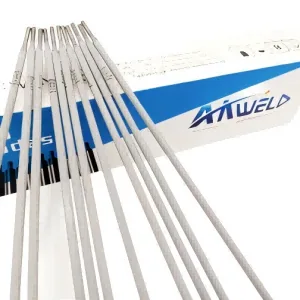
AK-ENiCrFe-2 Nickel-Chromium-Iron Alloy Electrode for High-Temperature and Dissimilar Metal Welding.
A low hydrogen manual electrode with high alloy content for welding Ni-Cr-Fe alloys, 9% Ni steel, and dissimilar metals, offering stable arc, clean bead, and excellent mechanical properties across a wide temperature range.
Product Overview
AK-ENiCrFe-2 is a low hydrogen type manual electrode with a nominal composition of 70% Ni-15% Cr-8% Fe-2% Mn-2% Nb+Ta-1.5% Mo, designed for welding Ni-Cr-Fe series alloys and dissimilar metal joints. It is suitable for base materials that are forged or casted and are weldable grades.
The electrode maintains stable arc performance, produces a beautiful bead appearance with few spatter, and allows easy slag removal. It exhibits excellent resistance to blowholes and delivers consistent mechanical properties in the deposited metal, including high low-temperature impact toughness and good oxidation resistance at elevated temperatures.
It can be used across a wide temperature range from low temperature up to 980°C. However, performance may deteriorate above 820°C due to reduced oxidation resistance and strength.
Application: Suitable for the welding of Ni-Cr-Fe series alloy, such as Incoloy 800, 800Halloy, Inconel 600,601alloy,ASTMB613andetc;Can also be used for welding 9% Ni steel and dissimilar metal between various alloy or alloy with creep resistance.
Key Benefits
Stable Arc and Clean Weld Bead.
The low hydrogen coating ensures a stable arc and minimal spatter, resulting in a clean, smooth bead profile that reduces post-weld cleaning and improves joint appearance.
Easy Slag Removal
Slag detaches easily after welding, reducing the need for extensive chipping and wire brushing between passes.
Excellent Blowhole Resistance
The electrode formulation resists porosity and blowholes, even in challenging welding conditions.
High Mechanical Properties in Deposited Metal.
The deposited metal achieves tensile strength of at least 550 MPa, yield stress of at least 360 MPa, and elongation of at least 30 percent, ensuring reliable performance under load.
Where It Is Used
- Welding of Ni-Cr-Fe series alloys such as Incoloy 800, 800H, Inconel 600, Inconel 601, and ASTM B613.
- Welding of 9% Ni steel and dissimilar metal joints involving various alloys or creep-resistant materials.
- Applications requiring high-temperature service up to 980°C and good low-temperature toughness.
Who It Is For
- Welding consumable distributors supplying high-alloy welding materials.
- Fabricators and maintenance teams working with high-temperature alloys and 9% Ni steel.
- Contractors involved in petrochemical, power generation, and pipeline systems requiring reliable dissimilar metal welds.
Problems It Solves
- Achieving consistent weld metal properties in high-alloy and dissimilar metal joints where standard electrodes fail.
- Avoiding porosity and blowholes in critical welds due to poor gas shielding or contamination.
- Managing weld joint integrity across a wide temperature range, especially in service conditions above 820°C.
Specifications
Published by the factory for AK-ENiCrFe-2. Values not shown are not published on the datasheet and are marked as such rather than estimated.
| Standard | Designation |
|---|---|
| Classification 1 | EN ISO 14172-E Ni 6133 |
| Classification 2 | AWS A5.11 |
| Classification 3 | ENiCrFe-2 |
| Classification 4 | GB/T 13814 |
| Classification 5 | ENi6133 |
| Element | Content |
|---|---|
| C | ≤0.10 |
| Si | ≤0.75 |
| Mn | 1.00-3.50 |
| S | ≤0.015 |
| P | ≤0.03 |
| Fe | ≤12.0 |
| Ni | ≥62 |
| Cr | 13.0-17.0 |
| Nb | 0.5-2.5 |
| Property | Value |
|---|---|
| Tensile strength (MPa) | ≥550 |
| Yield Stress (MPa) | ≥360 |
| Elongation (%) | ≥30 |
| Impact values (J) | —— |
Technical Features
- Low hydrogen manual electrode with nominal composition: 70% Ni, 15% Cr, 8% Fe, 2% Mn, 2% Nb+Ta, 1.5% Mo.
- Meets EN ISO 14172-E Ni 6133, AWS A5.11, ENiCrFe-2, GB/T 13814, and ENi6133 standards.
- Deposited metal tensile strength at least 550 MPa, yield stress at least 360 MPa, elongation at least 30 percent.
- Impact values not specified in available data.
- Chemical composition: C ≤0.10, Si ≤0.75, Mn 1.00–3.50, S ≤0.015, P ≤0.03, Fe ≤12.0, Ni ≥62, Cr 13.0–17.0, Nb 0.5–2.5.
Use Guide
- Select electrode diameter based on joint configuration and thickness. Use recommended current settings to maintain arc stability and avoid overheating.
- Clean base metal surfaces thoroughly from oil, grease, rust, and moisture before welding to prevent contamination and porosity.
- Store electrodes in sealed packaging and re-dry if exposed to humidity. Follow re-baking procedures as per manufacturer guidelines.
- Ensure complete slag removal between passes to avoid inclusions and ensure sound weld integrity.
How It Compares
AK-ENiCrFe-2 is a low hydrogen electrode designed for high-alloy and dissimilar metal welding. It differs from standard mild steel electrodes like E6013 in composition and performance, offering superior high-temperature strength and oxidation resistance. Compared to basic-coated electrodes, it provides better arc stability and easier slag removal while maintaining high toughness. It is not intended for low-alloy or carbon steel applications.
Related Articles
Technical background on this grade from the AKWELD knowledge centre.
Related Grades
Other welding electrodes in the same family.
AK-ENiCrFe-2 Questions
What standards does AK-ENiCrFe-2 meet?
What is the chemical composition of the deposited metal?
What mechanical properties does the deposited metal achieve?
What temperature range is this electrode suitable for?
What packing is AK-ENiCrFe-2 supplied in?
Can we test AK-ENiCrFe-2 before placing a production order?
Request a Quotation for AK-ENiCrFe-2
Send the diameter, the quantity and the destination port. Our technical team replies with packing, pricing and the data you need to qualify the grade.