
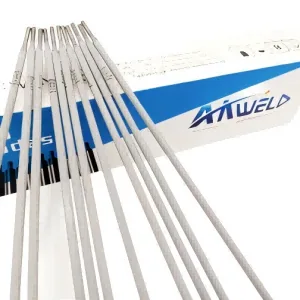
AK-E7024 Rutile Iron Powder Electrode for High-Efficiency Fillet Welding.
A gravity-type rutile electrode with iron powder for high deposition efficiency in flat and horizontal fillet welds on carbon and low alloy steel, with stable arc and easy re-strike.
Product Overview
AK-E7024 is a rutile-coated, iron powder, gravity-type covered electrode designed for high-efficiency fillet welding in the flat and horizontal positions on carbon steel and low alloy steel. The electrode delivers 180% recovery, meaning it deposits more weld metal per unit of electrode consumed compared to standard electrodes.
It operates with AC or DC+ polarity and features a stable arc and easy arc re-strike, which supports continuous welding without interruptions. AKWELD supplies AK-E7024 to the AWS A5.1 E7024, EN ISO 2560-A E 38 0 R R 7 3, and GB/T 5117 E5024 classifications.
Application: Flat and flat fillet welding on carbon steel and low alloy steel.
Key Benefits
High Deposition Efficiency with 180% Recovery.
The iron powder content increases the amount of weld metal deposited per pass, reducing the number of passes needed and improving productivity on fillet welds.
Stable Arc and Easy Re-strike.
The rutile coating ensures a stable arc during welding and allows quick re-striking after short interruptions, which improves workflow continuity.
Optimized for Flat and Horizontal Fillet Welds.
Designed specifically for flat and horizontal fillet welding, it provides consistent bead shape and good fusion without requiring position changes.
Good Mechanical Properties in the Weld Metal.
The deposited metal achieves tensile strength between 490 MPa and 660 MPa, yield stress of at least 400 MPa, elongation of at least 22 percent, and impact energy of at least 47 J at 0 degrees C.
Where It Is Used
- Flat and horizontal fillet welding in structural steel fabrication.
- Production welding on carbon steel and low alloy steel components.
- High-speed welding where deposition rate and efficiency are critical.
- Workshops requiring consistent performance with minimal rework.
Who It Is For
- Steel fabrication shops focused on high-volume production of fillet welds.
- Welding contractors working on structural steel and industrial equipment.
- Fabricators needing a reliable electrode with high recovery for cost-effective welding.
Problems It Solves
- Low deposition rate and high electrode consumption in fillet welding due to standard electrode types.
- Arc instability and difficulty re-striking during long welding sequences.
- Inconsistent weld bead quality and poor fusion in horizontal fillet joints.
Specifications
Published by the factory for AK-E7024. Values not shown are not published on the datasheet and are marked as such rather than estimated.
| Standard | Designation |
|---|---|
| Classification 1 | EN ISO 2560-A:E 38 0 R R 7 3 |
| Classification 2 | AWS A5.1 E7024 |
| Classification 3 | GB/T 5117 E5024 |
| Element | Content |
|---|---|
| C | 0.15 |
| Si | 0.9 |
| Mn | 1.25 |
| S | 0.035 |
| P | 0.035 |
| Ni | 0.30 |
| Mo | 0.30 |
| Cr | 0.20 |
| V | 0.08 |
| Property | Value |
|---|---|
| Tensile strength (MPa) | 490-660 |
| Yield Stress (MPa) | ≥400 |
| Elongation (%) | ≥22 |
| Impact values (J) | ≥47J/0℃ |
| Diameter | Current range |
|---|---|
| 3.2mm | F/H-120-150A |
| 4.0mm | F/H-220-250A |
Technical Features
- Rutile coating with iron powder for high deposition efficiency and gravity-type flow.
- Supplied in 3.2 mm and 4.0 mm diameters with recommended current ranges: 3.2 mm at 120-150 A, 4.0 mm at 220-250 A.
- Deposited metal tensile strength between 490 MPa and 660 MPa, yield stress at least 400 MPa.
- Elongation at least 22 percent and impact energy at least 47 J at 0 degrees C.
- Chemical composition includes C: 0.15%, Si: 0.9%, Mn: 1.25%, S: 0.035%, P: 0.035%, Ni: 0.30%, Mo: 0.30%, Cr: 0.20%, V: 0.08%
Use Guide
- Select electrode diameter based on joint size and welding position: 3.2 mm for thinner sections, 4.0 mm for heavier sections.
- Set welding current within the recommended range: 120-150 A for 3.2 mm, 220-250 A for 4.0 mm, using AC or DC+ polarity.
- Ensure the joint surfaces are clean and free from oil, rust, paint, and moisture before welding.
- Store electrodes in sealed packaging and re-dry if exposed to humidity before use.
How It Compares
AK-E7024 and E6013 both use rutile coatings and are suitable for flat and horizontal fillet welding, but AK-E7024 contains iron powder and is designed for higher deposition efficiency and gravity-type flow. E6013 is more general-purpose with better bead appearance on thin materials, while AK-E7024 prioritizes speed and recovery. For vertical or overhead fillets, a different electrode with all-position capability is required.
Related Grades
Other welding electrodes in the same family.
AK-E7024 Questions
What diameters and current ranges are available?
What classifications does this electrode meet?
What are the mechanical properties of the deposited metal?
Can I get a full catalogue and packing details before ordering?
What packing is AK-E7024 supplied in?
Can we test AK-E7024 before placing a production order?
Request a Quotation for AK-E7024
Send the diameter, the quantity and the destination port. Our technical team replies with packing, pricing and the data you need to qualify the grade.