
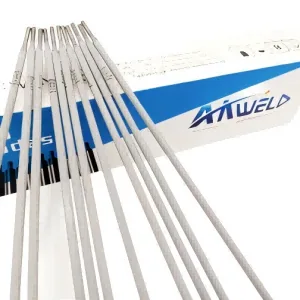
AK-E7018-1 Basic Coated Electrode for High-Strength Structural Welding.
A basic-coated electrode designed for high-quality welding with excellent strength and toughness, suitable for steels with low purity and high carbon content.
Product Overview
AK-E7018-1 is a basic-coated stick electrode for manual metal arc welding of carbon and low-alloy steels. It is formulated to deliver high strength and toughness in the deposited metal, making it suitable for critical structural applications.
The electrode is designed for use on steels with low purity and high carbon content, where consistent mechanical properties and low hydrogen levels are required to prevent cracking and ensure weld integrity.
Application: For welding of steel structures, boiler and vessel construction, vehicle construction, shipbuilding and machinery construction and buffer layer when constructed on high carbon steel.
Key Benefits
High Strength and Toughness.
The deposited metal achieves tensile strength of at least 490 MPa and yield stress of at least 430 MPa, with elongation of at least 24 percent and impact energy of at least 47 J at minus 50 degrees C.
Suitable for High Carbon and Low Purity Steels.
The electrode is effective on steels with high carbon content and low purity, where weld metal cleanliness and mechanical performance are critical.
Low Hydrogen Characteristics
The basic coating helps maintain low hydrogen levels in the weld metal, reducing the risk of hydrogen-induced cracking in high-strength and thick-section applications.
All-Position Welding Capability
AK-E7018-1 is suitable for flat, horizontal, vertical and overhead welding positions, allowing consistent performance across different joint geometries.
Where It Is Used
- Welding of steel structures and pressure vessels.
- Boiler and vessel construction.
- Shipbuilding and machinery construction.
- Buffer layer welding on high carbon steel substrates.
Who It Is For
- Welding consumable distributors supplying high-performance electrodes.
- Fabricators working on structural and pressure equipment requiring high toughness.
- Shipyards and machinery builders needing reliable electrodes for thick-section and high-strength steels.
Problems It Solves
- Weld cracking in high carbon or low purity steels due to insufficient toughness or high hydrogen content.
- Inconsistent weld metal properties when using electrodes not designed for demanding base metals.
- Need for multiple electrode types to cover different joint positions and material grades.
Specifications
Published by the factory for AK-E7018-1. Values not shown are not published on the datasheet and are marked as such rather than estimated.
| Standard | Designation |
|---|---|
| Classification 1 | EN ISO 2560-A:E 42 5 B 3 2 H5 |
| Classification 2 | AWS A5.1 E7018-1 |
| Classification 3 | GB/T 5117 E5018-1 |
| Element | Content |
|---|---|
| C | 0.15 |
| Si | 0.75 |
| Mn | 1.6 |
| S | 0.035 |
| P | 0.035 |
| Ni | 0.30 |
| Mo | 0.30 |
| Cr | 0.20 |
| V | 0.08 |
| Property | Value |
|---|---|
| Tensile strength (MPa) | ≥490 |
| Yield Stress (MPa) | ≥430 |
| Elongation (%) | ≥24 |
| Impact values (J) | ≥47J/-50℃ |
| Diameter | Current range |
|---|---|
| 2.5mm | 65-95A |
| 3.2mm | 100-135A |
| 4.0mm | 110-210A |
Technical Features
- Basic coating for low hydrogen and high toughness deposited metal.
- Deposited metal tensile strength at least 490 MPa, yield stress at least 430 MPa, elongation at least 24 percent.
- Impact energy at least 47 J at minus 50 degrees C.
- Chemical composition includes carbon 0.15%, silicon 0.75%, manganese 1.6%, sulfur 0.035%, phosphorus 0.035%, nickel 0.30%, molybdenum 0.30%, chromium 0.20%, vanadium 0.08%
- Supplied to EN ISO 2560-A:E 42 5 B 3 2 H5, AWS A5.1 E7018-1, and GB/T 5117 E5018-1 classifications.
Use Guide
- Select electrode diameter based on joint thickness and position. Use 2.5 mm for thin sections and 4.0 mm for thicker materials.
- Set welding current within the recommended ranges: 65-95 A for 2.5 mm, 100-135 A for 3.2 mm, and 110-210 A for 4.0 mm.
- Keep electrodes dry in sealed packaging. Re-bake if exposed to moisture before use.
- Clean joint surfaces thoroughly to remove rust, oil, paint, and moisture before welding.
- Remove slag completely between passes to avoid inclusions and ensure sound welds.
How It Compares
AK-E7018-1 and E6013 both weld low carbon steel, but they differ in coating type and performance. E6013 uses a rutile coating for easy arc starting and good slag removal, suitable for general-purpose welding. AK-E7018-1 uses a basic coating to deliver higher strength, toughness, and low hydrogen content, making it better for structural and high-strength applications. E7018-1 is not recommended for thin sheet metal where lower heat input is needed.
Related Grades
Other welding electrodes in the same family.
AK-E7018-1 Questions
What are the recommended welding currents for each diameter?
What mechanical properties does the deposited metal achieve?
Which standards does AK-E7018-1 meet?
Can I get technical data and packing details before ordering?
What packing is AK-E7018-1 supplied in?
Can we test AK-E7018-1 before placing a production order?
Request a Quotation for AK-E7018-1
Send the diameter, the quantity and the destination port. Our technical team replies with packing, pricing and the data you need to qualify the grade.