
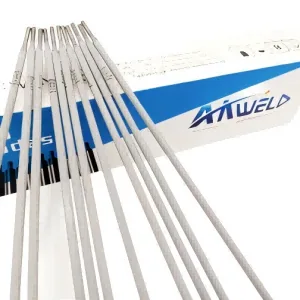
AK-E7015 Basic Carbon Steel Electrode for All-Position Welding.
A low-hydrogen basic electrode designed for high-strength, crack-resistant welds in critical structural applications using low and medium carbon steels.
Product Overview
AK-E7015 is a basic-coated carbon steel electrode for manual metal arc welding, supplied to AWS A5.1 E7015, EN ISO 2560-A E 42 3 B 2 2, and GB/T 5117 E5015 classifications. It requires direct current reverse polarity (DCEN) and is suitable for welding in all positions.
The electrode delivers excellent plasticity, toughness, and resistance to cracking in the deposited weld metal, making it suitable for demanding structural applications where mechanical integrity is essential.
Application: Mainly used for low carbon steel, medium carbon steel and low alloysteel, such as 16Mn, 09 Mn2Si and ship A,B,D,E grade steel plates for the main components of ships, as well as boilers, pressure vessels, vehicles, buildings, bridge dyeing, etc. Welding of important structural parts.
Key Benefits
High Toughness and Crack Resistance.
The deposited metal achieves impact energy of at least 47 J at minus 30 degrees C, with tensile strength between 490 MPa and 660 MPa, and elongation of at least 22 percent, ensuring reliable performance in low-temperature environments.
All-Position Welding Capability
AK-E7015 can be used in flat, horizontal, vertical, and overhead positions, allowing a single electrode to cover multiple joint orientations without changing consumables.
Low Hydrogen for Reduced Cracking Risk.
The basic coating minimizes hydrogen content in the weld metal, reducing the risk of hydrogen-induced cracking in high-stress or thick-section joints.
Consistent Mechanical Properties
Chemical composition is controlled to ensure consistent performance: carbon content ≤0.15%, sulfur and phosphorus each ≤0.035%, and manganese ≤1.6%.
Where It Is Used
- Welding of low carbon steel and medium carbon steel components.
- Joining low alloy steels such as 16Mn, 09 Mn2Si, and ship A, B, D, E grade steel plates.
- Construction of boilers, pressure vessels, and structural components in vehicles, buildings, and bridges.
- Critical structural welds requiring high toughness and crack resistance.
Who It Is For
- Welding consumable distributors supplying electrodes for structural and pressure equipment fabrication.
- Fabricators of boilers, pressure vessels, and heavy machinery requiring low-hydrogen electrodes.
- Shipbuilding and bridge construction teams working with ship-grade steels and high-strength structural steels.
Problems It Solves
- Cracking in welds due to high hydrogen content or poor toughness in low-temperature service.
- Inconsistent mechanical properties when using electrodes with uncontrolled chemistry or coating type.
- Need for multiple electrode types to cover different positions on a single joint.
Specifications
Published by the factory for AK-E7015. Values not shown are not published on the datasheet and are marked as such rather than estimated.
| Standard | Designation |
|---|---|
| Classification 1 | EN ISO 2560-A E 42 3 B 2 2 |
| Classification 2 | AWS A5.1 E7015 |
| Classification 3 | GB/T 5117 E5015 |
| Element | Content |
|---|---|
| C | ≤0.15 |
| Si | ≤0.9 |
| Mn | ≤1.6 |
| S | ≤0.035 |
| P | ≤0.035 |
| Ni | ≤0.30 |
| Mo | ≤0.30 |
| Cr | ≤0.20 |
| Property | Value |
|---|---|
| Tensile strength (MPa) | 490-660 |
| Yield Stress (MPa) | ≥400 |
| Elongation (%) | ≥22 |
| Impact values (J) | ≥47J/-30℃ |
| Diameter | Current range |
|---|---|
| 2.5mm | F/H-70-110A V/OH-50-80A |
| 3.2mm | F/H-100-140A V/OH-80-110A |
| 4.0mm | F/H-140-180A V/OH-130-170A |
Technical Features
- Basic coating for low hydrogen and high toughness deposited metal.
- Deposited metal tensile strength between 490 MPa and 660 MPa, yield stress ≥400 MPa, elongation ≥22 percent.
- Impact energy ≥47 J at minus 30 degrees C.
- Chemical composition: C ≤0.15%, Si ≤0.9%, Mn ≤1.6%, S ≤0.035%, P ≤0.035%, Ni ≤0.30%, Mo ≤0.30%, Cr ≤0.20%
- Available in 2.5 mm, 3.2 mm, and 4.0 mm diameters with published current ranges for each.
Use Guide
- Select diameter by joint thickness and set current within the recommended range: 2.5 mm – 70-110 A flat/horizontal, 50-80 A vertical/overhead; 3.2 mm – 100-140 A flat/horizontal, 80-110 A vertical/overhead; 4.0 mm – 140-180 A flat/horizontal, 130-170 A vertical/overhead.
- Use direct current reverse polarity (DCEN) only.
- Keep electrodes dry in sealed packaging; re-dry if exposed to moisture before use.
- Clean joint surfaces from rust, oil, paint, and moisture before welding to prevent porosity and cracking.
How It Compares
AK-E7015 and E6013 both weld carbon steel in all positions, but E7015 has a basic coating that produces lower hydrogen content and higher toughness, making it suitable for critical structural welds. E6013 uses a rutile coating for easier arc starting and better slag removal but is not recommended for high-strength or low-temperature applications. E7015 is preferred over E6013 when crack resistance and mechanical performance are priorities.
Related Articles
Technical background on this grade from the AKWELD knowledge centre.
Related Grades
Other welding electrodes in the same family.
AK-E7015 Questions
Which standards does AK-E7015 meet?
What are the recommended welding currents for each diameter?
What is the impact toughness of the deposited metal?
Can I get a full catalogue and packing details before ordering?
What packing is AK-E7015 supplied in?
Can we test AK-E7015 before placing a production order?
Request a Quotation for AK-E7015
Send the diameter, the quantity and the destination port. Our technical team replies with packing, pricing and the data you need to qualify the grade.