
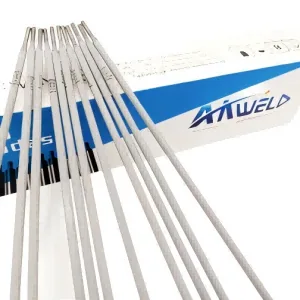
AK-E6019 Basic Coated Electrode for High-Quality Structural Welding.
A basic-coated electrode designed for high-strength, high-toughness welds in low-purity and high-carbon steels, suitable for critical structural and pressure equipment applications.
Product Overview
AK-E6019 is a basic-coated covered electrode for manual metal arc welding of low carbon and medium carbon steel structures. The electrode is formulated to deliver high strength and toughness in the deposited metal, making it suitable for demanding applications where weld integrity is critical.
It is specifically designed for welding steels with low purity and high carbon content, which can challenge weldability due to increased risk of cracking and reduced ductility. The electrode's composition and coating system help maintain sound weld metal properties under these conditions.
Application: For welding of steel structures, boiler and vessel construction, vehicle construction, shipbuilding and machinery construction and buffer layer when constructed on high carbon steel.
Key Benefits
High Strength and Toughness.
The deposited metal achieves tensile strength of at least 430 MPa and yield stress of at least 330 MPa, with elongation of at least 20 percent and impact energy of at least 27 J at minus 20 degrees C, meeting the requirements for structural integrity in low-temperature service.
Suitable for High-Carbon and Low-Purity Steels.
The electrode is effective on steels with higher carbon content and lower chemical purity, where standard electrodes may produce brittle or cracked welds, due to its controlled chemical composition and stable arc performance.
Stable Arc and Good Weld Pool Control.
The basic coating provides a stable arc and consistent weld pool behavior, which supports clean, well-defined weld beads with minimal spatter and good fusion, even in challenging joint configurations.
All-Position Welding Capability
AK-E6019 is suitable for flat, horizontal, vertical and overhead welding positions, allowing a single electrode to be used across multiple joint types without requalification.
Where It Is Used
- Welding of steel structures in construction and infrastructure.
- Boiler and pressure vessel fabrication.
- Shipbuilding and marine construction.
- Vehicle and machinery frame assembly.
- Buffer layer welding on high carbon steel substrates.
Who It Is For
- Welding consumable distributors supplying electrodes for structural and pressure equipment.
- Fabricators working with high-carbon or variable-quality steels.
- Contractors involved in shipbuilding, boiler construction, and heavy machinery where weld toughness is critical.
Problems It Solves
- Weld cracking and poor toughness in high-carbon or low-purity steels due to mismatched filler metal chemistry.
- Inconsistent weld quality when using electrodes not designed for challenging base metals.
- Need for multiple electrode types to cover different base metal conditions and joint positions.
Specifications
Published by the factory for AK-E6019. Values not shown are not published on the datasheet and are marked as such rather than estimated.
| Standard | Designation |
|---|---|
| Classification 1 | EN ISO 2560-A:E 35 A R 1 2 |
| Classification 2 | AWS A5.1 E6019 |
| Classification 3 | GB/T 5117 E4319 |
| Element | Content |
|---|---|
| C | ≤0.20 |
| Si | ≤1.0 |
| Mn | ≤1.2 |
| S | ≤0.035 |
| P | ≤0.040 |
| Mo | ≤0.30 |
| Cr | ≤0.20 |
| Ni | ≤0.30 |
| V | ≤0.08 |
| Property | Value |
|---|---|
| Tensile strength (MPa) | ≥430 |
| Yield Stress (MPa) | ≥330 |
| Elongation (%) | ≥20 |
| Impact values (J) | ≥27J/-20℃ |
| Diameter | Current range |
|---|---|
| 3.2mm | 90-140/A |
| 4.0mm | 150-210/A |
| 5.0mm | 200-270/A |
Technical Features
- Basic coating for high-quality weld metal with low hydrogen potential.
- Deposited metal tensile strength at least 430 MPa with yield stress at least 330 MPa.
- Elongation at least 20 percent and impact energy at least 27 J at minus 20 degrees C.
- Chemical composition: C ≤0.20, Si ≤1.0, Mn ≤1.2, S ≤0.035, P ≤0.040, Mo ≤0.30, Cr ≤0.20, Ni ≤0.30, V ≤0.08.
- Supplied in 3.2 mm, 4.0 mm, and 5.0 mm diameters with recommended current ranges.
Use Guide
- Select diameter by joint thickness and welding position: 3.2 mm for thin to medium sections, 4.0 mm for medium to thick sections, 5.0 mm for thick sections.
- Set welding current within the recommended range: 90-140 A for 3.2 mm, 150-210 A for 4.0 mm, 200-270 A for 5.0 mm.
- Ensure joint surfaces are clean and free of oil, rust, moisture, and paint before welding.
How It Compares
AK-E6019 and E6013 both weld low carbon steel in all positions, but they differ in coating type and performance. E6013 uses a rutile coating for easy arc starting and clean bead appearance, suitable for general fabrication. AK-E6019 uses a basic coating to produce low-hydrogen weld metal with higher strength and toughness, making it better suited for structural and pressure equipment where weld integrity is critical. For high-carbon or low-purity steels, AK-E6019 is preferred over standard rutile electrodes due to its resistance to cracking.
Related Grades
Other welding electrodes in the same family.
AK-E6019 Questions
What are the recommended welding currents for each diameter?
Which standards does AK-E6019 meet?
What are the mechanical properties of the deposited metal?
Can I get a full catalogue and packing details before ordering?
What packing is AK-E6019 supplied in?
Can we test AK-E6019 before placing a production order?
Request a Quotation for AK-E6019
Send the diameter, the quantity and the destination port. Our technical team replies with packing, pricing and the data you need to qualify the grade.