
AK-E6011 Cellulose-Type Electrode for All-Position Welding of Low Carbon Steel.
A high-efficiency cellulose-coated electrode for all-position welding with a good-looking bead appearance, suitable for single-pass applications on sheet steel structures.
Product Overview
AK-E6011 is a cellulose-type covered electrode for manual metal arc welding of low carbon steel structures. The electrode is designed for all-position welding and delivers high deposition efficiency with a clean, well-shaped bead appearance.
Its key operational requirement is maintaining a proper arc length and avoiding excessive electrode swing to achieve consistent performance. It is not recommended for multi-pass or cover welding applications.
Application: Suitable for butt welding, fillet welding, and lap weldings of sheet steelstructures, like plant chimneys, transformer tanks, ships, and external-low carbonsteel sheet structure vehicles, etc.
Key Benefits
High Deposition Efficiency
The cellulose coating enables fast melting and high deposition rates, which improves productivity on single-pass welds in sheet steel structures.
Good Bead Appearance
The electrode produces a smooth, visually acceptable bead profile on both butt and fillet joints, reducing the need for post-weld grinding.
All-Position Welding Capability
AK-E6011 can be used in flat, horizontal, vertical, and overhead positions, allowing a single electrode to cover multiple joint orientations.
Suitable for Thin and Medium Plate.
The electrode is effective on sheet steel structures where single-pass welding is practical, such as in chimneys, tanks, and vehicle bodies.
Where It Is Used
- Butt welding of low carbon steel sheet structures.
- Fillet welding in structural steel fabrication.
- Lap welding on sheet metal components.
- Welding of plant chimneys, transformer tanks, ship hulls, and external low carbon steel vehicle structures.
Who It Is For
- Welding consumable distributors stocking a high-efficiency electrode for sheet steel work.
- Fabricators of low carbon steel structures using single-pass welding techniques.
- Shipbuilding and plant construction teams requiring all-position electrodes for field welding.
Problems It Solves
- Inconsistent weld quality from electrodes that require precise arc control and swing technique.
- Low productivity due to slow deposition rates in manual welding of sheet steel.
- Need for multiple electrode types when different joint positions or pass counts are involved.
Specifications
Published by the factory for AK-E6011. Values not shown are not published on the datasheet and are marked as such rather than estimated.
| Standard | Designation |
|---|---|
| Classification 1 | EN ISO 2560-A:E 35 3 C 11 |
| Classification 2 | AWS A5.1 E6011 |
| Classification 3 | GB/T 5117 E4311 |
| Element | Content |
|---|---|
| C | ≤0.02 |
| Si | ≤1.0 |
| Mn | ≤1.2 |
| S | ≤0.035 |
| P | ≤0.040 |
| Ni | ≤0.30 |
| Mo | ≤0.30 |
| Cr | ≤0.20 |
| V | ≤0.08 |
| Property | Value |
|---|---|
| Tensile strength (MPa) | ≥430 |
| Yield Stress (MPa) | ≥330 |
| Elongation (%) | ≥17 |
| Impact values (J) | ≥27J/-30℃ |
| Diameter | Current range |
|---|---|
| 2.5mm | F/H-60-90A V/OH-50-80A |
| 3.2mm | F/H-70-110A V/OH-60-100A |
| 4.0mm | F/H-110-150A V/OH-100-140A |
Technical Features
- Cellulose coating for all-position manual metal arc welding.
- Deposited metal tensile strength at least 430 MPa with yield stress at least 330 MPa.
- Elongation at least 17 percent and impact energy at least 27 J at minus 30 degrees C.
- Supplied in 2.5 mm, 3.2 mm, and 4.0 mm diameters with published current ranges for each.
Use Guide
- Select diameter by joint thickness and set current within the published range: 2.5 mm runs 60-90 A flat/horizontal and 50-80 A vertical/overhead.
- Maintain a proper arc length and avoid excessive electrode swing to ensure consistent weld quality.
- Keep electrodes dry in sealed packaging; re-dry any that have been exposed before use.
- Clean the joint surfaces from oil, rust, paint, and moisture before welding to prevent porosity.
How It Compares
AK-E6011 and E6013 both weld low carbon steel in all positions, but they differ in coating type and performance. AK-E6011 has a cellulose coating that provides deep penetration and high deposition efficiency, ideal for single-pass welding. E6013 uses a rutile coating for better arc stability at low current and cleaner bead appearance, better suited for thin sheet metal. Where low hydrogen content is required, a basic-coated electrode is preferred over cellulose types.
Related Grades
Other welding electrodes in the same family.
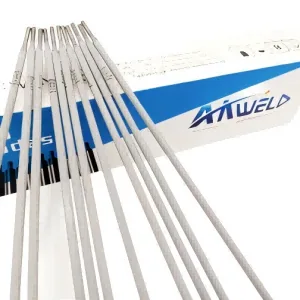
AK-E6011 Questions
Which diameters and current ranges are available?
What classifications does this electrode meet?
What impact toughness does the deposited metal reach?
Can I get a full catalogue and packing details before ordering?
What packing is AK-E6011 supplied in?
Can we test AK-E6011 before placing a production order?
Request a Quotation for AK-E6011
Send the diameter, the quantity and the destination port. Our technical team replies with packing, pricing and the data you need to qualify the grade.