
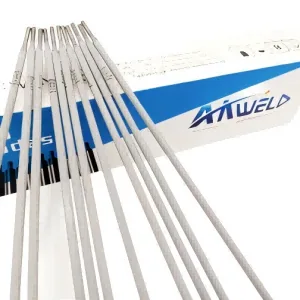
AK-E410-16 Cr13 Stainless Steel Electrode for All-Position Welding.
A rutile-coated electrode for welding 06Cr13 and 12Cr13 stainless steel with stable arc, low spatter, and clean slag removal in all positions.
Product Overview
AK-E410-16 is a Cr13 stainless steel electrode with a rutile coating designed for manual metal arc welding of stainless steel structures. It is suitable for both AC and DC power sources and supports all-position welding, including flat, horizontal, vertical, and overhead joints.
The electrode delivers good welding process performance with a stable arc, minimal spatter, and easy slag removal. The coating resists reddening during use, and the deposited weld metal shows good strength and resistance to porosity.
Application: It is suitable for welding stainless steel structures such as 06Cr13 and 12Cr13, and can also be used for corrosion- resistant and wear- resistant surface su rfacing.
Key Benefits
Stable Arc and Low Spatter.
The rutile coating ensures a stable arc across a wide current range, reducing spatter and improving weld consistency, especially in vertical and overhead positions.
Easy Slag Removal
Slag detaches cleanly after cooling, reducing the need for extensive chipping and wire brushing between passes.
All-Position Welding Capability
The electrode performs reliably in flat, horizontal, vertical, and overhead positions without requiring changes in technique or consumable.
Good Strength and Porosity Resistance.
The deposited metal achieves tensile strength of at least 450 MPa and elongation of at least 15 percent, with resistance to porosity under standard welding conditions.
Where It Is Used
- Welding of 06Cr13 and 12Cr13 stainless steel structures.
- Corrosion-resistant and wear-resistant surface surfacing.
- General-purpose stainless steel welding in fabrication and maintenance.
Who It Is For
- Welding consumable distributors stocking Cr13 stainless steel electrodes.
- Fabricators working with 06Cr13 and 12Cr13 stainless steel components.
- Maintenance teams requiring reliable electrodes for surface surfacing and repair.
Problems It Solves
- Welding defects caused by unstable arc or excessive spatter when using electrodes with poor process performance.
- Difficult slag removal that increases cleaning time and risk of inclusions.
- Limited position flexibility requiring multiple electrode types for different joint orientations.
Specifications
Published by the factory for AK-E410-16. Values not shown are not published on the datasheet and are marked as such rather than estimated.
| Standard | Designation |
|---|---|
| Classification 1 | EN ISO 3581-A:E (1 3) R 1 2 |
| Classification 2 | AWS A5.4 E410-16 |
| Classification 3 | GB/T983 E410-16 |
| Element | Content |
|---|---|
| C | 0.12 |
| SI | 0.90 |
| Mn | 1.0 |
| S | 0.03 |
| P | 0.04 |
| Ni | 0.7 |
| Cr | 11.0-14.0 |
| Mo | 0.75 |
| Cu | 1.2-2.0 |
| Property | Value |
|---|---|
| Tensile strength (MPa) | ≥450 |
| Elongation (%) | ≥ 15 |
| Diameter | Current range |
|---|---|
| 2.5mm | F/H-60-80A V/OH-40-70A |
| 3.2mm | F/H-80-120A V/OH-60-100A |
| 4.0mm | F/H-100-150A V/OH-80-130A |
Technical Features
- Rutile-coated Cr13 stainless steel electrode for all-position manual metal arc welding.
- Deposited metal tensile strength at least 450 MPa and elongation at least 15 percent.
- Chemical composition: C 0.12%, Si 0.90%, Mn 1.0%, S 0.03%, P 0.04%, Ni 0.7%, Cr 11.0-14.0%, Mo 0.75%, Cu 1.2-2.0%
- Supplied in 2.5 mm, 3.2 mm, and 4.0 mm diameters with published current ranges for each.
Use Guide
- Select diameter by joint thickness and set current within the published range: 2.5 mm runs 60-80 A flat/horizontal and 40-70 A vertical/overhead; 3.2 mm runs 80-120 A flat/horizontal and 60-100 A vertical/overhead; 4.0 mm runs 100-150 A flat/horizontal and 80-130 A vertical/overhead.
- Clean the joint surfaces of oil, grease, rust, and moisture before welding to ensure sound fusion and porosity resistance.
- Store electrodes in sealed packaging and re-dry if exposed to moisture before use.
- Remove slag completely between passes to prevent entrapment and ensure sound weld metal.
How It Compares
AK-E410-16 and E410-16 both weld Cr13 stainless steel, but AK-E410-16 uses a rutile coating optimized for stable arc and clean slag removal. Basic-coated electrodes offer higher toughness and better resistance to cracking but require strict drying and are more sensitive to contamination. For surface surfacing, AK-E410-16 provides a smooth, wear-resistant deposit with good adhesion and low dilution.
Related Grades
Other welding electrodes in the same family.
AK-E410-16 Questions
Which standards does AK-E410-16 meet?
What are the recommended welding parameters?
What is the chemical composition of the deposited metal?
Can I get a full catalogue and packing details before ordering?
What packing is AK-E410-16 supplied in?
Can we test AK-E410-16 before placing a production order?
Request a Quotation for AK-E410-16
Send the diameter, the quantity and the destination port. Our technical team replies with packing, pricing and the data you need to qualify the grade.