
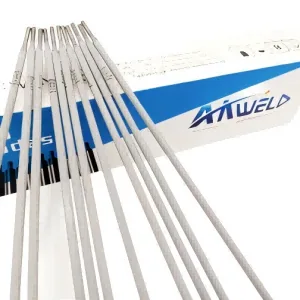
AK-E318-16 Rutile-Coated Electrode for Niobium-Stabilized Stainless Steel Welding.
A dual-current (AC/DC) rutile-type electrode for all-position welding of niobium-stabilized Cr19Ni12Mo2Nb stainless steel, with improved resistance to intergranular corrosion compared to A202 and A207.
Product Overview
AK-E318-16 is a rutile-coated stainless steel electrode containing niobium-stabilized Cr19Ni12Mo2Nb, designed for manual metal arc welding of corrosion-resistant stainless steel structures. It is suitable for use with AC or DC current and supports all welding positions.
The deposited metal exhibits better resistance to intergranular corrosion than electrodes classified as A202 and A207, making it suitable for service in aggressive environments. It meets the EN ISO 3581-A:E (19 12 3) Nb R 1 2 and AWS A5.4 E318-16 standards.
Application: It is suitable for welding urea synthesis towers, vinylon equipment and other parts that are in contact with strong corrosive media, such as 06Cr17Ni12Mo2Ti, 06Cr17Ni12MoNb and other stainless steel structures.
Key Benefits
Improved Intergranular Corrosion Resistance.
The niobium stabilization in the deposited metal enhances resistance to intergranular corrosion, particularly in welded joints exposed to corrosive media such as those found in urea synthesis towers and vinylon equipment.
Dual-Current Operation
AK-E318-16 can be used with both AC and DC power sources, providing flexibility in field and shop welding environments where power availability may vary.
All-Position Welding Capability
The electrode performs reliably in flat, horizontal, vertical, and overhead positions, allowing a single consumable to be used across multiple joint orientations without retooling.
Stable Arc and Good Process Performance.
The rutile coating ensures a stable arc and consistent weld pool control, resulting in smooth bead formation and reduced spatter during welding.
Where It Is Used
- Welding of urea synthesis towers and related equipment.
- Fabrication and repair of vinylon production equipment.
- Joining of stainless steel structures exposed to strong corrosive media.
- Welding of 06Cr17Ni12Mo2Ti and 06Cr17Ni12MoNb stainless steel base metals.
Who It Is For
- Welding consumable distributors supplying corrosion-resistant stainless steel electrodes.
- Fabricators working on chemical and petrochemical equipment requiring high corrosion resistance.
- Maintenance teams repairing stainless steel components in aggressive service environments.
Problems It Solves
- Achieving intergranular corrosion resistance in welded joints of niobium-stabilized stainless steel without relying on higher-cost or less stable alternatives.
- Using a single electrode for all welding positions in complex or vertical structures, reducing inventory and setup time.
- Maintaining consistent weld quality and corrosion resistance in service-critical components exposed to strong chemical media.
Specifications
Published by the factory for AK-E318-16. Values not shown are not published on the datasheet and are marked as such rather than estimated.
| Standard | Designation |
|---|---|
| Classification 1 | EN ISO 3581-A:E (19 12 3)Nb R 1 2 |
| Classification 2 | AWS A5.4 E318-16 |
| Element | Content |
|---|---|
| C | 0.08 |
| SI | 1.00 |
| Mn | 0.5-2.50 |
| S | 0.03 |
| P | 0.03 |
| Ni | 11.0-14.0 |
| Cr | 17.0-20.0 |
| Mo | 2.0-3.0 |
| Cu | 0.75 |
| Property | Value |
|---|---|
| Tensile strength (MPa) | ≥550 |
| Elongation (%) | ≥ 20 |
| Diameter | Current range |
|---|---|
| 2.5mm | F/H-60-80A V/OH-40-70A |
| 3.2mm | F/H-80-120A V/OH-60-100A |
| 4.0mm | F/H-100-150A V/OH-80-130A |
Technical Features
- Rutile coating with niobium stabilization for improved intergranular corrosion resistance.
- Deposited metal tensile strength of at least 550 MPa and elongation of at least 20 percent.
- Chemical composition includes Cr 17.0-20.0%, Ni 11.0-14.0%, Mo 2.0-3.0%, C 0.08%, Si 1.00%, Mn 0.5-2.50%, S 0.03%, P 0.03%, Cu 0.75%
- Supplied in 2.5 mm, 3.2 mm, and 4.0 mm diameters with published current ranges for each.
Use Guide
- Select diameter by joint thickness and position: 2.5 mm for thin sections, 3.2 mm for medium, 4.0 mm for thicker sections.
- Use 60-80 A in flat and horizontal positions, 40-70 A in vertical and overhead for 2.5 mm; 80-120 A and 60-100 A for 3.2 mm; 100-150 A and 80-130 A for 4.0 mm.
- Clean base metal surfaces of oil, grease, rust, and moisture before welding to ensure sound fusion and corrosion resistance.
- Store electrodes in sealed packaging and re-dry if exposed to moisture before use to maintain coating integrity and arc stability.
How It Compares
AK-E318-16 and A202 both weld Cr19Ni12Mo2Nb stainless steel, but AK-E318-16 offers better resistance to intergranular corrosion due to niobium stabilization. A207 has a basic coating and higher hydrogen control, which may be preferred in high-strength or critical applications, but requires stricter storage and preheat. AK-E318-16 provides better process performance and all-position capability with a rutile coating, at the cost of slightly higher hydrogen content.
Related Grades
Other welding electrodes in the same family.
AK-E318-16 Questions
Which standards does AK-E318-16 meet?
What are the mechanical properties of the deposited metal?
What is the chemical composition of the deposited metal?
What current ranges are recommended for each diameter?
What packing is AK-E318-16 supplied in?
Can we test AK-E318-16 before placing a production order?
Request a Quotation for AK-E318-16
Send the diameter, the quantity and the destination port. Our technical team replies with packing, pricing and the data you need to qualify the grade.