
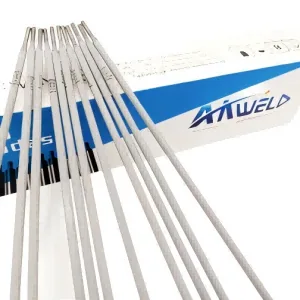
AK-E309L-16 Super-Low Carbon Stainless Steel Electrode for Corrosion-Resistant Welding.
A super-low carbon stainless steel electrode designed for welding Cr23Ni13 and similar steels, with weld metal carbon content ≤0.04% and excellent resistance to corrosion and porosity.
Product Overview
AK-E309L-16 is a super-low carbon stainless steel covered electrode for manual metal arc welding, formulated to deposit metal with carbon content ≤0.04%. It is intended for welding Cr23Ni13 and similar composition steels, as well as clad and dissimilar steels in petrochemical equipment fabrication.
The electrode delivers excellent arc stability and weldability, with a weld metal that exhibits strong resistance to corrosion and porosity. Its chemical composition is tailored to maintain performance in demanding environments where intergranular corrosion must be avoided.
Application: Used to weld similar composition steels, clad steels, and dissimilar steels to manufacture petrochemical equipment.
Key Benefits
Low Carbon Deposit for Corrosion Resistance.
The deposited metal has carbon content ≤0.04%, which reduces the risk of sensitization and intergranular corrosion in service, especially in welded joints exposed to corrosive media.
Excellent Porosity Resistance
The electrode produces weld metal with high resistance to porosity, ensuring sound, dense welds even in challenging welding conditions.
Good Weld Metal Mechanical Properties.
The deposited metal achieves tensile strength ≥510 MPa and elongation ≥25%, meeting the mechanical performance requirements for critical applications.
Suitable for Clad and Dissimilar Steels.
It is effective for joining Cr23Ni13 steels, clad steels, and dissimilar steels, making it suitable for complex petrochemical equipment construction.
Where It Is Used
- Welding of Cr23Ni13 and similar composition stainless steels.
- Joining clad steels in petrochemical equipment.
- Welding dissimilar steels in pressure vessels and piping systems.
- Fabrication of equipment requiring high corrosion resistance.
Who It Is For
- Petrochemical equipment fabricators requiring low-carbon stainless steel welding solutions.
- Welding teams working with clad or dissimilar stainless steel joints.
- Contractors building equipment where intergranular corrosion resistance is critical.
Problems It Solves
- Avoiding intergranular corrosion in welded joints by using a super-low carbon filler metal with carbon content ≤0.04%
- Reducing porosity in welds when joining stainless steels in aggressive environments.
- Providing a single electrode solution for welding Cr23Ni13, clad, and dissimilar steels without compromising corrosion resistance.
Specifications
Published by the factory for AK-E309L-16. Values not shown are not published on the datasheet and are marked as such rather than estimated.
| Standard | Designation |
|---|---|
| Classification 1 | EN ISO 3581-A:E (23 12 L) R 1 2 |
| Classification 2 | AWS A5.4 E309L-16 |
| Element | Content |
|---|---|
| C | 0.04 |
| SI | 1.00 |
| Mn | 0.50-2.50 |
| S | 0.03 |
| P | 0.04 |
| Ni | 12.0-14.0 |
| Cr | 22.0-25.0 |
| Mo | 0.75 |
| Cu | 0.75 |
| Property | Value |
|---|---|
| Tensile strength (MPa) | ≥510 |
| Elongation (%) | ≥ 25 |
| Diameter | Current range |
|---|---|
| 2.5mm | F/H-60-80A V/OH-40-70A |
| 3.2mm | F/H-80-120A V/OH-60-100A |
| 4.0mm | F/H-100-150A V/OH-80-130A |
Technical Features
- Super-low carbon deposit with carbon content ≤0.04%
- Chemical composition: C ≤0.04%, Si 1.00%, Mn 0.50-2.50%, S 0.03%, P 0.04%, Ni 12.0-14.0%, Cr 22.0-25.0%, Mo 0.75%, Cu 0.75%
- Deposited metal tensile strength ≥510 MPa and elongation ≥25%
- Supplied to EN ISO 3581-A:E (23 12 L) R 1 2 and AWS A5.4 E309L-16 classifications.
Use Guide
- Select diameter by joint thickness and position: 2.5 mm for thin sections, 3.2 mm for medium, 4.0 mm for thicker sections.
- Use flat and horizontal positions at 60-80 A (2.5 mm), 80-120 A (3.2 mm), 100-150 A (4.0 mm).
- For vertical and overhead positions: 40-70 A (2.5 mm), 60-100 A (3.2 mm), 80-130 A (4.0 mm).
- Ensure joint surfaces are clean and free of oil, grease, rust, and moisture before welding.
- Store electrodes in sealed packaging and re-dry if exposed to humidity before use.
How It Compares
AK-E309L-16 and E309-16 both weld stainless steels with similar Cr/Ni content, but E309L-16 has a super-low carbon deposit (≤0.04%) to reduce sensitization risk. Standard E309-16 has higher carbon content and is less suitable for service environments where intergranular corrosion is a concern. E309L-16 is preferred for welded joints in corrosive or high-temperature applications.
Related Grades
Other welding electrodes in the same family.
AK-E309L-16 Questions
What is the carbon content of the deposited metal?
Which standards does AK-E309L-16 meet?
What are the mechanical properties of the deposited metal?
What are the recommended current ranges for each diameter?
What packing is AK-E309L-16 supplied in?
Can we test AK-E309L-16 before placing a production order?
Request a Quotation for AK-E309L-16
Send the diameter, the quantity and the destination port. Our technical team replies with packing, pricing and the data you need to qualify the grade.