
AK-E2209T1-1 Flux-Cored Wire for Duplex Stainless Steel Welding.
An ultra-low carbon austenitic-ferritic dual-phase flux-cored wire with 40% ferrite in the weld metal, designed for high corrosion resistance in petrochemical applications.
Product Overview
AK-E2209T1-1 is a flux-cored welding wire for manual and semi-automatic gas-shielded arc welding of duplex stainless steel. It is formulated to produce a weld metal with approximately 40% ferrite, combining the strength of ferritic stainless steel with the ductility and corrosion resistance of austenitic stainless steel.
The wire meets EN ISO 17633-A T 22 9 3 N L P M21, AWS A5.22 E2209T1-1, and GB/T 17853 E2209T1-1 standards. It is intended for welding 00Cr22Ni5Mo3N (SUS2205) base metal, commonly used in petrochemical and offshore environments where stress corrosion resistance is critical.
Application: For welding 00Cr22Ni5Mo3N (SUS2205) stainless steel structure.
Key Benefits
High Stress Corrosion Resistance.
The dual-phase microstructure with about 40% ferrite in the deposited metal provides excellent resistance to chloride-induced stress corrosion cracking, making it suitable for aggressive chemical environments.
Low Spatter and Easy Slag Removal.
The flux formulation produces minimal spatter and a clean, easily removable slag layer, reducing post-weld cleaning time and improving weld appearance.
All-Position Welding Capability
AK-E2209T1-1 can be used in flat, horizontal, vertical, and overhead positions, allowing consistent performance across complex joint geometries without changing consumables.
Controlled Chemical Composition
The wire has a maximum carbon content of 0.04%, and the alloying elements—Cr, Ni, Mo, and Cu—are balanced to achieve the target ferrite content and mechanical properties.
Where It Is Used
- Welding of 00Cr22Ni5Mo3N (SUS2205) duplex stainless steel structures.
- Petrochemical plant components exposed to chlorides and high temperatures.
- Offshore and onshore piping systems requiring high corrosion resistance.
- Pressure vessels and heat exchangers in aggressive service environments.
Who It Is For
- Petrochemical and pipeline contractors requiring corrosion-resistant welds.
- Fabricators working with duplex stainless steel in chemical processing equipment.
- Maintenance teams performing repairs on existing 2205 duplex steel systems.
- Welding distributors supplying materials for high-integrity industrial applications.
Problems It Solves
- Achieving the required ferrite content and corrosion resistance in duplex stainless steel welds when base metal chemistry is sensitive to heat input and cooling rate.
- Reducing the risk of weld cracking and corrosion failure in chloride-rich environments by using a wire with ultra-low carbon and balanced alloying elements.
- Simplifying the welding process by using a single wire that performs reliably in all positions without requiring complex parameter adjustments.
Specifications
Published by the factory for AK-E2209T1-1. Values not shown are not published on the datasheet and are marked as such rather than estimated.
| Standard | Designation |
|---|---|
| Classification 1 | EN ISO 17633-A T 22 9 3 N L P M21 |
| Classification 2 | AWS A5.22 E2209T1-1 |
| Classification 3 | GB/T 17853 E2209T1-1 |
| Element | Content |
|---|---|
| C | 0.04 |
| Si | 1.00 |
| Mn | 0.50-2.50 |
| S | 0.03 |
| P | 0.04 |
| Ni | 7.5-10.0 |
| Cr | 21.0-24.0 |
| Mo | 2.5-4.0 |
| Cu | 0.75 |
| Property | Value |
|---|---|
| Tensile strength (MPa) | ≥690 |
| Elongation (%) | ≥20J |
| Diameter | Current range |
|---|---|
| 1.2mm | 22-36/V 120-260/A |
| 1.6mm | 26-38/V 200-300/A |
Technical Features
- Ultra-low carbon content (max 0.04%) to minimize sensitization risk.
- Weld metal ferrite content approximately 40% by magnetic measurement.
- Tensile strength of at least 690 MPa and elongation of at least 20%
- Chemical composition: C 0.04, Si 1.00, Mn 0.50-2.50, S 0.03, P 0.04, Ni 7.5-10.0, Cr 21.0-24.0, Mo 2.5-4.0, Cu 0.75.
- Available in 1.2 mm and 1.6 mm diameters with specified voltage and current ranges.
Use Guide
- For 1.2 mm wire: use 22-36 V and 120-260 A; for 1.6 mm wire: use 26-38 V and 200-300 A.
- Ensure the base metal and surrounding area are free of oil, grease, rust, and moisture before welding.
- Use shielding gas as specified in the welding procedure, typically a mixture of argon and carbon dioxide or pure argon.
- Clean the weld surface between passes to remove slag and ensure full fusion; avoid contamination from previous welds or tools.
How It Compares
AK-E2209T1-1 is a flux-cored wire for duplex stainless steel welding, distinct from solid wires like E2209 or E2553. It offers better weld metal toughness and lower spatter than solid wires in some positions, but requires careful control of heat input to maintain the ferrite balance. Compared to basic-coated electrodes, it has higher deposition efficiency and easier slag removal, but is not suitable for low-hydrogen applications where hydrogen-induced cracking is a concern.
Related Grades
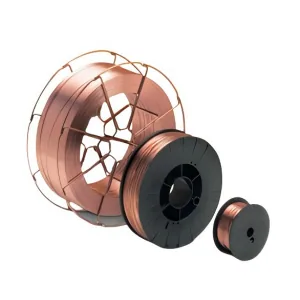
Other welding wire in the same family.
AK-E2209T1-1 Questions
What are the recommended welding parameters for 1.2 mm and 1.6 mm diameters?
Which standards does AK-E2209T1-1 meet?
What is the ferrite content in the deposited metal?
Can I get technical data sheets and packing details before ordering?
What packing is AK-E2209T1-1 supplied in?
Can we test AK-E2209T1-1 before placing a production order?
Request a Quotation for AK-E2209T1-1
Send the diameter, the quantity and the destination port. Our technical team replies with packing, pricing and the data you need to qualify the grade.