
AK-757Q Ultra-Low Hydrogen Electrode for High-Toughness Bridge Welding.
A low-hydrogen sodium coated electrode designed for all-position welding of critical low alloy steel bridge structures with excellent toughness at low temperatures.
Product Overview
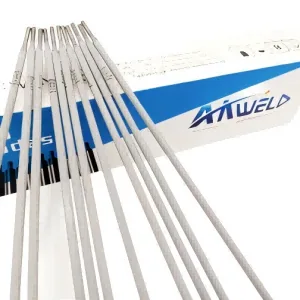
AK-757Q is a low-hydrogen sodium type covered electrode for manual metal arc welding, formulated for all-position welding of important low alloy steel bridge structures. The electrode uses DC reverse polarity and delivers high toughness in the deposited metal.
It meets the EN ISO 18275 AE695Z1.5Mn2NiMoB3 2 and AWS A5.5 E10018M classifications, and is also aligned with GB/T 5118-1995 E7515-G. The chemical composition is tailored to achieve high strength and impact resistance, with controlled levels of carbon, manganese, nickel, molybdenum, and copper.
Application: lt is used for important low alloy seel bridge welding structures.
Key Benefits
Ultra-Low Hydrogen for Reduced Cracking Risk.
The low-hydrogen sodium coating minimizes hydrogen content in the weld metal, reducing the risk of hydrogen-induced cracking in high-strength low alloy steels.
High Toughness at Low Temperatures.
The deposited metal achieves impact energy of at least 47 J at minus 40 degrees C, suitable for service in cold environments.
All-Position Welding Capability
The electrode performs reliably in flat, horizontal, vertical, and overhead positions, allowing continuous welding without changing consumables.
High Strength and Ductility.
The weld metal has a tensile strength of at least 740 MPa and yield stress of at least 640 MPa, with elongation of at least 13 percent.
Where It Is Used
- Critical low alloy steel bridge structures.
- High-strength structural joints requiring high toughness.
- Welding in cold climates where low-temperature impact performance is essential.
- All-position welding in fabrication and field erection.
Who It Is For
- Bridge fabricators requiring certified high-toughness electrodes.
- EPC contractors working on large-scale infrastructure projects.
- Welding distributors supplying consumables for demanding structural applications.
Problems It Solves
- Weld cracking in high-strength low alloy steels due to high hydrogen content in the weld metal.
- Insufficient toughness at low temperatures in critical structural joints.
- Need for multiple electrode types to cover different welding positions on the same structure.
Specifications
Published by the factory for AK-757Q. Values not shown are not published on the datasheet and are marked as such rather than estimated.
| Standard | Designation |
|---|---|
| Classification 1 | EN ISO 18275 AE695Z1.5Mn2NiMoB3 2 |
| Classification 2 | AWS A5.5 E10018M, GB/T 5118-1995 E7515-G |
| Element | Content |
|---|---|
| C | 0.12 |
| Si | 0.6 |
| Mn | 1.0-2.0 |
| S | 0.025 |
| P | 0.025 |
| Ni | 0.6-2.5 |
| Mo | 0.8 |
| Cu | 0.6 |
| Property | Value |
|---|---|
| Tensile strength (MPa) | ≥740 |
| Yield Stress (MPa) | ≥640 |
| Elongation (%) | ≥13J |
| Impact values (J) | ≥47J/-40℃ |
| Diameter | Current range |
|---|---|
| 2.5mm | F/H-70-110A V/OH-50-80A |
| 3.2mm | F/H-90-130A V/OH-80-110A |
| 4.0mm | F/H-140-180A V/OH-130-170A |
Technical Features
- Low-hydrogen sodium coating with DC reverse polarity connection.
- Deposited metal tensile strength at least 740 MPa, yield stress at least 640 MPa.
- Elongation at least 13 percent, impact energy at least 47 J at minus 40 degrees C.
- Chemical composition: C 0.12%, Si 0.6%, Mn 1.0-2.0%, S 0.025%, P 0.025%, Ni 0.6-2.5%, Mo 0.8%, Cu 0.6%
- Available in 2.5 mm, 3.2 mm, and 4.0 mm diameters.
Use Guide
- Select diameter by joint thickness and position: 2.5 mm for thin sections, 3.2 mm for medium, 4.0 mm for thicker sections.
- Use recommended current ranges: 2.5 mm – flat/horizontal 70-110 A, vertical/overhead 50-80 A; 3.2 mm – flat/horizontal 90-130 A, vertical/overhead 80-110 A; 4.0 mm – flat/horizontal 140-180 A, vertical/overhead 130-170 A.
- Keep electrodes dry in sealed packaging; re-dry if exposed to moisture before use.
- Clean joint surfaces of rust, oil, paint, and moisture before welding to ensure sound welds.
How It Compares
AK-757Q and E7515-G both serve high-strength low alloy steel applications, but AK-757Q is specifically formulated with ultra-low hydrogen and high toughness for critical bridge structures. E7515-G may have similar strength but lacks the same documented low-temperature impact performance. Basic-coated electrodes like AK-757Q are preferred over rutile or cellulosic types when hydrogen control and toughness are essential.
Related Grades
Other welding electrodes in the same family.
AK-757Q Questions
What classifications does AK-757Q meet?
What are the recommended welding currents?
What is the impact toughness of the deposited metal?
Can I get technical data and packaging details before ordering?
What packing is AK-757Q supplied in?
Can we test AK-757Q before placing a production order?
Request a Quotation for AK-757Q
Send the diameter, the quantity and the destination port. Our technical team replies with packing, pricing and the data you need to qualify the grade.