
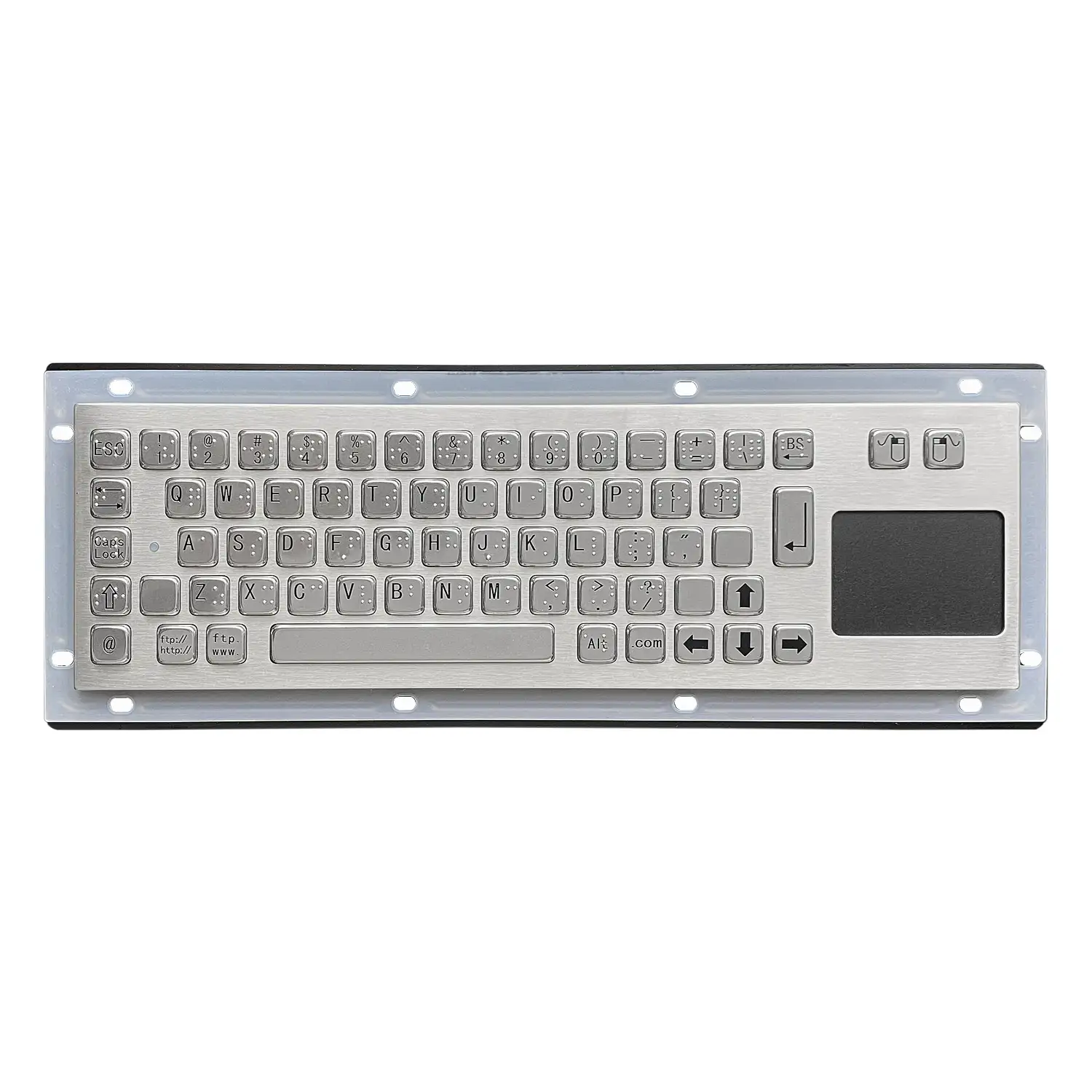
Daily Maintenance for Industrial Keyboards
Why Sealing Is Not the Same as Immunity
Moisture protection is standard equipment on an industrial keyboard, so a short splash on the panel will not normally harm the unit. The problem is sustained exposure. A keyboard left in a permanently damp or cold area, or one whose face is repeatedly wetted, will first show water staining on the panel and later suffer damage to the circuit behind it. Once moisture reaches the internal circuit the failure mode is no longer cosmetic: keys become unreliable and the keyboard can be lost entirely. Treat any standing water on the surface as something to wipe off straight away rather than something the rating will handle indefinitely, and site the keyboard away from spray, condensation drips and washdown lines wherever the layout allows.
Hot Swapping USB and PS/2 Safely
Industrial keyboards are commonly supplied with either a USB or a PS/2 connector, and the two behave very differently when unplugged. USB is designed for hot swapping, so a USB industrial keyboard can be disconnected and reconnected while the host is running. PS/2 is not. Pulling a PS/2 keyboard out of a live machine can damage the keyboard's internal circuit board, and the damage is not always obvious at the moment it happens. If your installed base mixes both connector types, label them or standardise on USB during a refresh. Where a PS/2 host has to stay in service, shut the machine down before any keyboard swap and make that step part of the written maintenance procedure rather than leaving it to operator memory.
Key Life and Operator Habits
The keys on an industrial keyboard are rated for a large number of light presses, and that rating assumes a light press. These are not mechanical switch keys with a heavy travel; the key returns through an elastic element rather than a mechanical shaft. Applying force well beyond a normal keystroke deforms that elastic element, and repeated over months it loses its springiness, so the key stops returning cleanly and eventually stops registering. Many keyboards carry a small warning on the unit for exactly this reason. Gloved operators and anyone working at speed are the usual offenders. A short line in the operator instruction, plus a keyboard mounted at a comfortable working height, prevents far more key failures than any cleaning routine will.
When Stainless Steel Is the Right Answer
If the environment itself is the problem, maintenance habits only go so far and the material specification has to change. A metal keyboard built from stainless steel such as SUS304 or 316L is rugged, waterproof, dustproof and corrosion resistant by construction. That matters in industrial control, outdoor equipment, public access points, outdoor kiosks, self-service terminals, coal and mining sites, and oil and gas installations. Stainless steel copes with high temperature, humidity and chemical attack while still giving the operator a stable interface, and in public locations it also absorbs high-frequency use and deliberate abuse on devices such as payphones, cash machines and security terminals. The right grade turns a recurring replacement cost into a fit-and-forget installation.
Protection Ratings and Impact Resistance
Two separate ratings matter when a keyboard is exposed to the public or the weather, and buyers often quote only one. Ingress protection covers water and dust; KEYU metal keyboards are available with IP65 dynamic water protection. Impact protection is a different scale, and vandal resistant models are available at IK08 and IK09. A keyboard can be well sealed and still be easy to smash, or hard to smash and poorly sealed, so specify both when the unit sits on an unattended terminal. Ask for the figures in writing against the specific model you are quoting rather than against the product family, because sealing and impact ratings vary with panel thickness and mounting method.
Specifying a Unit That Needs Less Maintenance
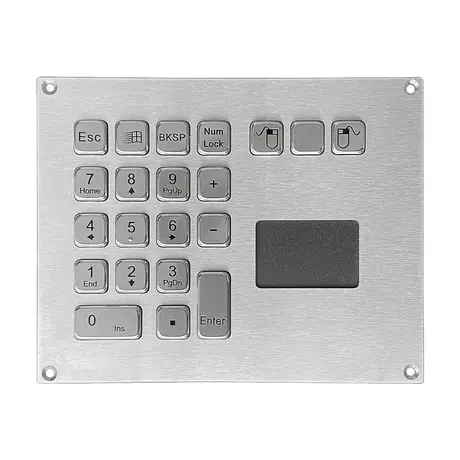
Much of what gets logged as a maintenance problem is actually a specification problem. Each KEYU keyboard is built to order, so the country layout, connection option, front panel design, mounting method and integrated pointing device are all decided before production rather than worked around afterwards. Choosing panel mounting instead of a loose desktop unit removes the cable strain and the gap where liquid collects. Choosing the correct layout removes the relabelling that operators otherwise do with tape. Integrating a trackball or touchpad removes a second device that would need its own sealing. Every element you resolve at the quotation stage is one fewer thing for the maintenance team to manage over the life of the installation.
Questions On This Topic
Can I unplug an industrial keyboard while the machine is running?
Is a waterproof keyboard damaged by a spill?
Why do keys stop working after heavy use?
Which stainless steel grades does KEYU use for metal keyboards?
Put This Into A Specification
Send us the application and we will tell you which of these choices actually matter for your terminal.