If you have ever asked which fire-rated panel you need, you probably walked away from the conversation more confused than when you started. A2, B1, B2, Class A, Class 1, FR — the alphabet soup is real, and getting it wrong has consequences that are measured in whole elevations.
The short version
Both A2 and B1 are considered fire-rated classifications under major international standards, but they perform very differently in a real fire. The difference comes down to what is in the core of the panel.
- A2 — practically non-combustible. The core is mineral-based, usually built on aluminium hydroxide. It does not burn, does not release toxic gases and does not produce flaming droplets.
- B1 — flame-retardant. The core is a low-smoke, fire-resistant polyethylene. It does not ignite easily and flame spread is slow.
How each rating is measured
Two standards cover most of the world's projects. EN 13501-1 rates construction products A1 to F using a single-flame-source test and a small-flame test, plus smoke classes s1 to s3 and burning droplet classes d0 to d2. Our A2 panel is classified A2-s1, d0 — the best rating short of non-combustible A1. GB 8624-2012 uses A1, A2, B1, B2, B3 on a similar scale with different test conditions; our A2 panel is A2 there too, and our B1 panel is B1.
For a 50,000 m² commercial facade, choosing B1 where A2 is required can mean re-cladding the entire building. Specifying the right rating up front is the cheapest decision you will make on the project.
Which rating do I need
It depends on the local code, the building height and its use. The general pattern:
- High-rise residential or commercial above about 24 m in most markets: A2 is usually required
- Mid-rise commercial, hospitals and schools: A2 or B1 depending on local code
- Low-rise commercial, interior partitions and shopfitting: standard PE core (B2) is usually acceptable
The mineral core difference
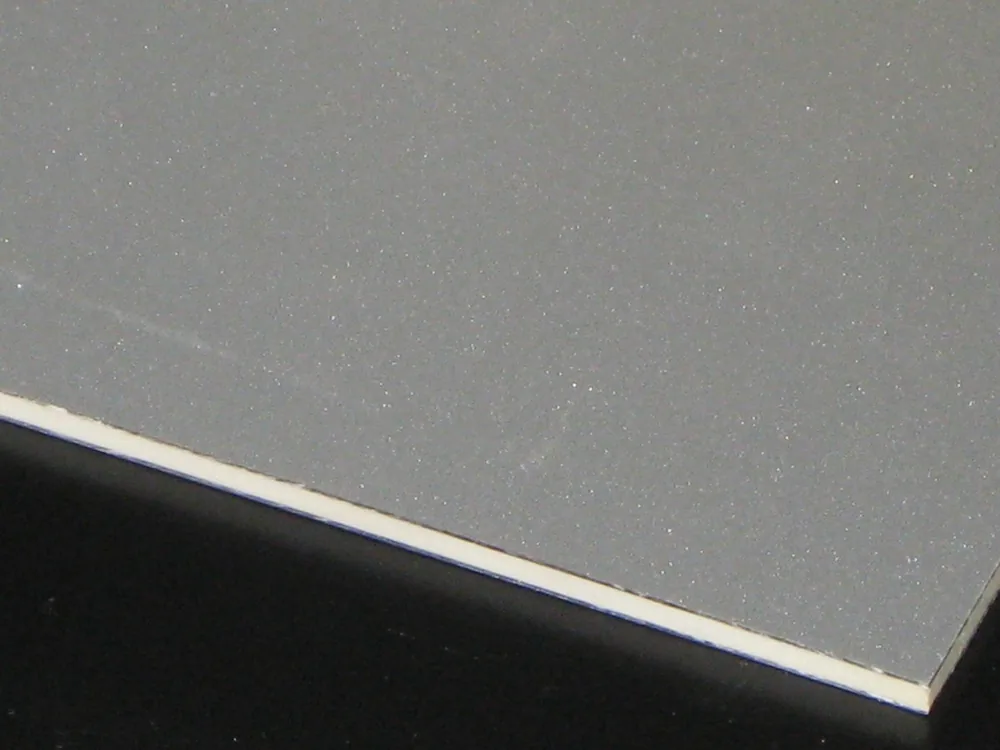
Standard PE-core ACP is rated B2, normal flammable, under GB 8624 — the plastic core melts and burns. To reach B1 we add flame retardants to the PE compound. To reach A2 we replace the plastic core entirely with a mineral compound of aluminium hydroxide and fillers.
That A2 core is roughly 50% heavier than a PE core, and the price per m² is about 1.8 to 2.2 times higher. It is also the only choice where the local code requires non-combustible cladding.
What we can supply
ALUCOVERBOND supplies both A2 and B1 panels with current test reports from an EU-notified body under EN 13501-1 (A2-s1, d0), the National Center for Building Materials Testing under GB 8624-2012 (A2 and B1), and ASTM E84 (Class A) for North American projects.
Send us the project location, building height and the relevant local code — we will specify the right panel and provide the test certificates.