
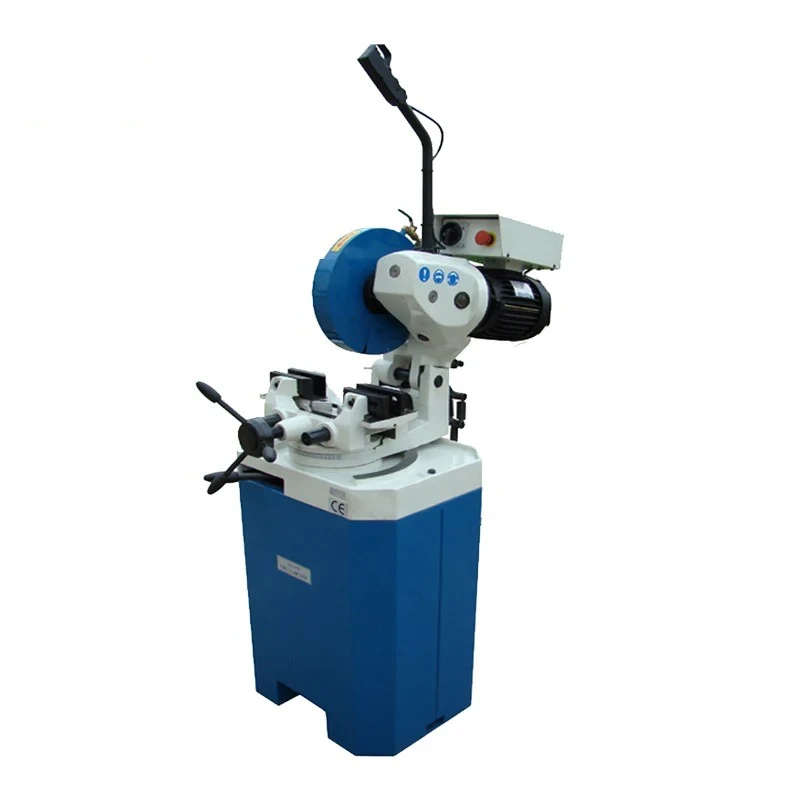
CS-315 Cold Cutting Saw
The CS-315 is a cold saw: a 315 mm blade turning at low speed shears metal away in chips rather than burning through it, so the cut comes off square and cool with no heat-affected edge and no grinding discs to replace. At 90 degrees it takes round stock up to 100 mm and rectangular sections up to 140x90 mm, and the hea...
What This Machine Does
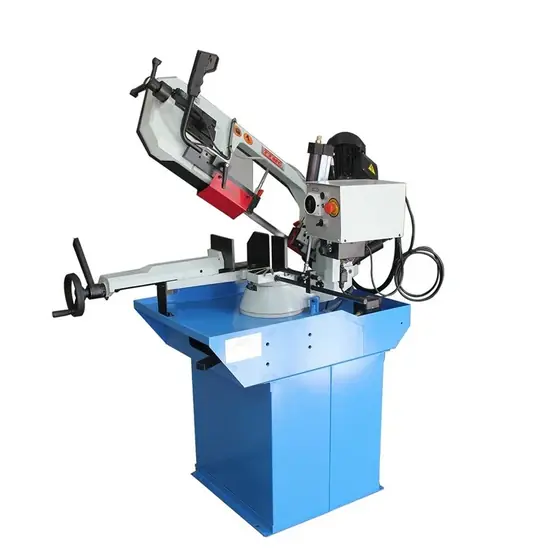
The CS-315 is a cold saw: a 315 mm blade turning at low speed shears metal away in chips rather than burning through it, so the cut comes off square and cool with no heat-affected edge and no grinding discs to replace. At 90 degrees it takes round stock up to 100 mm and rectangular sections up to 140x90 mm, and the head swivels between minus 45 and plus 45 degrees for mitre work, where capacity is 90 mm round and 100x90 mm rectangular. Two blade speeds of 18 and 36 rpm let the operator match the speed to the material instead of forcing one setting through everything. The direct-drive head runs on all-metal gears that are ground and hardened, a coolant system feeds the blade so the operator is not pushing a dry cut, and a dual material clamp holds the section on both sides of the blade. Head return is spring assisted. The larger CS-350 takes a 350 mm blade and 120 mm round capacity.
Why Buyers Choose This Machine
- Cold cutting leaves a square burr-free end with no heat discolouration so the cut is ready to weld or fit
- Two blade speeds of 18 and 36 rpm let one machine handle a range of materials properly
- Head swivels between minus 45 and plus 45 degrees so mitres are cut without a separate setup
- Dual material clamp system holds the section on both sides of the blade and stops it rolling
- Coolant system lubricates the blade which reduces operator effort and extends blade life
- Ground and hardened all-metal gears in the direct-drive head stand up to daily production cutting
- Spring assisted head return takes the weight of the head off the operator on repeat cuts
Where CS-315 Cold Cutting Saw Earns Its Place
Problems It Solves
- Abrasive chop saws burn the cut face and leave an edge that must be ground before welding
- One fixed blade speed forces the wrong cutting speed on part of the material range
- Round stock rolls in a single clamp and gives an out-of-square cut
- Dry cutting overheats the blade and shortens its life
- Mitred joints cut by hand or on a fixed-head saw do not close cleanly
- Lifting the saw head on every cut tires the operator through a long run
Who It Is For
- Metal fabrication shops cutting tube and section to length
- Railing and balustrade manufacturers
- Chassis and frame builders
- Maintenance workshops needing accurate square cuts on stock material
- Distributors supplying workshop sawing equipment
Application Scenarios
- Cutting marine rails and hand railings to length in fabrication work
- Producing tube and section parts for playground equipment
- Cutting chassis members and frame tubing
- Mitring tube at 45 degrees for frames and railing corners
- General fabrication cutting of round and rectangular stock
- Batch cutting sections to length ahead of welding
Technical Detail
Technical Features
- Accepts a 315 mm 12.4 inch blade
- Two blade speeds 18 and 36 rpm
- Direct-drive head with ground and hardened all-metal gears
- Coolant system feeding the blade during the cut
- Dual material clamp system
- Head swivel between minus 45 and plus 45 degrees
- Spring assisted head return
- Round capacity 100 mm at 90 degrees and 90 mm at 45 degrees
- Rectangular capacity 140x90 mm at 90 degrees and 100x90 mm at 45 degrees
Specifications
| Machine type | Circular cold cutting saw |
|---|---|
| Models | CS-315 / CS-350 |
| Max blade size | 315 mm (12.4 in) on CS-315 and 350 mm (13.8 in) on CS-350 |
| Cut circular at 90° | 100 mm on CS-315 and 120 mm on CS-350 |
| Cut rectangular at 90° | 140x90 mm on CS-315 and 140x100 mm on CS-350 |
| Cut circular at 45° | 90 mm on CS-315 and 105 mm on CS-350 |
| Cut rectangular at 45° | 100x90 mm on CS-315 and 100x100 mm on CS-350 |
| Blade speeds | 18 and 36 rpm |
| Head swivel | -45° to +45° |
| Clamping | Dual material clamp system |
| Coolant | Blade coolant system fitted |
Figures above are taken from the product information we hold. Send us your application and we will confirm the exact specification for the model quoted.
How It Is Built and What Can Be Changed
Operations Performed
- Cold sawing
- Cutting to length
- Mitre cutting
Quality Control
- Blade arbor run-out checked on the assembled direct-drive head
- Head swivel checked for square and for accurate 45 degree stops
- Both blade speeds run and checked under load
- Coolant delivery checked at the blade before packing
- Test cuts taken on round and rectangular stock and checked for squareness
Customisation Options
- CS-315 or CS-350 chosen against the largest section you cut
- Supply voltage frequency and phase built for your market
- Blade specification matched to the materials you cut most
- Length stop and roller table supplied where you cut repeat lengths
- Machine plates and manual prepared in your working language
How It Compares With the Alternatives
| CS-275 electric circular sawing machine | The CS-275 is the smaller machine in the range; the CS-315 takes a 315 mm blade and 100 mm round stock at 90 degrees, which is the choice when your sections are larger |
|---|---|
| CS-350 cold cutting saw | The CS-350 takes a 350 mm blade and cuts 120 mm round and 140x100 mm rectangular at 90 degrees, so it is the model to take if your stock is close to the CS-315 limit |
| Abrasive chop saw | An abrasive wheel is cheap but burns the cut face, throws sparks and consumes discs; the cold saw leaves a square cool cut that goes straight to welding |
Running the Machine
Step 1
Select the blade speed for the material 18 rpm for heavier and harder sections and 36 rpm for lighter cutting
Step 2
Set the head swivel angle for square or mitre cutting and lock it
Step 3
Clamp the section in the dual clamp so it is held on both sides of the blade
Step 4
Check coolant is reaching the blade before starting the cut
Step 5
Lower the head at a steady rate and let the blade cut without forcing it
Step 6
Let the spring assist return the head and clear chips before the next cut
Step 7
Keep the blade sharp and replace it before tooth wear starts loading the drive
Related Applications and Guides
General Machining Job Shops
Job shops take whatever work comes through the door, which means their equipment has to cover a wide range rather than do one thing perfectly. XAIMC s
How to Choose a Metal Band Saw for a Fabrication Shop
A metal band saw cuts bar, tube, section and plate to length ahead of machining, welding and assembly, and the right one depends on section size, mate
Questions About CS-315 Cold Cutting Saw
What is the maximum size the CS-315 will cut?
At 90 degrees it cuts 100 mm round and 140x90 mm rectangular. At 45 degrees it cuts 90 mm round and 100x90 mm rectangular. If your sections are larger the CS-350 cuts 120 mm round at 90 degrees.
Why two blade speeds?
Different materials need different cutting speeds. Switching between 18 and 36 rpm lets you cut a range of materials on one machine instead of forcing everything at one speed.
Can it cut mitres?
Yes. The head swivels between minus 45 and plus 45 degrees, and the capacity at 45 degrees is 90 mm round and 100x90 mm rectangular.
What blade does it take and do you supply them?
The machine accepts a 315 mm 12.4 inch blade. Tell us the materials and sections you cut and we will specify the blade with the machine.
What voltage will the machine be supplied at?
Send us your supply voltage frequency and phase and the machine will be built for your market.
How is it packed for export?
Machines are painted rust-protected and crated for sea freight. Tell us your destination port and we will confirm case dimensions and shipping weight.
What are your payment and trade terms?
We quote FOB CFR and CIF. Payment is 30 percent by T/T on order and 70 percent before shipment, or an irrevocable L/C at sight.
Request a Quote on the CS-315 Cold Cutting Saw
Send us the work you need it to do, the voltage on your site and the port you ship to. We will come back with the model, the tooling and the lead time.