
Sphere Forming Process Guide
Three forming routes with different size limits wall thicknesses and seams and how to pick the right one.
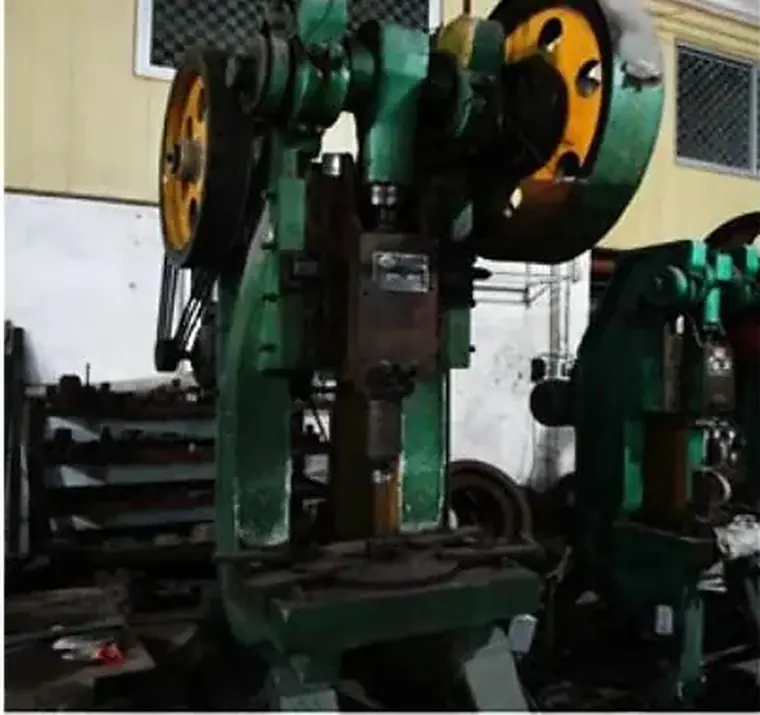
Stamping Press
A die deforms the sheet into a hemisphere. Two halves are welded, the seam is ground and the ball is mirror polished.
Range ∅6mm to ∅700mm, thickness 0.6mm to 3mm. Seams are invisible after finishing. There is a standard mould limit, which means the diameter has to match existing tooling — a customised size under ∅250mm needs a new mould at USD 1,000.
Standard press hole moulds are ∅19mm, ∅25mm, ∅32mm, ∅38mm and ∅50mm, so apertures in those sizes cost nothing extra.
Water Pressuring
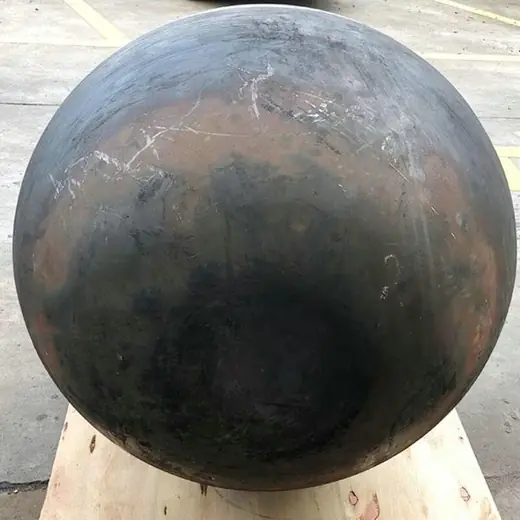
Our technicians calculate the sheet development. Workers bend the leaf shapes and weld them into a closed spherical cube. Water pressure then forms it into a true sphere. The seam is ground and mirror polished.
Range ∅200mm to ∅3500mm, thickness 1mm to 6mm. Seams are invisible. There is no standard mould limit, so any diameter can be made.
This is also the route for water drop sculptures, where the sheet development is calculated for a compound curve rather than a sphere.
Spinning
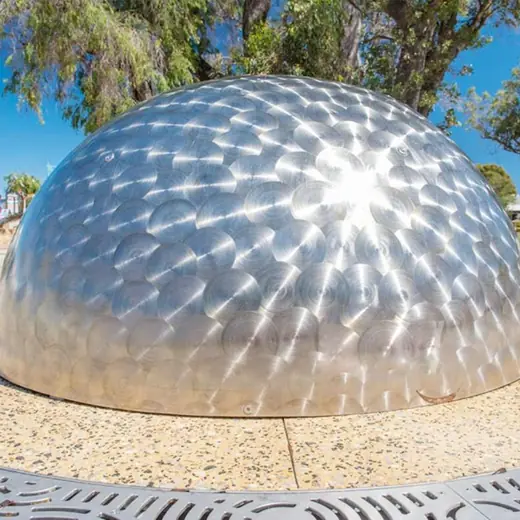
Two hemispheres are spun from sheet, welded together, then ground and polished. This is the thickest option we offer.
Range ∅89mm to ∅3500mm, thickness 2mm to 16mm. The equator seam is visible and the surface carries a spun texture. There is a standard mould limit.
Spun hemispheres carry the 45° welding groove, which is why they are the right choice if you plan to weld the sphere yourself.
Hand Assembling
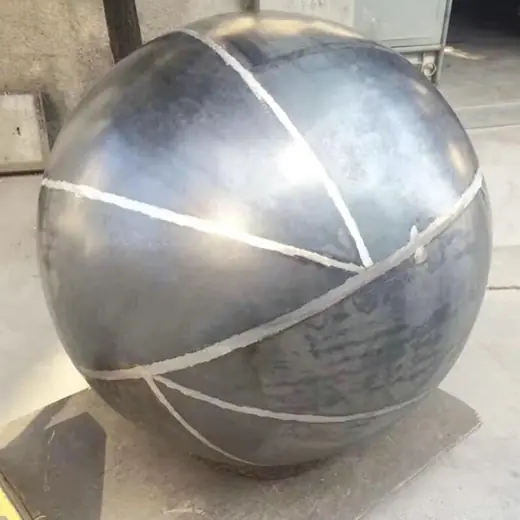
Sheet is developed, bent to leaf shapes and welded by hand into a complete sphere or hemisphere, then ground burr free.
Range ∅200mm to ∅3500mm, thickness 1mm to 6mm. Seams are visible. There is no mould limit, so any size is possible — which is exactly when this route earns its place.
At a Glance
| Method | Size range | Thickness | Seam | Mould limit |
|---|---|---|---|---|
| Stamping press | ∅6mm to ∅700mm | 0.6mm to 3mm | Invisible | Yes |
| Water pressuring | ∅200mm to ∅3500mm | 1mm to 6mm | Invisible | No |
| Spinning | ∅89mm to ∅3500mm | 2mm to 16mm | Visible at equator | Yes |
| Hand assembling | ∅200mm to ∅3500mm | 1mm to 6mm | Visible, burr free | No |
Explore Further
Related categories
Industry applications
Solutions
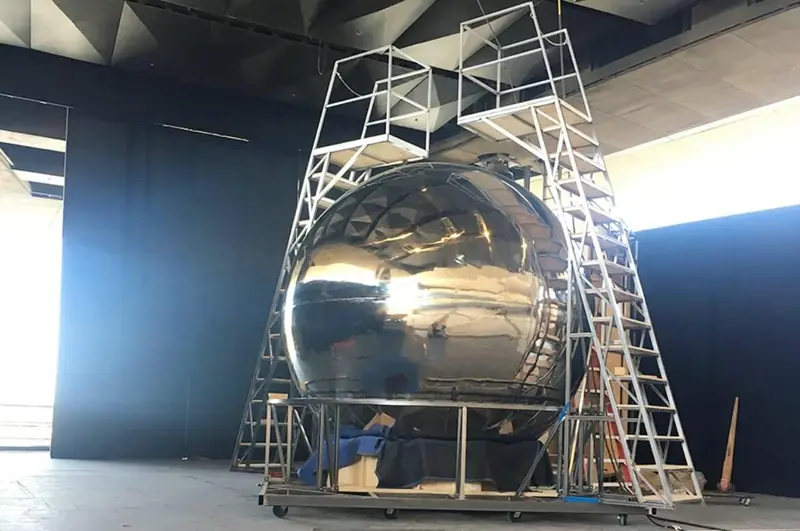
3.6 Meter Large Steel Balls For Santa Fe Opera Theater
The sphere reached site in a standard 40ft container and was assembled from quarter sections.
Santa Fe, United States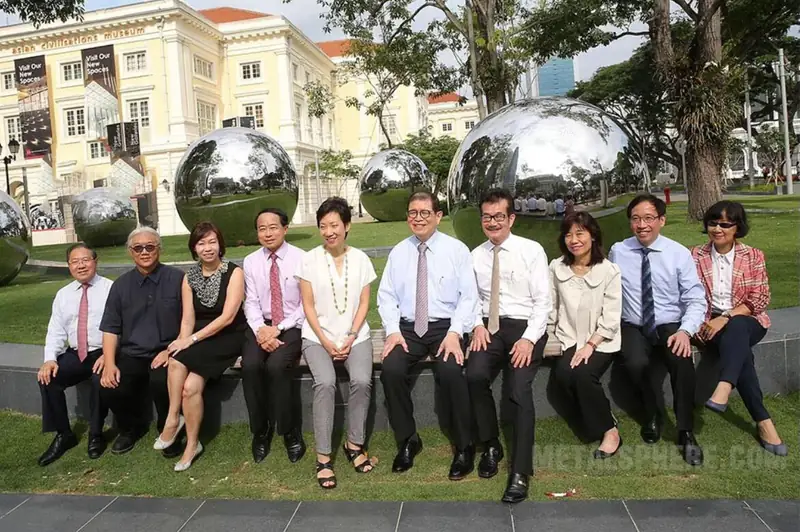
Large Stainless Steel Gazing Globes Installed In Singapore
The installation's audio recordings feature familiar everyday sounds, from suburban traffic and MRT trains to chatter in wet markets and coffee shops.
Singapore
Suspended Hollow Stainless Steel Spheres For Publicis Russia
The Sun Lion reads across the workplace as a single suspended image assembled from thousands of mirror spheres.
Moscow, RussiaSphere Forming Process Guide FAQ
Which method gives an invisible seam?
Which method reaches the heaviest wall?
Which method has no size restriction?
When is the USD 1,000 mould fee charged?
Put This Into Practice
Send the specification, or the question this guide raised, and an engineer will answer directly.