
Pneumatic Valve Actuator
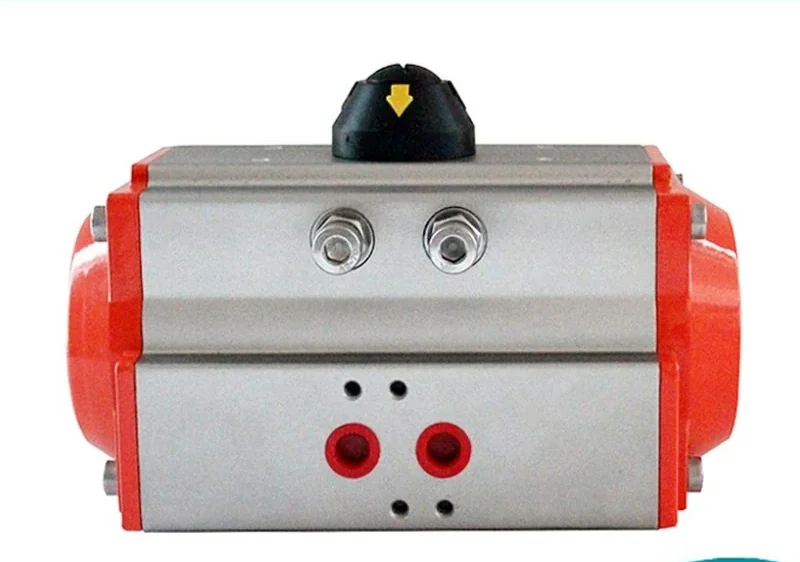
This pneumatic valve actuator uses air pressure acting on dual pistons to drive open, close, or adjust valves.
What This Model Does
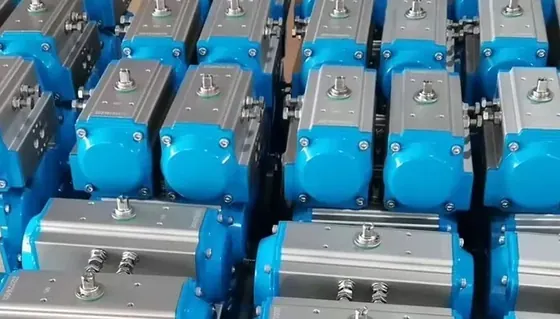
This pneumatic valve actuator uses air pressure acting on dual pistons to drive open, close, or adjust valves. Also known as a pneumatic head, the unit converts compressed air from 2 to 8 Bar into rotary motion via internal rack and pinion gearing. It features standard travel adjustment bolts providing plus or minus 5 degrees at both 0 degree and 90 degree rotation points. It pairs with auxiliary accessories including valve positioners, limit switch boxes, and handwheel mechanisms for plant process control.
| Product type | Pneumatic valve actuator |
|---|---|
| Operating medium | Dry or lubricated air, or non-corrosive gases |
| Air filtration requirement | Maximum particle diameter less than 30 μm |
| Minimum supply pressure | 2 Bar |
| Maximum supply pressure | 8 Bar |
| Standard temperature range | -20℃ to +80℃ |
| Low temperature type | -40℃ to +80℃ |
| High temperature type | -20℃ to +160℃ |
| Travel adjustment | ±5° at 0° and 90° rotation |
| Application | Indoor or outdoor |
| Warranty | 18 months |
Why Buyers Specify This Model
- Dual piston rack and pinion mechanism converts 2 to 8 Bar air supply into positive quarter turn valve actuation
- External travel stops allow fine adjustment of plus or minus 5 degrees at both the 0 and 90 degree travel limits
- Available in standard, low temperature down to minus 40 degrees, and high temperature up to 160 degrees configurations
- Hard anodized cast aluminum cylinder body resists wear and external environmental corrosion in indoor or outdoor applications
- Accepts standard valve positioners to realize accurate positioning according to control signals using the feedback principle
- Integrates with manual handwheel mechanisms so operators can control valves during power, gas, or controller failures
- Configurable with 0 to 12 pre-compressed stainless steel springs for double acting or spring return service
Problems It Solves
- Valves fail to seat or seal completely because actuator rotation cannot be adjusted at stroke ends
- Standard actuators fail in cold outdoor storage or hot boiler rooms due to improper seal temperature ratings
- Loss of plant air or electrical signal stops production because valves lack auxiliary manual handwheel override capability
- Actuators stall or drift on throttling duties when operated without valve positioner feedback loops
- Corrosion from harsh outdoor weather degrades actuator cylinder walls and causes internal piston seal leaks
Application Scenarios
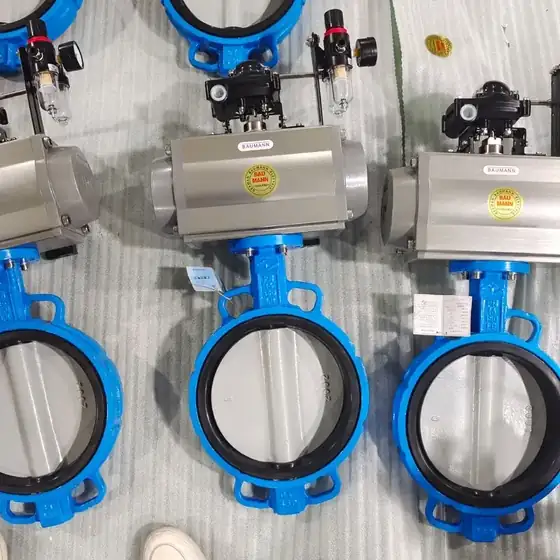
- Quarter turn ball or butterfly valve automation on indoor process plant piping skids
- Outdoor flow control installations requiring sealed actuators rated for wide ambient operating temperatures
- Automated throttling valve service paired with an electro pneumatic positioner for accurate continuous control
- Critical process lines where emergency manual override via an optional handwheel mechanism is mandatory
- Replacing worn pneumatic actuators on production lines without altering existing air supply ranges
Who It Is For
- Valve and actuator OEMs assembling automated valve packages for global process customers
- EPC engineering contractors sourcing pneumatic actuators and valve automation accessories for plant builds
- Instrumentation and valve distributors stocking quarter turn automation spares for local industrial plants
- Plant maintenance teams replacing failed or leaking actuators on quarter turn ball and butterfly valves
- Trading companies sourcing form fit replacement pneumatic heads matching international mounting interfaces
Technical Features
- Dual piston movement driven linearly toward cylinder head ends by incoming compressed air
- Rack on pistons meshes with central alloy steel pinion to deliver rotary output
- External stainless steel limit bolts and adjusting screws provide plus or minus 5 degrees adjustment at 0 and 90 degrees
- Operating temperature options covering standard, low temperature down to minus 40 degrees, and high temperature to 160 degrees
- Internal spring pockets accommodating between 0 and 12 stainless steel dipping paint springs
- Equippable with auxiliary positioners, limit switch boxes, pilot valves, or handwheel mechanisms
Materials and Construction
- Cylinder body: cast aluminum with hard anodizing
- Pistons: cast aluminum or cast steel with oxidation, zinc plating, or stainless steel options
- Pinion and cam: alloy steel with nickel plating or stainless steel options
- End covers: cast aluminum with powder coating
- O-rings and plugs: NBR standard, with Viton, fluoro rubber, or silicone rubber options
- Springs: stainless steel with dipping paint (0 to 12 springs)
- Adjusting bolts, limit bolts, limit nuts, washers, and spring clips: stainless steel
- Bearings, guide plates, and gaskets: engineering plastic
- Position indicator and indicator screw: plastic
Dimensions and Connection Detail
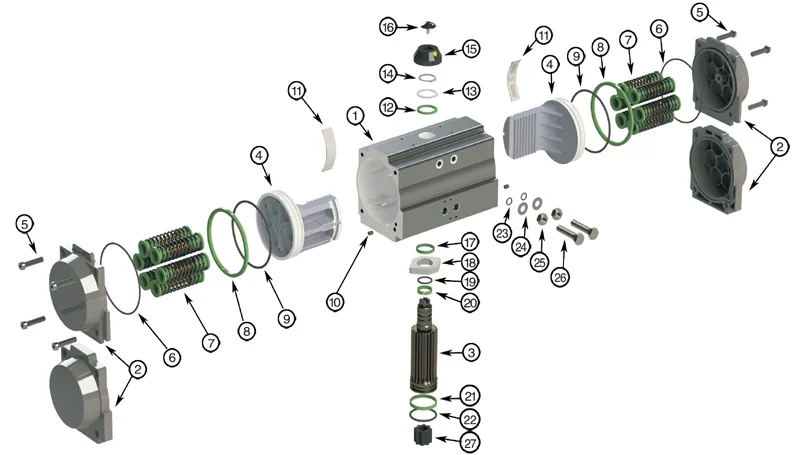
Reference image published with this model on the original catalogue. Confirm critical dimensions against the datasheet before machining a bracket.
Manufacturing and Quality Control
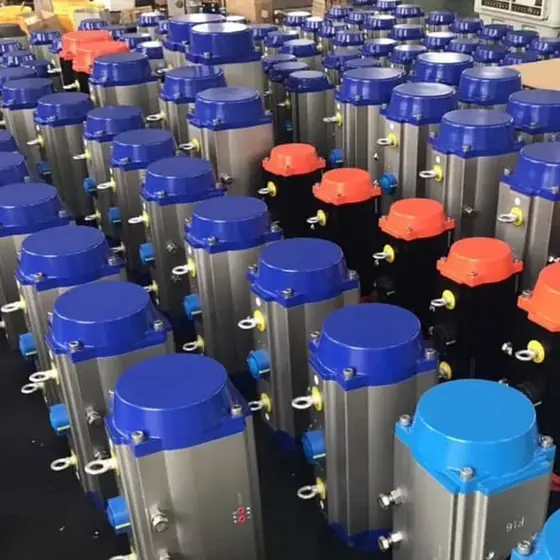
Every unit is calibrated and stroke tested before it is packed. We can film or photograph your units in the sample room or warehouse before they ship.
Manufacturing Steps
High precision die casting and CNC machining of aluminum cylinder bodies and end covers
Hard anodizing of cylinder internal and external surfaces for wear and corrosion protection
Machining and surface treatment of alloy steel rack, pinion, and cam components
Installation of engineering plastic guide plates, bearings, and elastomer O-rings
Spring configuration assembly for double acting or spring return requirements
Travel stop bolt setting, pressure integrity testing, and powder coating of end covers
Optional painting in customer specified housing colours and custom nameplate marking
Quality Control
- Pressure hold testing from 2 Bar to 8 Bar supply pressures to verify seal integrity
- Stroke and travel adjustment checks ensuring plus or minus 5 degrees range at 0 and 90 degrees
- Real product photos and inspection videos provided from warehouse or sample room on request
- 18 month warranty covering faulty units with direct replacement rather than repair
- Fastest way dispatch of replacement parts or units if urgent replacement is required
Customisation Options
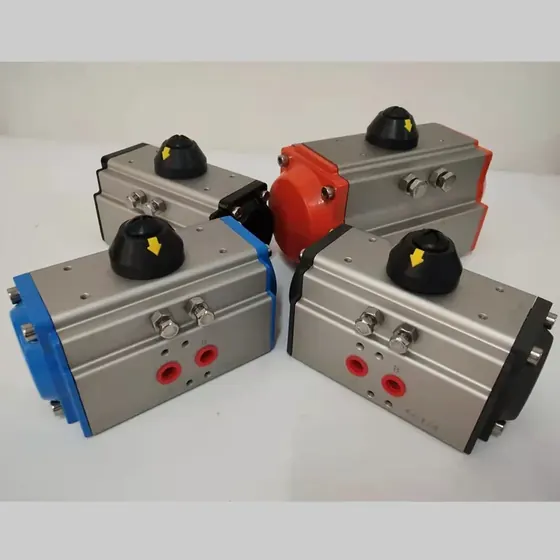
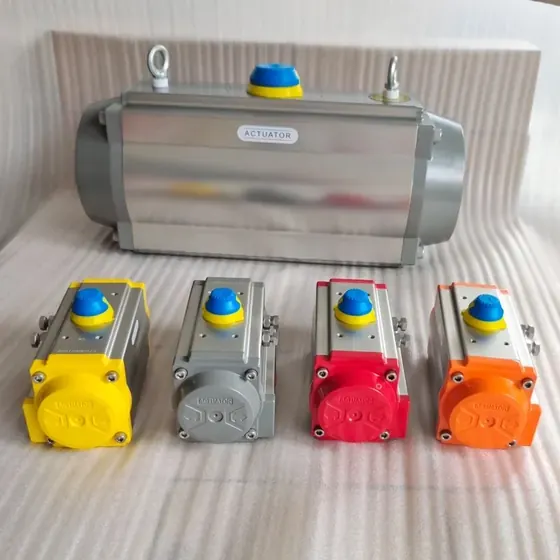
- Housing and end cover painting in custom colours including black, blue, yellow, and others
- Customer logo marking and custom nameplate modules
- Low temperature seal build down to minus 40 degrees or high temperature seal build up to 160 degrees
- Carton and inner packaging customisation for OEM export shipments
- Pre-assembly with electro pneumatic valve positioners, limit switch boxes, and pilot valves
How It Compares With the Alternatives
| Actuator without travel adjustments | This actuator includes plus or minus 5 degree limit bolts at both ends, allowing precise valve disc alignment to prevent internal seat leaks |
|---|---|
| Standard temperature NBR seals | Viton or silicone rubber seal options allow operation up to 160 degrees or down to minus 40 degrees without hardening or leaking |
| Actuator without positioner | Adding a valve positioner uses feedback control to achieve accurate positioning to controller signals rather than coarse on-off movement |
| Actuator without handwheel mechanism | An auxiliary handwheel maintains manual plant production control during complete pneumatic air or electrical failure |
Fitting and Setting Up This Model
General field procedure. Always follow the datasheet for the exact calibration sequence and any hazardous area requirements.
Ensure operating air supply is clean, dry, or lubricated gas with particulate diameter filtered below 30 μm
Supply regulated air pressure between the minimum 2 Bar and maximum 8 Bar limits
Mount the actuator directly to the valve or bracket, confirming correct drive shaft engagement
Connect compressed air lines to air ports to stroke the internal double pistons
Loosen the limit nuts and turn the adjusting bolts to set rotation limits within plus or minus 5 degrees at 0 and 90 degrees
Retighten limit nuts against the housing to lock travel stop positions securely
Mount positioner feedback linkage or limit switch box to the top pinion and indicator assembly if fitted
Pneumatic Valve Actuator FAQ
What supply air pressure does this actuator require?
The actuator operates on a minimum air supply pressure of 2 Bar up to a maximum supply pressure of 8 Bar.
What air quality is needed for proper operation?
Use dry, lubricated air or non-corrosive gases with maximum particle diameter filtered to less than 30 μm.
What temperature ranges are available for this actuator?
Standard is -20℃ to +80℃. A low-temperature type covers -40℃ to +80℃, and a high-temperature type covers -20℃ to +160℃.
Can the rotation angle be adjusted on site?
Yes. It has external stainless steel adjusting bolts that provide a travel adjustment range of ±5° at 0° and 90° rotation.
What is the lead time for standard and large orders?
Regular quantities normally ship in 2 to 3 days from stock. Large orders take 7 to 10 days.
Can you provide this actuator under our own OEM brand?
Yes. We offer OEM and ODM services including custom logo marking, custom carton packaging, and body painting in your specified colours.
What happens if an actuator fails during operation?
We provide an 18 month warranty. Faulty units are replaced rather than repaired upon photo or video evidence, usually shipped with your next order.
Applications Cases and Guides
Get A Price on This Model
Tell us the quantity, the actuator it goes on and the destination port. We come back with price, lead time and confirmation that the model matches your valve.