
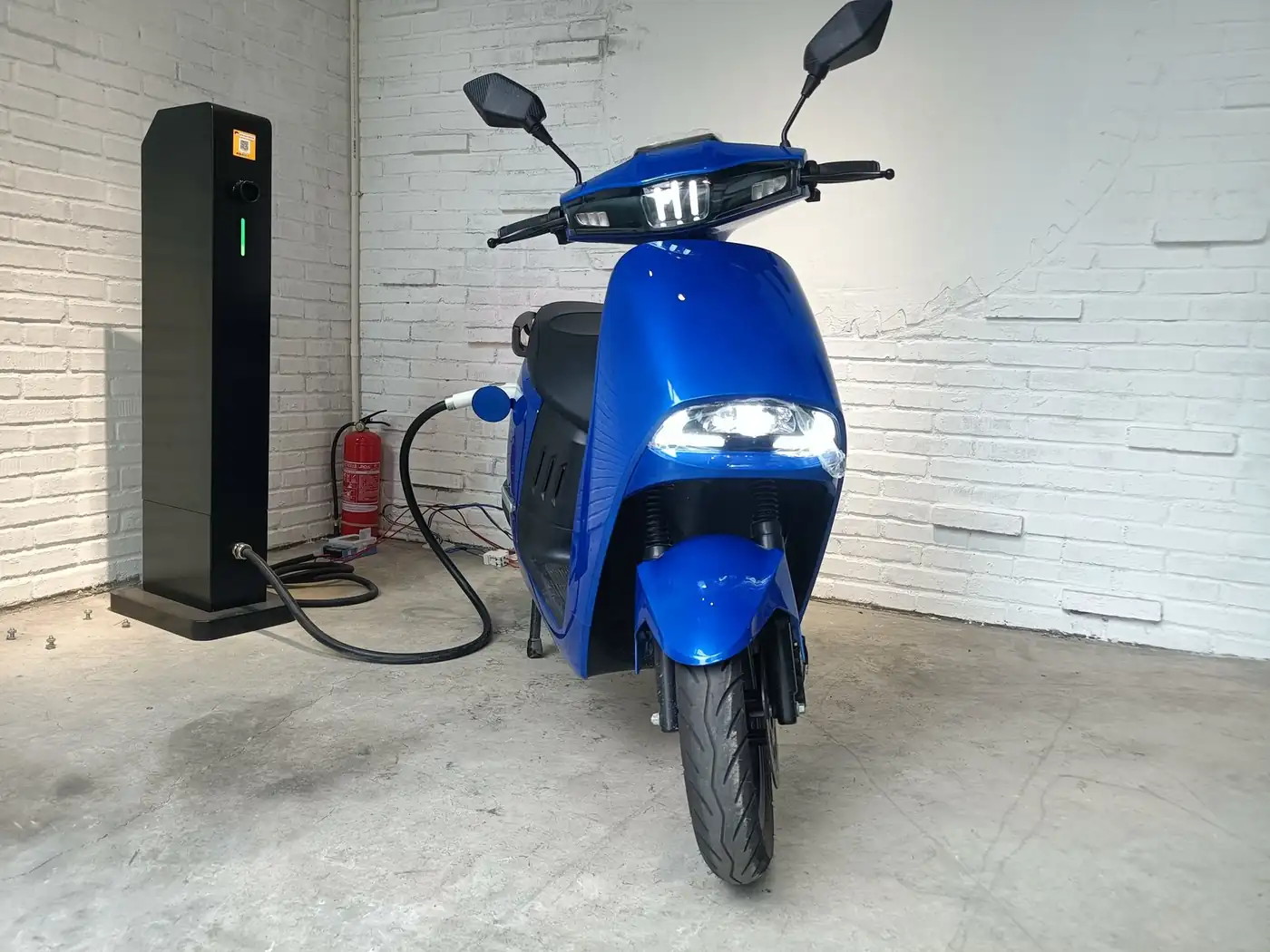
New Energy Vehicle · EV 01
Electric motorcycles built for the city
Urban commuters and delivery scooters on reliable LiFePO4 battery platforms, paired with a dedicated charging post for fast, simple top-ups at home or in the fleet yard.
Product overview
What the electric motorcycle is
One rider commuting 20 km a day and an operator running hundreds of delivery vehicles want very different things from a motorcycle — except for the part that matters. Both want a machine that starts every morning, charges where it parks, and does not need a different spare parts list from everything else in the yard.
That is the reason the range shares one battery platform, one charger and one telematics option set across every model. The 45 km/h regulated variant and the 110 km/h version differ in motor, controller and gearing, not in how the yard supports them. For a fleet that is the entire operating cost argument.
Battery capacity is specified per duty cycle rather than sold on a headline range figure: 40, 60 or 90 Ah at 72 V, with swap-pack support on selected models where downtime costs more than the spare pack does.
Key benefits
Six things this product does better
Fast charging post
A dedicated charging station for quick top-ups, shared with the cargo tricycles so a mixed fleet needs one yard installation rather than two.
Swap-pack option
Selected models support battery swap, which takes charging time out of the shift entirely for operators running continuous delivery rotations.
Telematics ready
GPS, ride scoring and over-the-air firmware updates are available as options rather than compulsory.
Zero tailpipe emissions
Per vehicle, an electric scooter displaces meaningful CO2 against an equivalent petrol machine — and removes the noise from the street it operates on.
IP-rated battery
Sealed against rain, fording and dust, which is the environment urban delivery actually happens in rather than the one brochures photograph.
Smart dashboard
Range prediction that adapts to load, weather, terrain and rider style instead of quoting one laboratory number all day.
Who it is for
The buyers this was designed around
Food and parcel delivery operators
High stop counts and short hops, where the duty cycle suits electric and the fuel saving compounds daily.
Urban commuters
Riders covering predictable daily distances who charge at home overnight.
Rental and sharing fleets
Machines that need telematics, remote immobilisation and a predictable maintenance schedule.
Distributors and OEM buyers
A platform that can be specified in colour, components and certification for a particular market.
Problems it solves
What it removes
Fuel cost that scales with every order
Petrol is a variable cost per delivery. Electricity, especially self-generated, is closer to a fixed one.
Downtime while a vehicle charges
Swap packs on selected models turn a charging window into a two-minute exchange.
Maintenance schedules built for engines
No oil, no filters, no spark plugs. Fewer service visits and fewer reasons a vehicle is off the road.
Noise restrictions on early routes
Quiet operation opens delivery windows that a petrol fleet is excluded from.
Technical features
How it is engineered
72 V LiFePO4 platform
40, 60 or 90 Ah battery options, with swap capability on selected models.
Hub-drive PMSM motor
3, 6 or 12 kW peak depending on model — the difference between a regulated 45 km/h machine and a 110 km/h one.
Braking specified by model
Combined braking system as standard; dual-disc ABS on Pro models.
Charging flexibility
Dedicated charging post or on-board charger, depending on how the fleet operates.
Optional connectivity
4G, GPS and keyless operation available as an option package.
Warranty structure
1–2 years on the vehicle and 3 years on the battery.
Application scenarios
Specifications
The numbers
Transcribed from the ZCForest specification sheet for this product.
| Top speed | 45 / 80 / 110 km/h (model dependent) |
|---|---|
| Range (typical) | 70 — 160 km |
| Battery | 72 V · 40 / 60 / 90 Ah LiFePO4 (swappable on some models) |
| Motor | Hub-drive PMSM · 3 / 6 / 12 kW peak |
| Charging | Dedicated charging post or on-board charger |
| Connectivity | Optional 4G · GPS · keyless |
| Brakes | CBS · dual-disc ABS (Pro models) |
| Customisation | OEM/ODM colour, components and certifications |
| Warranty | 1–2 years vehicle · 3 years battery |
| Homologation | TBC — confirm the type-approval route for your market before ordering |
Homologation is marked TBC because type approval for electric two-wheelers varies by country and is confirmed per market before an order is placed.
Customisation
OEM and ODM options
- Motor and top-speed variant selected for local regulation
- Battery capacity at 40, 60 or 90 Ah
- Swap-pack configuration on supported models
- Colour and component specification
- 4G, GPS and keyless option package
- Charger type and connector for the destination market
- Local certification and homologation support
Use guide
Getting the specification right
Specify to the route, not the top speed
A regulated 45 km/h machine covers most urban delivery patterns. The 110 km/h variant exists for riders who genuinely use arterial roads.
Decide swap or charge before you buy
Swap packs change the yard layout and the spare-pack budget. It is a fleet architecture decision, not an accessory.
Charge the fleet on the tariff, not the habit
Scheduled overnight charging on a depot post costs materially less than opportunistic daytime charging in most markets.
Treat range prediction as a planning tool
The dashboard adapts to load, weather, terrain and rider style — useful for dispatch, which is where range actually matters.
Comparison
How it compares with the alternatives
Delivery operators usually compare an electric scooter against the petrol machine it replaces, or against a cargo tricycle for the same routes.
| ZCForest electric motorcycle | Petrol scooter | ZCForest cargo tricycle | |
|---|---|---|---|
| Typical payload | Rider plus delivery box | Rider plus delivery box | 200 — 500 kg |
| Range per charge or tank | 70 — 160 km | Tank dependent, refuelled in minutes | 80 — 130 km |
| Refuel or recharge | Post, on-board charger or pack swap | Fuel station | On-board AC or charging post |
| Routine servicing | No oil, filters or plugs | Regular engine service | No oil, filters or plugs |
| Noise | Quiet — permitted on early routes | Restricted in some areas | Quiet |
| Best fit | High-stop urban delivery and commuting | Long rural runs with no charging | Bulk and multi-drop loads |
FAQ
About the electric motorcycle
What real-world range should I plan for?
Which models support battery swap?
Can the vehicles be homologated for my market?
Do the motorcycles and tricycles share a charger?
What does the battery warranty cover?
Is telematics included?
Related products
Industry applications
Quote the Electric Motorcycle
Send the route profile — distance, stop count, load and terrain — and the market you are registering in. We recommend the variant and the battery capacity from that.