Tapered roller bearings carry combined radial and axial load in one position, which is why they appear in wheel ends, gearboxes, axle boxes and rolling mills. The geometry is simple to describe and easy to get wrong in practice.
Cup Cone And Contact Angle
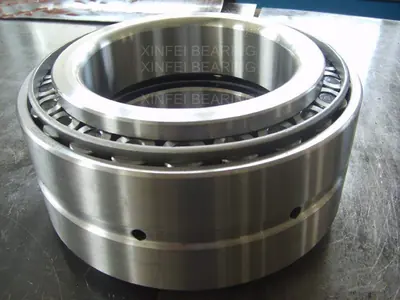
A tapered roller bearing has an outer ring called the cup, an inner ring called the cone, and a set of tapered rollers held by a cage. The extended lines of the raceways and the roller axis all meet at one point on the bearing axis. That geometry is what makes the rollers roll rather than skid.
The steeper the cup angle, the more axial load the bearing takes for a given radial load. A shallow angle suits mainly radial duty; a steep angle suits mainly axial duty.
Single Double And Four Row
A single row takes axial load in one direction only and must be opposed by a second bearing. Double row units, including the CD designs listed here, handle axial load in both directions in a single housing.
Four row units are used almost exclusively in work roll applications such as rolling mills. They accommodate combined radial and axial loads at low to moderate speeds and package a very high capacity into one chock.
Setting And Preload
Tapered bearings are supplied unmounted and the internal clearance is created during assembly. Setting can be end play, zero, or preload. End play tolerates thermal growth; preload maximises stiffness and reduces runout but generates heat. On wheel ends and gearboxes, following the machine builder's specified setting matters more than the bearing brand.
Inch And Metric Series
Much of the installed base in mills, off-highway equipment and older machinery uses inch series designations. Those series are still in service long after they stopped appearing in current catalogues, which is the usual reason a maintenance buyer struggles to source them. Both inch and metric series are listed in the tapered roller catalogue on this site.