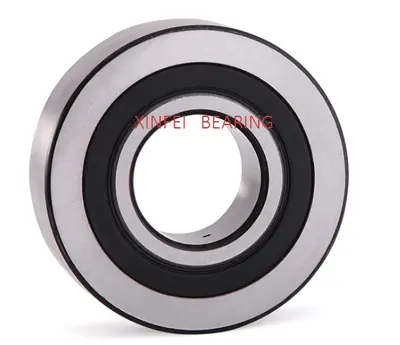
Angular contact ball bearings transmit load between the raceways at an angle to the bearing axis. That single feature is why they take combined load while still running fast enough for machine tool spindles, gas turbines and centrifugal machines.
Contact Angle
A small contact angle favours radial capacity and speed. A large contact angle favours axial capacity and stiffness. Spindle bearings commonly use 15 or 25 degrees; heavier duty positions use larger angles.
Single row angular contact bearings take axial load in one direction only and must be opposed, either by a second bearing or by a duplex pair.
Back To Back Face To Face And Tandem
Back to back arrangements give a wide effective support base and resist tilting moments. Face to face arrangements are more tolerant of misalignment but less rigid. Tandem arrangements share axial load in one direction between two bearings.
Universally matchable bearings can be combined in any of these arrangements and will produce a defined preload or clearance when clamped together.
Preload
Preload removes internal clearance, raises stiffness and improves running accuracy. It also raises operating temperature. Light preload suits high speed spindles, heavy preload suits stiffness critical low speed positions. Preload is set by the matched pair, not by the fitter, which is why matched sets should not be broken up.
Double Row And Special Forms
Double row units combine the function of a matched pair in one bearing and simplify assembly. Eccentric locking collar types clamp directly to a plain shaft without a machined seat, which is common in agricultural and conveyor equipment. Thin section constant cross section bearings hold the same ring section as bore diameter increases, for robotics and rotary tables.