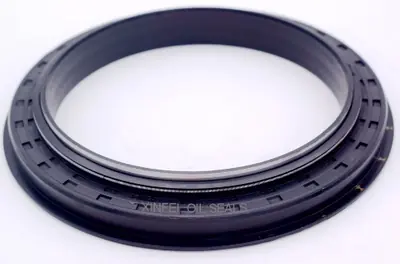
Oil seals retain lubricants and fluids around an oscillating, rotating or reciprocating shaft, and prevent the entry of contaminants that can destroy the internal components behind them. Material choice decides how long they do that.
NBR Nitrile
The default material for mineral oil and grease at moderate temperature. Good abrasion resistance, low cost, wide availability. It hardens in the presence of heat and ozone and is not suitable for many synthetic fluids.
FKM Fluoroelastomer
Much higher temperature capability and far better chemical resistance, including many synthetic oils and aggressive process fluids. More expensive, and less tolerant of very low temperature start-up than nitrile.
Silicone
Wide temperature range and good behaviour at low temperature, but poor abrasion resistance. Suited to clean, well lubricated positions rather than dirty ones.
PTFE
Chemically inert and capable of running with marginal lubrication, which suits dry start conditions and high surface speed. It is stiffer than an elastomer, so shaft finish and runout requirements are tighter.
Floating Labyrinth Seals
Where contamination rather than fluid retention is the problem, a non contacting labyrinth seal has no lip to wear. Floating labyrinth designs are used on mining and heavy equipment final drives and gearboxes, and appear in the seal range on this site.
The Shaft Matters As Much As The Seal
Most premature seal failures come from the shaft, not the seal: a wear groove from the previous seal, a plunge ground rather than helically ground finish, surface roughness outside the correct window, or excessive runout. Check the shaft before blaming the part.