Almost every bearing on this site is made from through hardening chrome bearing steel. Knowing what that means, and where it stops being the right answer, avoids most material specification errors.
GCr15 And GCr15SiMn
GCr15 is the standard Chinese high carbon chrome bearing steel, broadly equivalent to 100Cr6, SUJ2 and AISI 52100. It hardens through the section, reaches roughly 58 to 64 HRC and gives the fine, uniform carbide structure that rolling contact fatigue life depends on.
GCr15SiMn adds silicon and manganese to increase hardenability, so larger rings harden right through rather than only near the surface. Both grades appear in the material row of the specification tables on this site.
Case Carburised Grades
Where shock load is high, a carburised steel gives a hard case over a tough core. The case resists rolling contact fatigue while the core resists cracking. This is the usual choice for railway, mill and heavy off-highway positions, and appears in the tables as cemented steel.
Temperature Limits
Standard bearing steel is dimensionally stabilised to around 120 degrees Celsius. Above that, special heat stabilisation is required or the rings will grow in service and consume internal clearance. If your application runs hot continuously, say so at enquiry stage rather than after installation.
Other Materials In The Range
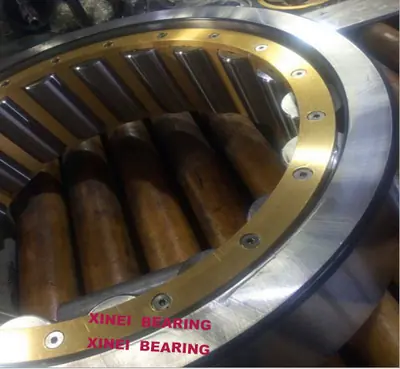
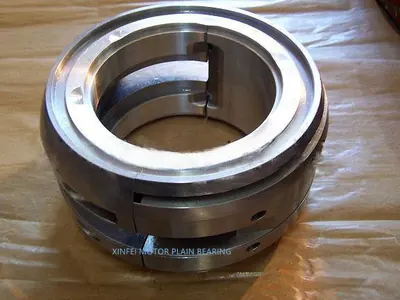
Slide bearings for motors and generators use ZSnSb11Cu6 Babbitt alloy on a cast backing. Housings and split bearing bodies use cast steel, ductile iron or cast iron. Cages use brass, steel, bakelite or nylon depending on speed and temperature. Some special bearings use titanium alloy or copper nickel where the environment demands it.