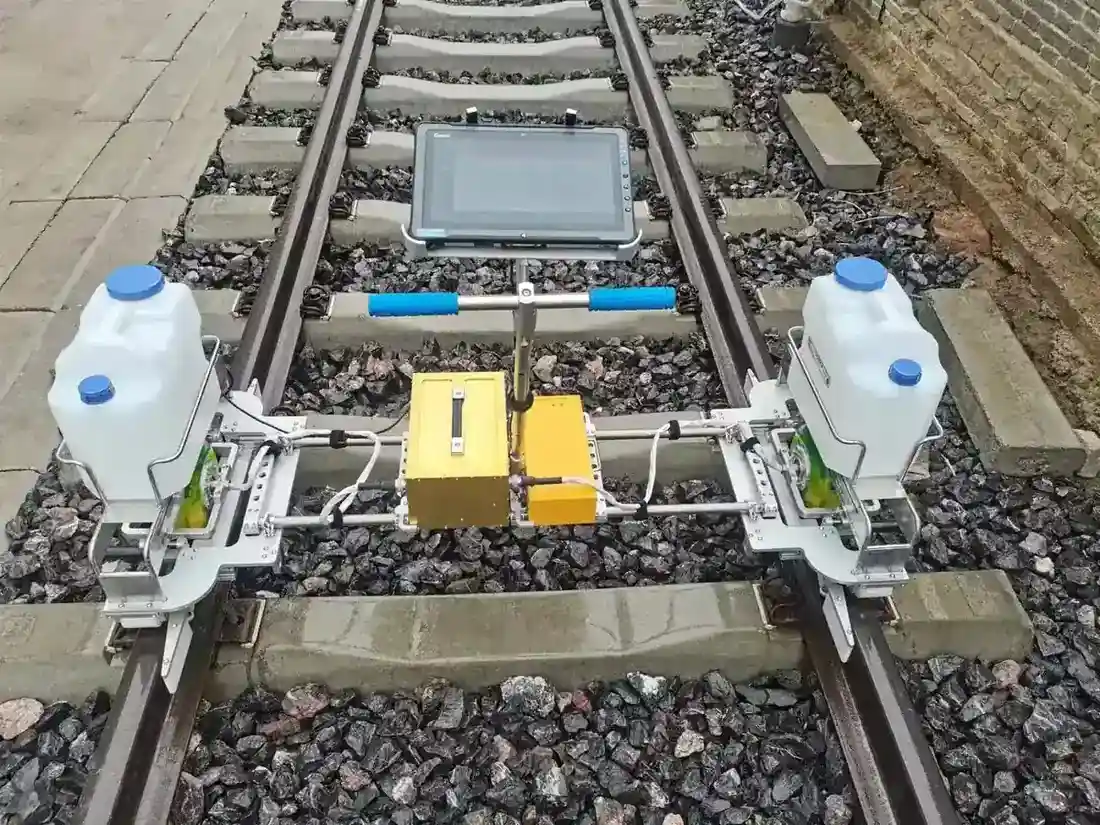
RTS18-B Portable Dual-Rail Ultrasonic Flaw Detector
The RTS18-B is a hand push portable ultrasonic flaw detector designed for inspection of both rails in a single pass. It uses a dual rail scanning system with two 9-channel wheel probes, operates at up to 5 km/h
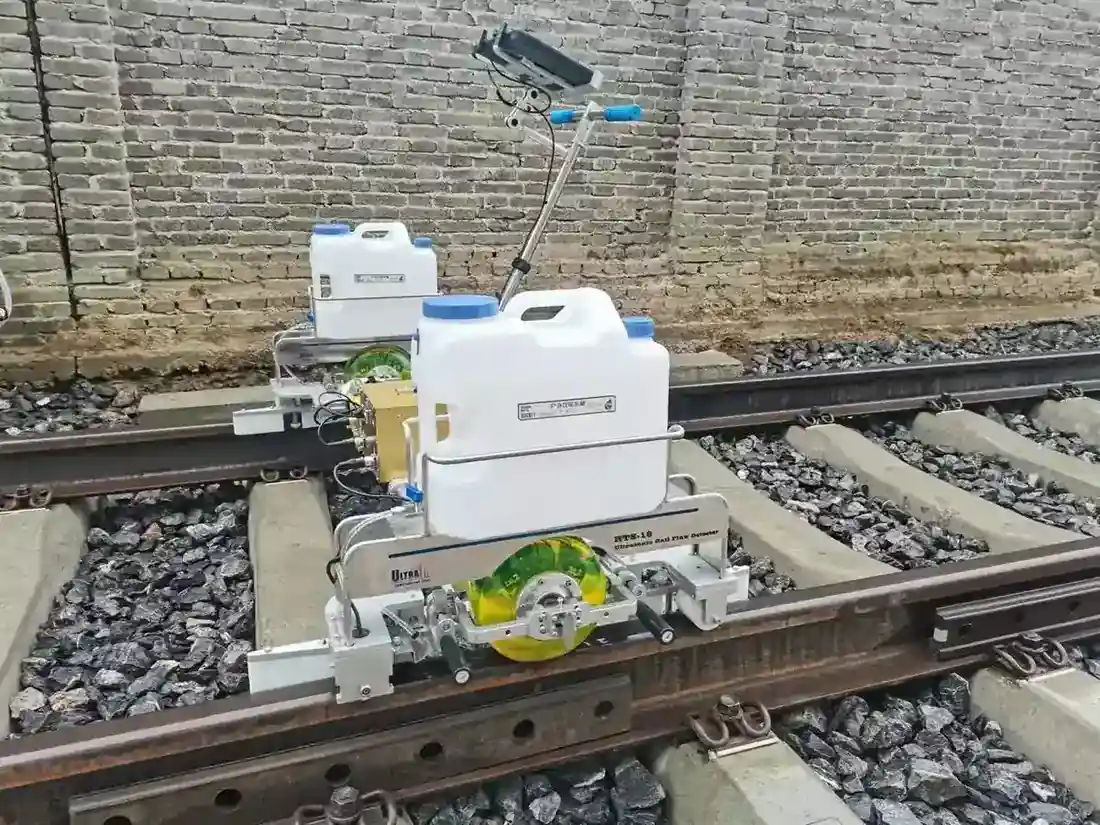
RTS18-B Portable Dual-Rail Ultrasonic Flaw Detector
The RTS18-B is a hand push portable ultrasonic flaw detector designed for inspection of both rails in a single pass. It uses a dual rail scanning system with two 9-channel wheel probes, operates at up to 5 km/h, and records A-scan and B-scan data in real time. The system is built for field use with a rugged tablet, high-brightness display, and a lightweight modular cart that disassembles into parts under 10 kg for easy transport.
- Inspects both rails in one pass, reducing inspection time and effort
- Detection speed up to 5 km/h with real-time data recording
- Modular cart disassembles into parts under 10 kg, carried by one person
- Assembly or disassembly in less than 3 minutes without tools
- High-brightness 8.4 inch display readable in direct sunlight
- Data recorded over up to 400 miles with selectable file range
- Differential GPS with 1Hz update and <5 meter accuracy for location tracking
Problems It Solves
- Manual walking inspection is slow and inconsistent over long distances
- Single rail equipment requires two passes per kilometre, doubling effort
- Heavy or non-modular systems require lifting gear and more crew
- Data loss or lack of traceability due to paper-based or non-digital records
- Poor visibility or low light conditions reduce operator accuracy during night shifts
Who It Is For
Rail maintenance contractors covering multiple short lines
Port and mine operators with heavy haul industrial track
Urban metro systems requiring fast, repeatable inspections
Private railways with limited crew and equipment resources
Railway bureaus needing portable systems for spot checks
Application Scenarios
- Routine inspection of industrial railway lines with limited access
- Periodic checks on port and mine track where heavy equipment cannot operate
- Urban metro track inspection during short night maintenance windows
- Verification runs after rail grinding or welding operations
- Inspection of remote or difficult-to-access track sections
Technical Features
- Dual rail scanning system with two 9-channel wheel probes
- Real-time data collection driven by encoder with 3 mm/pulse resolution
- Simultaneous A-scan and B-scan display for immediate defect assessment
- Rugged tablet with high-brightness amorphous silicon TFT LCD panel
- Differential GPS with 1Hz update and <5 meter location accuracy
- Adjustable alarm threshold and slope line detection for signal analysis
- Data files stored with position, speed, sensitivity, and probe signals
- Modular cart design allows disassembly into parts under 10 kg
- Water tank of 25 liters for probe coupling, with temperature range matching operating conditions
- All components rated for operating and storage temperatures from -30°C to 85°C
Technical Specifications
| Detection Speed | Up to 5 km/h |
|---|---|
| Channels | Total 18 channels, 9 per roller search unit |
| Probe Configuration | One 0 degree compressive probe, two 37 degree shear wave probes, six 70 degree probes per unit |
| Scan Modes | A-scan and B-scan |
| Display | 8.4 inch amorphous silicon TFT LCD, 800×600 resolution, high brightness |
| Encoder Pulse | 3 mm/pulse |
| Frequency Range | 4~5 MHz |
| Gain Range | 0~80 dB in 1 dB steps |
| Alarm | Threshold level adjustable, slope line detection |
| Data Recording Range | 200 miles, selectable up to 400 miles |
| Battery | Lithium 14.4V, 10.0 Ah, up to 9 hours |
| Recharge Time | 4 hours |
| Charger Input | 100~240VAC, 50~60Hz |
| GPS | Differential GPS, 1Hz, <5 meter accuracy |
| Operating Temperature | -30°C ~ 80°C (-22°F~176°F) |
| Storage Temperature | -40°C ~ 85°C (-40°F~185°F) |
| Water Tank Capacity | 25 liters |
| Cart Weight | Less than 45 kg |
| Single Module Weight | No part exceeds 10 kg |
| Assembly Time | Less than 3 minutes |
How It Is Operated
Disassemble cart into parts and carry to inspection site
Reassemble cart in less than 3 minutes without tools
Fill water tank with coupling fluid and verify level
Set probe position and angle from the console before starting
Begin inspection at up to 5 km/h with encoder-driven data collection
Quality Control
- System tested under operating and storage temperature extremes
- Data recording range verified up to 400 miles with selectable file size
- GPS accuracy confirmed at <5 meter with 1Hz update
- Probe signals validated across full frequency range and gain steps
- All components tested for durability in field conditions
Customization Options
- Probe configuration adjusted to match rail profile in service
- Console interface and report format adapted to railway operating standards
- On-site commissioning and operator training provided with delivery
How It Compares With Other Options
| UR18-D dual-rail vehicle | The UR18-D runs at 15 km/h and covers more track per shift, but the RTS18-B is lighter and can be carried into remote or narrow-access areas |
|---|---|
| GT6600 hi-rail vehicle | The GT6600 drives on road at 40 km/h and covers long distances, but the RTS18-B is more portable and usable in confined spaces without road access |
| Single rail hand push detector | The RTS18-B inspects both rails in one pass, eliminating the need for two separate runs and reducing inspection time by half |
Use Guide
- Confirm possession window before assembling the cart on track
- Check water tank level before starting the run to ensure proper probe coupling
- Verify probe alignment and encoder signal at the start of each shift
- Maintain detection speed at or below 5 km/h to ensure consistent data quality
- Back up recorded job data after each inspection before charging the battery
Related Products
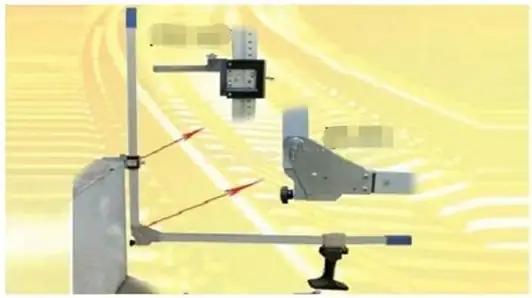
RAILWAY PLATFORM GAUGE
The Railway Platform Gauge is a portable measuring tool designed for precise measurement of the horizontal distance...
View Product →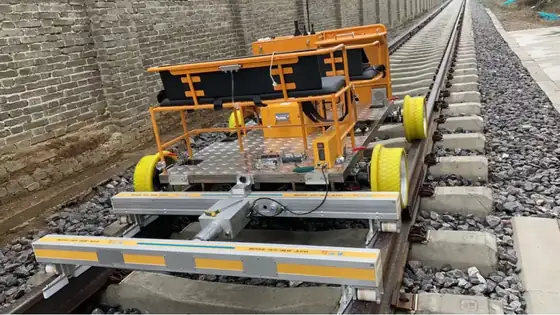
Track Geometry Measurement
The GJY-H-CK-22CM Track Geometry Measurement system is integrated into an electric flaw detection vehicle and runs at a...
View Product →
CK2108 Ultrasonic Flaw Detector
The CK2108 is a portable handheld ultrasonic flaw detector designed for rapid, accurate detection and evaluation of...
View Product →Frequently Asked Questions
How many people are needed to carry the RTS18-B?
One person can carry each module. The cart disassembles into parts under 10 kg, so a single operator can transport all components to the site.
What defects can it detect?
It detects transverse cracks and other defects in the rail head, web, and base using 0 degree compressive, 37 degree shear wave, and 70 degree probes.
How much track can one shift cover?
Data recording is selectable up to 400 miles, and the battery lasts up to 9 hours, allowing for extended inspection runs at 5 km/h.
Can it be used in extreme temperatures?
Yes. The system operates from -30°C to 80°C and can be stored from -40°C to 85°C, suitable for Arctic and desert environments.
How is the data recorded and reviewed?
The system records A-scan, B-scan, GPS location, speed, and sensitivity. Data is transferred to a computer for playback and expert review after the shift.
Is operator training provided?
Yes. Pre-sales, in-sales, and after-sales technical support, on-site engineer training, and construction team support are included with the order.
How do I get a quotation?
Email [email protected] with your rail profile, line type, and annual inspection volume. Our engineers will provide a configuration and price.
Get a Configuration for the RTS18-B Portable Dual-Rail Ultrasonic Flaw Detector
Send the rail profile, line type and annual inspection kilometres. Our engineers reply with a configuration and a price, not a brochure.