
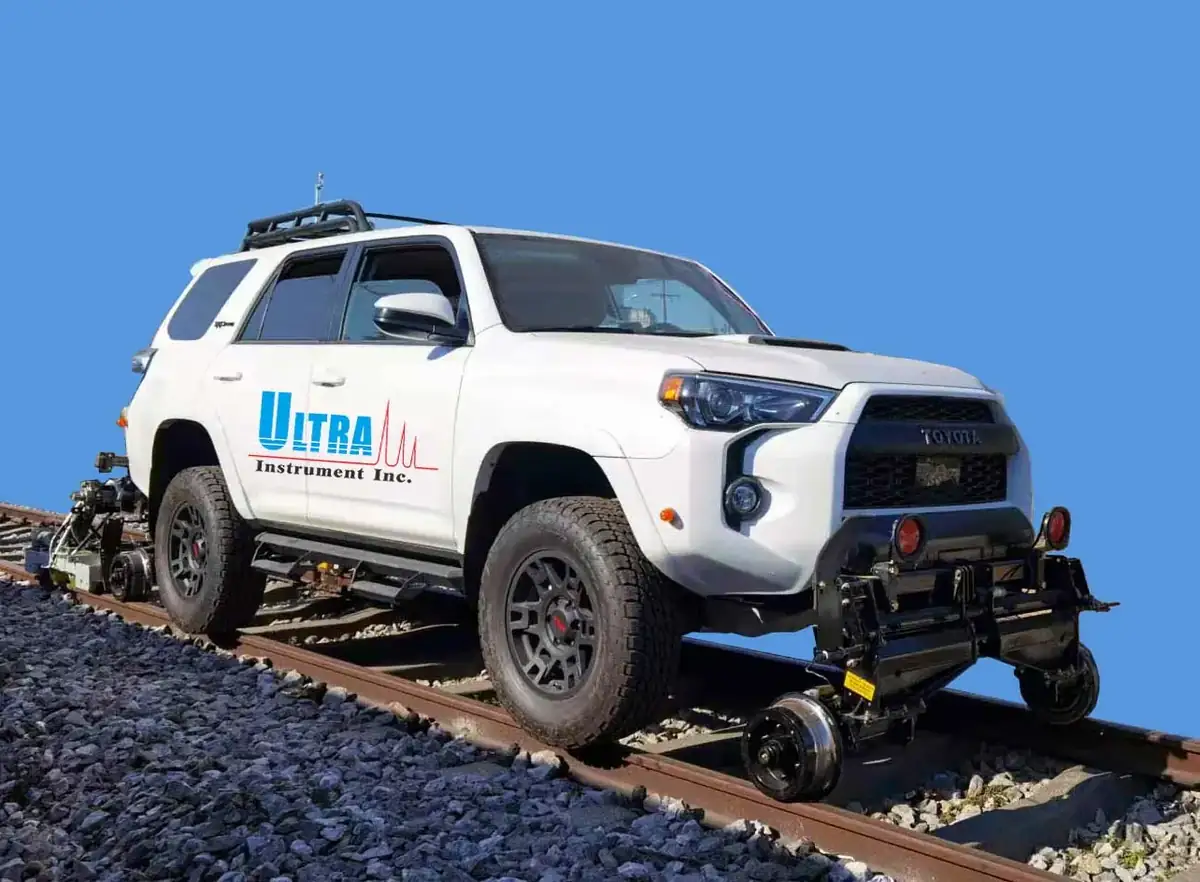
GT6600 Hi-Rail Ultrasonic Flaw Detection Vehicle
The GT6600 is a four-wheel-drive hi-rail ultrasonic flaw detection vehicle designed for high-speed inspection of long track sections under tight maintenance windows. It operates at up to 40 km/h on rail and can
GT6600 Hi-Rail Ultrasonic Flaw Detection Vehicle
The GT6600 is a four-wheel-drive hi-rail ultrasonic flaw detection vehicle designed for high-speed inspection of long track sections under tight maintenance windows. It operates at up to 40 km/h on rail and can be driven on roads with the hi-rail gears retracted. The vehicle carries two 10-channel wheel probes and provides real-time A-scan and B-scan display, enabling continuous detection with data storage for later review. It is built for operation in extreme temperatures and remote locations.
- Inspects track at up to 40 km/h, covering long distances within short maintenance windows
- Hi-rail gears retract for road travel, allowing transport between sites without a trailer
- Two 10-channel wheel probes enable detection on both rails simultaneously
- Real-time B-scan display allows immediate assessment of rail condition
- Data storage capacity of 300 km with adjustable settings for extended runs
- Operates in temperatures from –30°C to 45°C, suitable for harsh environments
Problems It Solves
- Traditional hand push carts cannot cover 30 km of track within 120–180 minute maintenance windows
- Manual inspection at walking speed is too slow for high-speed rail networks
- Heavy equipment requires lifting gear and multiple crew members to deploy
- Lack of real-time data display delays defect identification during the run
- Inability to travel on roads limits mobility between inspection sites
Who It Is For
State-owned railways requiring high-speed inspection of long track segments
Private and industrial railways with limited maintenance windows and remote lines
Port and mine operators managing heavy haul track with frequent inspection needs
Rail maintenance contractors covering multiple sites with one vehicle
Urban metro systems needing fast, reliable inspection during night shutdowns
Application Scenarios
- Scheduled inspection of high-speed main line track during 120 to 180 minute maintenance windows
- Long-distance inspection of industrial or private railway lines with limited access
- Track maintenance in remote or extreme climate zones where transport is difficult
- Urban metro or freight line inspection where speed and coverage are critical
- Verification runs after rail replacement or grinding on high-traffic lines
Technical Features
- Four-wheel-drive SUV platform with retractable hi-rail gears for road and rail operation
- Hydraulically controlled test carriage with remote operation from the console
- Two 10-channel wheel probes with automatic alignment and position control
- Real-time B-scan display for immediate defect assessment during detection
- Data storage of up to 300 km with adjustable settings for extended runs
- Mileage error not more than 2 ‰ for accurate location tracking
- Operating range from –30°C to 45°C, suitable for extreme environments
- Trigger pulse of 520 V negative pulse for consistent signal generation
- Gain range from 0 to 72 dB for sensitivity adjustment across rail profiles
- Software records and stores detection data including speed, sensitivity, and scan modes
Technical Specifications
| Detection Speed | Not less than 40 km/h continuous |
|---|---|
| Road Travel Speed | Not less than 60 km/h |
| Detection Endurance | Not less than 10 hours at 40 km/h |
| Road Driving Range | Not less than 6 hours at 60 km/h |
| Probe Configuration | Two 10-channel wheel probes |
| Probe Frequency | 2 ~ 4 MHz |
| Trigger Pulse | 520 V negative pulse |
| Gain Range | 0 ~ 72 dB |
| Data Storage | 300 km (adjustable) |
| Mileage Error | Not more than 2 ‰ |
| Coupling Water Tank | Not less than 400 L |
| Operating Temperature | –30°C to 45°C |
| Rail Type | 43 kg/m to 75 kg/m |
| Vehicle Type | 4WD SUV |
| Engine Volume | 3.0 L |
| Transmission Type | Manual |
| Display Mode | A-scan and B-scan (B-scan real-time display) |
How It Is Operated
Drive the vehicle to the site and retract the hi-rail gears for road travel
Position the vehicle on the track and deploy the hi-rail gears for rail operation
Fill the coupling water tank and verify water level before starting the run
Set probe position and angle from the console and begin continuous detection
Monitor real-time A-scan and B-scan data during the run for immediate assessment
Quality Control
- Data storage capacity of 300 km allows full job review after completion
- Mileage error not more than 2 ‰ ensures accurate defect location tracking
- Real-time B-scan display enables immediate verification of suspected defects
- Recorded data can be transferred to a central analysis system for expert review
Customization Options
- Probe configuration adjusted to match the rail profile in service
- Console interface and report format adapted to the operating railway’s standards
- On-site commissioning and operator training provided with the order
How It Compares With Other Options
| RT10-C hand push trolley | The trolley operates at 5 km/h and covers far less track per shift, making it unsuitable for long intervals under tight maintenance windows |
|---|---|
| UR18-D dual-rail vehicle | The UR18-D is lighter and easier to carry on track, but the GT6600 covers more distance at higher speed and can travel on roads between sites |
| Single rail detection equipment | The GT6600 inspects both rails simultaneously with two probes, reducing the number of passes needed compared to single rail systems |
Use Guide
- Confirm the maintenance window duration before deploying the vehicle on track
- Retract hi-rail gears before driving on roads to avoid damage
- Check coupling water level before starting the run to ensure proper probe coupling
- Verify probe alignment and gain settings at the start of each shift
- Maintain detection speed at or below 40 km/h to ensure consistent sensitivity
- Back up recorded job data after each run before charging the battery or shutting down
Related Products
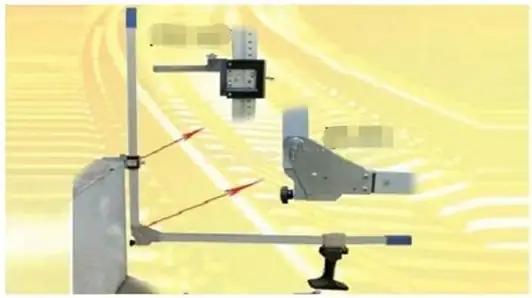
RAILWAY PLATFORM GAUGE
The Railway Platform Gauge is a portable measuring tool designed for precise measurement of the horizontal distance...
View Product →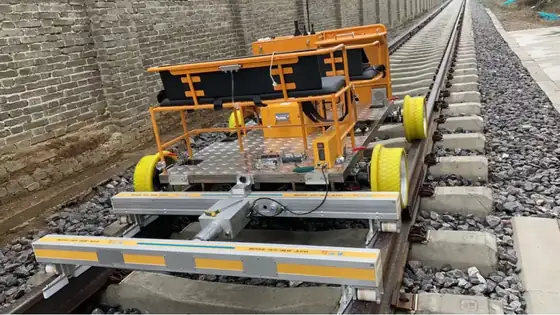
Track Geometry Measurement
The GJY-H-CK-22CM Track Geometry Measurement system is integrated into an electric flaw detection vehicle and runs at a...
View Product →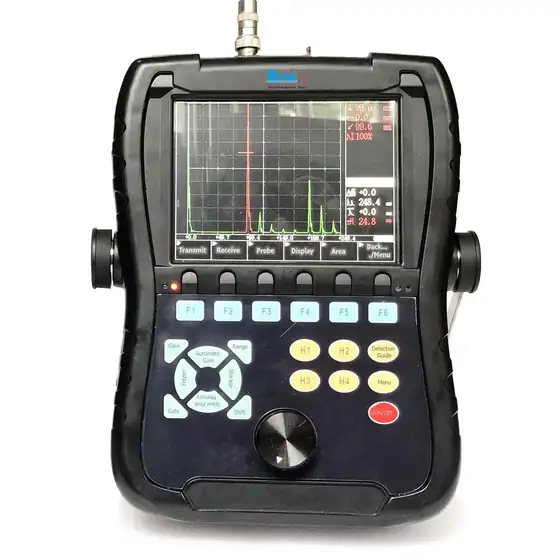
CK2108 Ultrasonic Flaw Detector
The CK2108 is a portable handheld ultrasonic flaw detector designed for rapid, accurate detection and evaluation of...
View Product →Frequently Asked Questions
How fast can the GT6600 travel on rail and on road?
It can detect at up to 40 km/h on rail and travel at up to 60 km/h on roads with the hi-rail gears retracted.
Can it operate in extreme temperatures?
Yes. It operates in temperatures from –30°C to 45°C, making it suitable for harsh environments.
How much data can it store?
It stores up to 300 km of detection data, with settings adjustable for longer or shorter runs.
How many probes does it have?
It has two 10-channel wheel probes, one on each rail, enabling simultaneous inspection of both rails.
Can it be driven on roads?
Yes. The hi-rail gears can be retracted, allowing the vehicle to be driven on roads like a standard SUV.
Is operator training provided?
Yes. We provide on-site commissioning, operator training, and technical support as part of the delivery process.
How do I get a quotation?
Email [email protected] with your rail profile, line type, and annual inspection volume, and our engineers will provide a configuration and price.
Get a Configuration for the GT6600 Hi-Rail Ultrasonic Flaw Detection Vehicle
Send the rail profile, line type and annual inspection kilometres. Our engineers reply with a configuration and a price, not a brochure.