
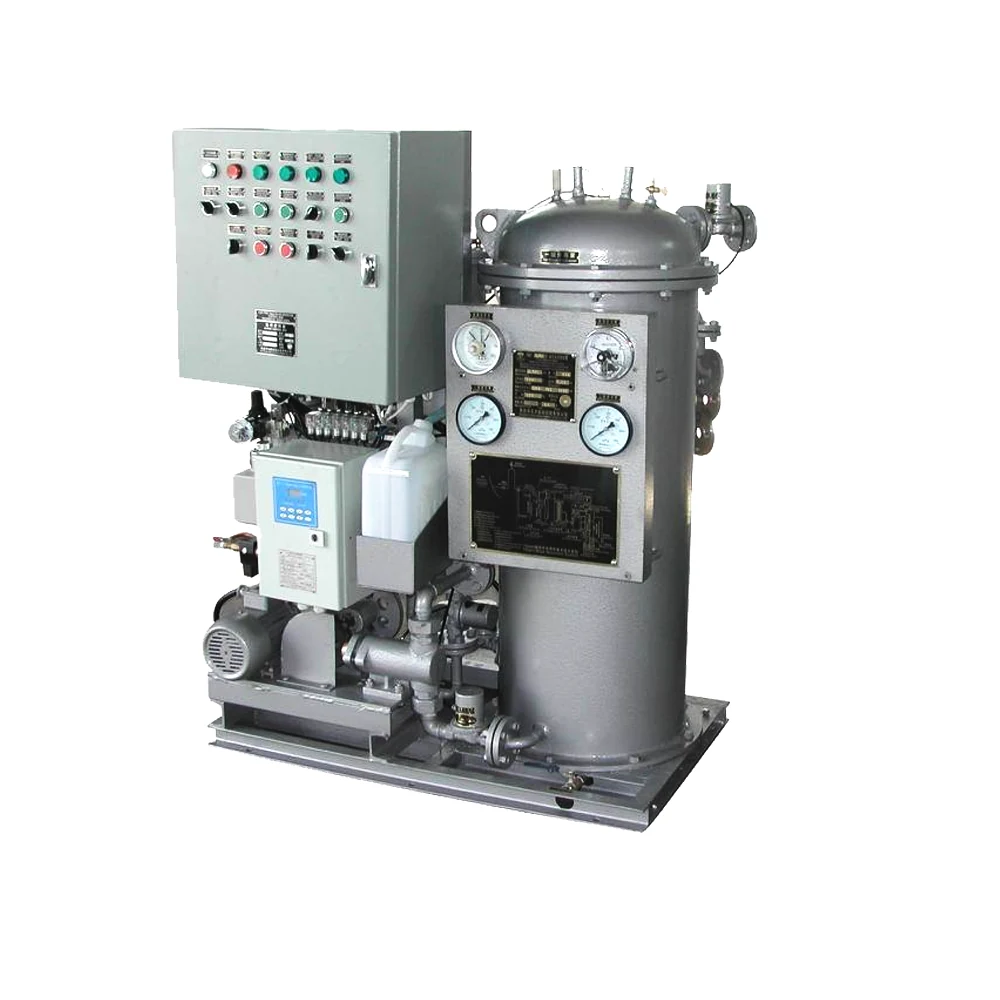
Every ship generates oily bilge water and no ship may discharge it untreated. The oil water separator is what makes the discharge legal, and the standard it has to meet is IMO MEPC.107(49). Our units treat engine room bilge water through inclined plate gravity and coalescence separation, a fibre filter stage and a final stage, in capacities from 0.25 to 5 m3/h.
Specification notes
Capacity 0.25 m3/h to 5 m3/h. Motor 1.1kW, 1.5kW or 2.2kW. Supply 380V, 415V or 480V at 50Hz or 60Hz. Meets IMO MEPC.107(49). Standard wooden box packing. CCS, BV, LR and DNV certificates available.
What you get from us in this category
Built to the discharge standard
The device treats engine room bilge oil sewage to meet the requirements of IMO MEPC.107(49), which is the standard port state control checks against.
Three stage treatment
First stage inclined plate gravity and coalescence separation, second stage fibre filtration, third stage final polishing, so the load on each stage stays within what it can hold.
Capacity matched to the bilge generation rate
0.25, 0.5, 1, 1.5, 2.0, 2.5, 3, 4 and 5 m3/h, so the unit runs at its design point instead of cycling.
Supplied with the control panel
All necessary accessories including the control panel are delivered with the unit.
Marine Oil Water Separators product range
Marine Oil Water Separators FAQ
What capacity do I need?
It follows from the vessel's bilge generation rate and how often you want to run the unit. Give us the rate in m3 per day and we will size it.
Does it meet current discharge requirements?
It is built to treat engine room bilge oil sewage to the requirements of IMO MEPC.107(49).
What supply voltage is available?
380V, 415V or 480V at 50Hz or 60Hz, with motor ratings of 1.1kW, 1.5kW and 2.2kW according to capacity.
Is the control panel included?
Yes. All necessary accessories including the control panel are supplied with the separator.
Which certificates are available?
CCS, BV, LR and DNV, applied for against the unit on your order.
Send the vessel data, get a specified quotation
Tell us the vessel, the duty and the classification society. We come back with the specification, the certificate list and the packing method — not just a price.