The Class Is A Column Not A Product
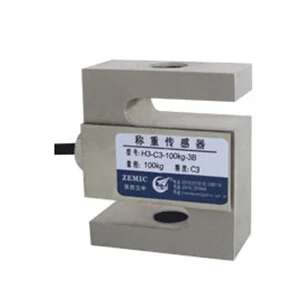
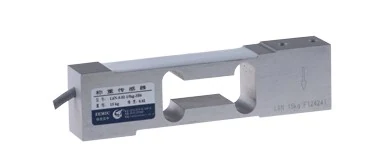
On these datasheets C2, C3, C4 and the A and B classes are columns across one table, not different products. The same physical cell family is offered in several classes, and the class you order fixes the error limits printed against it. That is why the enquiry has to state the class, not just the capacity.
n max Is Your Division Budget
The maximum number of verification intervals, written n max, is the headline number. C2 families here publish 2000, C3 publishes 3000 and C4 publishes 4000. A scale cannot be legally verified to more divisions than the cell supports, so n max is the first filter on any design that has to be approved for trade.
v min Is The Fine Print
The minimum load cell verification interval, v min, is published as Emax divided by a number: Emax over 5000 for C2, over 10000 for C3 and over 14000 for C4 in the shear beam families. It sets the smallest interval the cell can resolve reliably. A 1 t C3 cell gives a v min of 0.1 kg, so a scale using 50 g divisions on that cell is outside the cell specification even though the display will happily show them.
Combined Error, Creep And Temperature
The rest of the table describes how the cell behaves in the real world. Combined error is typically at or under 0.020 percent of full scale for C3 and 0.030 percent for C2. Creep over 30 minutes is at or under 0.016 percent for C3. Temperature effect on sensitivity and on zero are quoted per 10 degrees Celsius. In a plant with a 20 degree daily swing these two lines matter more than the headline error.
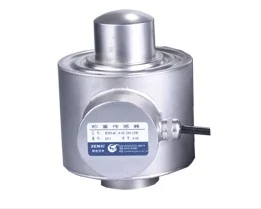
HM14C column load cell, 10 t to 50 t →
Electrical Lines You Must Not Ignore
Input and output resistance, usually 350 ohm or 700 ohm in these families, decide how many cells one indicator can drive. Output sensitivity, quoted in mV/V, has to match the indicator range. Excitation is recommended at 5 to 12 V DC with a maximum of 18 V DC on most families. Mixing a 2 mV/V cell with a 3 mV/V cell under the same platform makes corner trimming impossible.
How To Quote It
A complete load cell enquiry contains five items: family, capacity, accuracy class, protection rating and cable length. With those five we can confirm availability and send the certificate that covers the exact combination, rather than a general company document.