Start With Total Capacity Not Cell Capacity
The first mistake in most load cell enquiries is quoting the cell capacity when the sender means the scale capacity. A four cell platform rated 2 t does not use 2 t cells. Divide the intended scale capacity by the number of cells, then add the dead load of the deck and any fixed fixtures, then add margin for off centre loading. A 2 t platform with a 150 kg deck on four cells lands comfortably on 1 t cells.
Leave Headroom For Overload
Every load cell family in this catalogue publishes two overload figures. Safe overload, typically 150 percent of full scale, is the load the cell can take and still return to its stated accuracy. Ultimate overload, typically 300 percent, is where mechanical failure is expected. Design mechanical stops to the safe overload figure. Sizing a cell so that normal working load already sits near full scale leaves nothing for the pallet truck that lands hard on one corner.
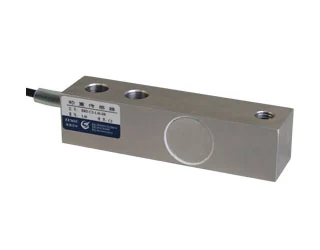
H8C single shear beam load cell, 0.5 t to 10 t →
Match Accuracy Class To Division Count
Accuracy class is not a quality ranking, it is a statement about how many verification intervals the cell supports. A C3 cell in these families publishes n max 3000, which means a scale using it can be verified to 3000 divisions. C4 publishes n max 4000 and C2 publishes 2000. If you sold a 3000e scale and specified a C2 cell, the scale cannot be verified no matter how well it is built.
Check v min Against Your Smallest Division
The second half of the class specification is v min, the minimum load cell verification interval. C3 families here publish v min of Emax divided by 10000, C4 publishes Emax divided by 14000. Divide the cell capacity by that figure to get the smallest verification interval the cell can support, and compare it with the division you intend to use. If your division is smaller, move up a class or reduce the cell capacity.
Then Choose Construction And Protection
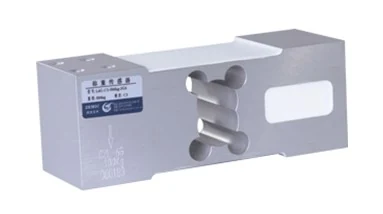
Only after capacity and class are settled does the physical choice matter: aluminium single point cells for small platforms, shear beam for platforms and floor scales, S type for tension and crane work, column for weighbridges. Protection runs from IP65 on aluminium cells up to IP68 on sealed stainless steel families. In a washdown or salt environment choose stainless steel and IP68 even if the accuracy requirement is modest.
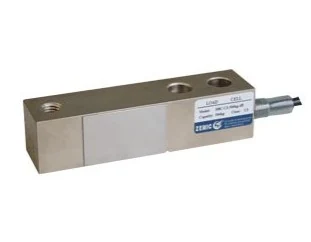
B8D stainless steel shear beam load cell →
A Worked Example
A bench scale of 300 kg with a 3000 division display, single cell, deck weight 8 kg. Capacity needed is 300 kg plus deck plus margin, so a 300 kg single point cell is marginal and a 500 kg cell is safer if the platform stays within the published maximum platform size. For 3000e the cell must be at least C3. Checking v min: a 500 kg C3 cell gives 500 divided by 10000, which is 0.05 kg, and the intended division of 0.1 kg is larger, so the design passes.