
product guide
How Air Atomizing Nozzles Work
Air Atomizing Nozzles Deliver Fine Sprays Without High Liquid Pressure
When the process requires very fine droplets at low liquid flow, air atomizing nozzles provide independent control of air and liquid. This allows precise adjustment of droplet size without relying on high liquid pressure. The system is ideal for applications where fine mist is needed, such as humidification, cooling, dust suppression, or surface treatment, especially in environments with high temperatures or where liquid pressure is limited.
Internal Mixing for Finest Droplets, External Mixing for Viscous Liquids
Internal mixed nozzles achieve the finest spray quality by mixing air and liquid inside the nozzle body. This design is best suited for clean liquids and applications requiring ultra-fine droplets. External mixed nozzles are preferred when handling higher viscosity liquids, as they allow for more stable mixing and reduced risk of clogging at the mixing point.
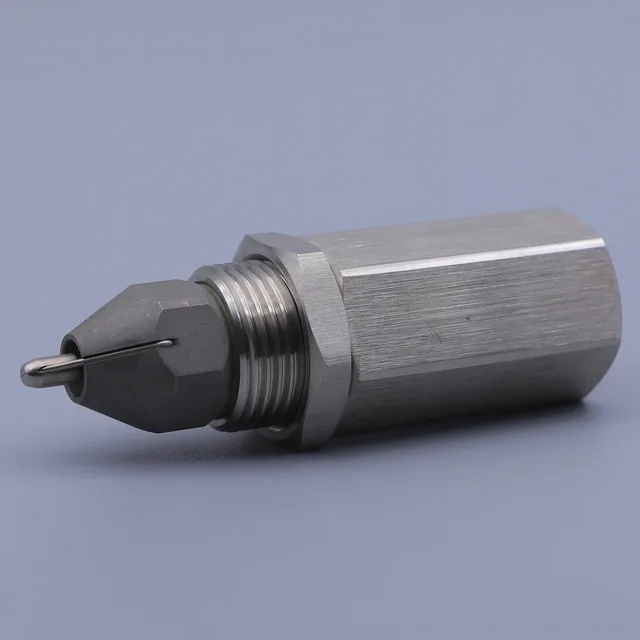
Stainless steel hex nozzle with threaded connection and fine tip
Three Feed Types Match Different System Designs
Air atomizing nozzles are available in pressure, siphon, and gravity feed types. Pressure feed requires liquid pressure to deliver the fluid to the nozzle. Siphon and gravity feed types do not require liquid pressure; instead, they draw liquid from a reservoir using the air stream. This flexibility allows integration into existing systems regardless of liquid delivery method.
Adjustable Flow and Spray Pattern for Process Control
The adjustable air atomizing nozzle allows variation in liquid flow rate while maintaining constant air pressure. This enables the operator to match spray output to process demand. Available spray patterns include flat fan, round, and wide-angle round, allowing coverage to be tailored to the target surface or volume.
Air Inlet and Liquid Inlet Are Clearly Marked for Correct Installation
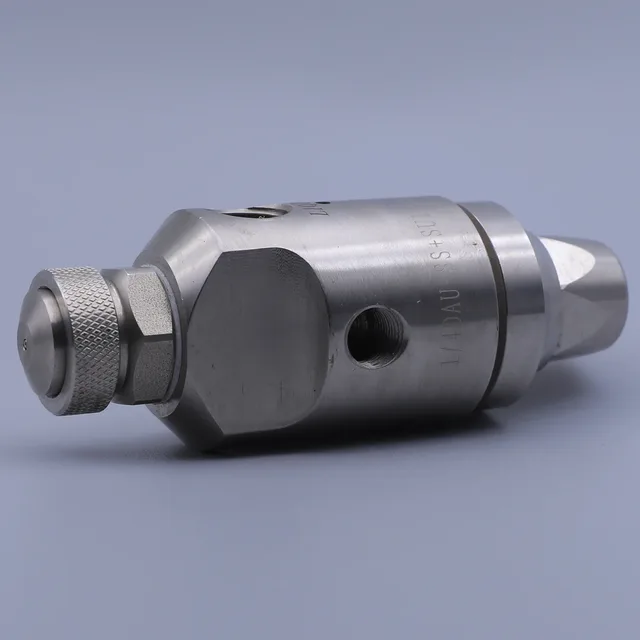
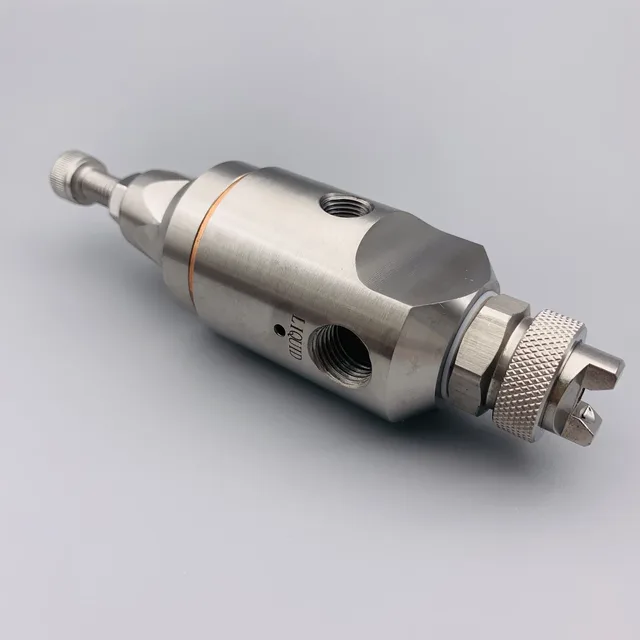
Each nozzle body has two distinct inlets: one marked 'LIQUID' or 'L', and the other marked 'AIR' or 'A'. Correct connection of air and liquid lines is essential for proper operation. Misconnection can result in poor atomization or equipment damage.
Spray Distance and System Simplicity Are Key Advantages
Air atomizing nozzles can deliver spray up to 3 meters, making them suitable for large or hard-to-reach areas. Compared to high-pressure fog systems, they require lower-pressure air lines, simpler piping, and longer service life. Installation is straightforward, and maintenance is reduced due to fewer high-pressure components.
Applications Across Heavy Industry and Environmental Control
These nozzles are used in high-temperature environments such as wax factories, cement plants, injection molding, ceramics, and metallurgical facilities. They support humidification, cooling, dust suppression, and disinfection tasks where consistent, fine droplet delivery is essential for process performance.
Products in This Guide
Parts Referred To Above
Keep Reading
Ranges Industries and Other Guides
Questions Buyers Ask
Questions on This Topic
What is the difference between internal and external mixing in air atomizing nozzles?
Internal mixed nozzles mix air and liquid inside the body, producing the finest droplets and best atomization. External mixed nozzles mix air and liquid outside the body, which is better suited for viscous liquids and reduces clogging risk.
Do I need liquid pressure to use an air atomizing nozzle?
No. Air atomizing nozzles can operate in siphon or gravity feed modes without liquid pressure. Liquid pressure is only required for pressure feed types, which are used when the system already has pressurized liquid supply.
Can I adjust the spray pattern on an air atomizing nozzle?
Yes. Air atomizing nozzles offer flat fan, round, and wide-angle round spray patterns. The pattern is fixed by the nozzle design, but multiple nozzle types can be selected to match the required coverage.
How far can an air atomizing nozzle spray?
An air atomizing nozzle can spray up to 3 meters. This range allows coverage of large areas without requiring high-pressure lines or complex mounting.
What should I check before installing an air atomizing nozzle?
Verify that the air inlet is connected to the air supply and the liquid inlet is connected to the liquid source. Confirm the correct feed type (pressure, siphon, or gravity) matches your system. Ensure the nozzle is marked 'LIQUID' or 'L' and 'AIR' or 'A' for proper connection.
Are air atomizing nozzles suitable for high-temperature environments?
Yes. Air atomizing nozzles are used in high-temperature applications such as wax factories, cement plants, and metallurgical facilities. They are designed to operate reliably under harsh conditions with consistent performance.
Can I get trial samples of air atomizing nozzles?
Yes. Trial samples can be sent free of charge, and samples can be ready within 10 days. This allows you to test the nozzle in your system before placing a full order.
Apply This to Your Own Line
Send the duty, the pressure and a photograph of the existing head. We will confirm the pattern, the size and the material.