
buying guide
How to Choose a Spray Pattern for an Industrial Process
Start From the Shape of the Target Not the Nozzle
Most nozzle mistakes start with a catalogue rather than with the job. Before you look at any model number, describe the surface the liquid has to reach. Is it a line across a moving belt, a round area under a tank lid, a volume of gas moving through a duct, or a single point on a machined part? That shape decides the pattern, and the pattern narrows the choice from hundreds of nozzles to a handful.
Flat Fan for Lines and Moving Strip
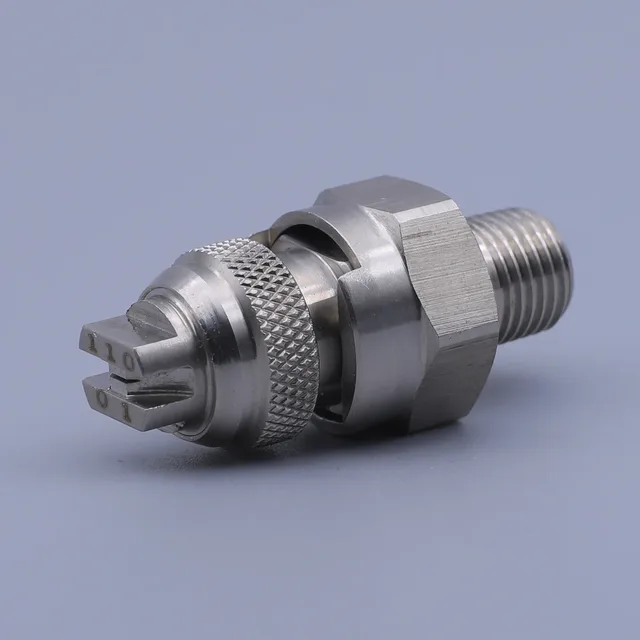
A flat fan lays a straight band of spray. It is the right answer when the target moves under the nozzle in one direction: rinse headers over conveyors, cooling and quenching of hot strip, parts washing cabinets, and sand or gravel washing bars. Coverage comes from spacing several fans along a header and overlapping their tapered edges. Get the overlap wrong and the washed surface shows streaks.
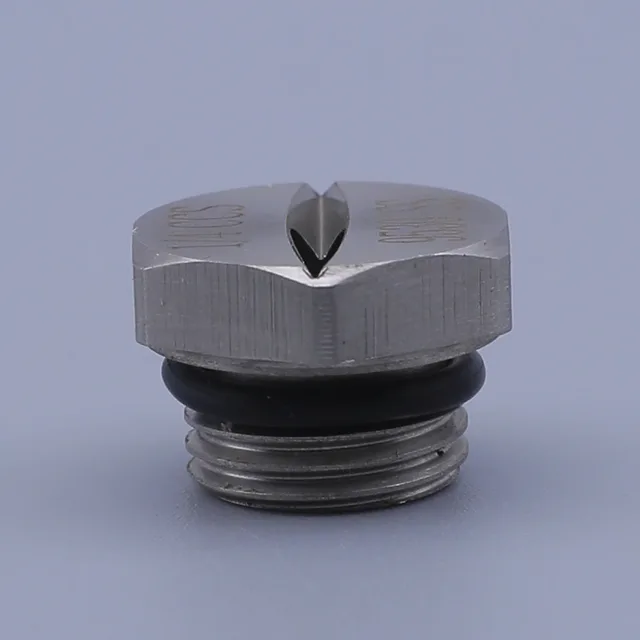
Stainless steel hex nozzle with V-shaped slit tip, black O-ring, and threaded base on a plain background
Full Cone for Area and Volume
A full cone fills a round footprint with medium to large drops. Use it when a whole area has to be wetted rather than a line: tank filling, dust suppression over a stockpile, gas cooling in a duct, or chemical dosing into a vessel. Because a full cone usually forms its pattern with an internal vane, the free passage is smaller, so it is the pattern most likely to block on dirty water.
Hollow Cone for Gas Contact
A hollow cone puts the liquid in a ring and makes smaller drops than a full cone at the same pressure. Smaller drops mean more surface area per litre, which is what matters when the liquid has to exchange heat or capture particles from a gas stream. That is why hollow cones dominate scrubbing, gas cooling, evaporative cooling and humidification duty.
Spiral When the Liquid Carries Solids
A spiral nozzle forms its cone on an external vane, so the bore stays open. If your liquid is recirculated wash water, a scrubbing slurry or anything with fines in it, the spiral will keep running where a vaned full cone blocks. The same property makes it common in fire protection, where a nozzle sits idle for years and then has to work first time on dirty water.
Air Atomizing When Drop Size Matters More Than Flow
When you need a very fine mist at low liquid flow, compressed air does the work instead of liquid pressure. Air atomizing nozzles mix air and liquid inside or outside the body and give you independent control of flow and drop size. They cost air, so they are used where fine drops are the point: coating, humidification, gas conditioning and evaporative cooling.
Then Fix Pressure Angle and Material
Once the pattern is settled, three numbers finish the selection. Line pressure sets the flow the nozzle will actually pass. Spray angle plus standoff distance sets the coverage width. Body material has to survive the liquid and the temperature: stainless steel for general washing, 316 stainless steel where chlorides or scrubbing liquor are present, brass for plain water, and plastics where acids or solvents rule out metal.
Trial One Position Before You Change the Bar
Spray behaviour on a real line rarely matches the test bench exactly, because pressure at the far end of a header is not the pressure at the pump. Fit the new nozzle at one position, run a production cycle, and look at the coverage before you commit the rest of the header. Trial samples can be sent free of charge and samples can be ready within 10 days, so this costs time rather than money.
Products in This Guide
Parts Referred To Above
Keep Reading
Ranges Industries and Other Guides
Questions Buyers Ask
Questions on This Topic
What information does a nozzle supplier actually need from me?
Liquid and its temperature, line pressure at the nozzle, required flow, the width or area to cover, the standoff distance, and the thread on the existing header. With those six items a pattern and size can be quoted without a drawing.
Does a wider spray angle give more flow?
No. Angle sets how wide the spray opens, flow is set by the orifice and the pressure. A wider angle spreads the same flow over a larger area, so impact per unit area falls.
Why does my nozzle pass less water than the catalogue says?
Catalogue flow is quoted at a stated pressure, usually at the nozzle itself. Friction along a long header, a partly closed valve or a blocked strainer all drop the pressure at the far positions.
When should I choose a filtered nozzle?
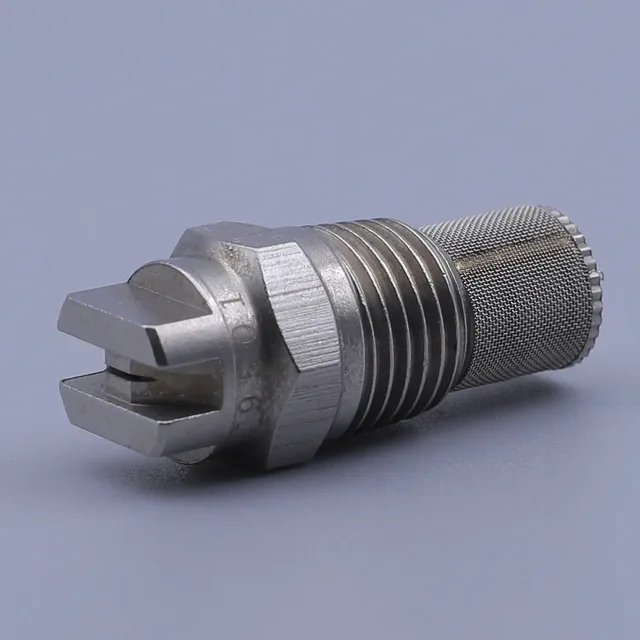
Whenever the water is recirculated or carries scale and fines. A strainer at the nozzle protects the orifice, at the cost of a filter that has to be cleaned on a schedule.
Can I mix patterns on one header?
Yes, and it is common. A washing bar may run flat fans across the width and a straight jet at each end to clear the edge. Keep the flows in mind so one pattern does not starve the other.
Apply This to Your Own Line
Send the duty, the pressure and a photograph of the existing head. We will confirm the pattern, the size and the material.