
Flat Fan Nozzle Range
Flat fan nozzles deliver a uniform, straight-line spray across a moving surface, which is required when the target is a conveyor belt, a strip of material, or a row of parts rather than a tank or duct.
Who It Is For
Buyers Who Specify This Range
- Maintenance engineers replacing nozzles on an existing rinsing or washing header
- Scrubber and gas cleaning system builders specifying nozzles by angle and flow rate
- Quarry and mineral processing plants washing sand, coal, and gravel
- OEM machine builders needing one nozzle family across multiple machine models
- Distributors stocking a range of nozzles for local industrial customers
Problems It Solves
What Goes Wrong Without It
- Dry bands between nozzles when the spray angle and spacing on a header do not align
- Excess spray that misses the target, wasting water and pump energy
- Corrosion in brass nozzles when used in chemical washing or scrubbing lines
- Inconsistent spray patterns due to mismatched thread types (BSPT vs NPT) on existing plant
- Production delays caused by waiting for a replacement spray bar to be sourced
Core Advantages
Why This Range Holds Up in Service
- One-piece body with no internal parts that can loosen or wear separately
- Tapered spray edges allowing adjacent fans to overlap without dry bands
- Fan and straight jet patterns available from the same body family
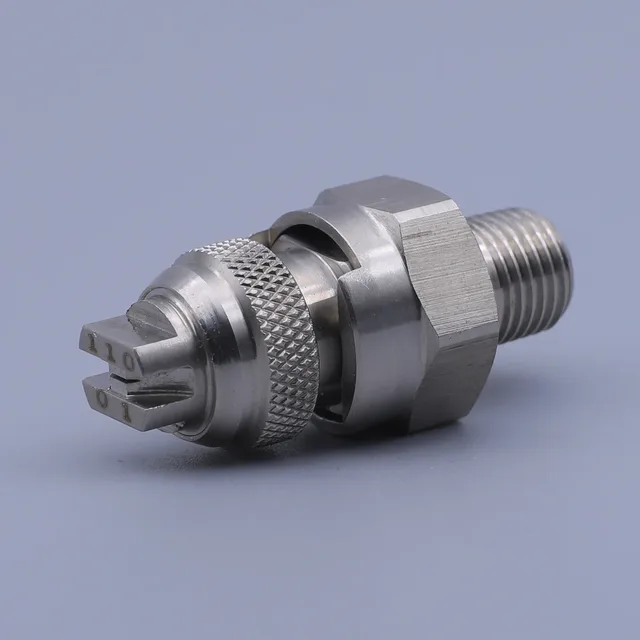
- Male and female connections so the nozzle can be installed either way on a bar
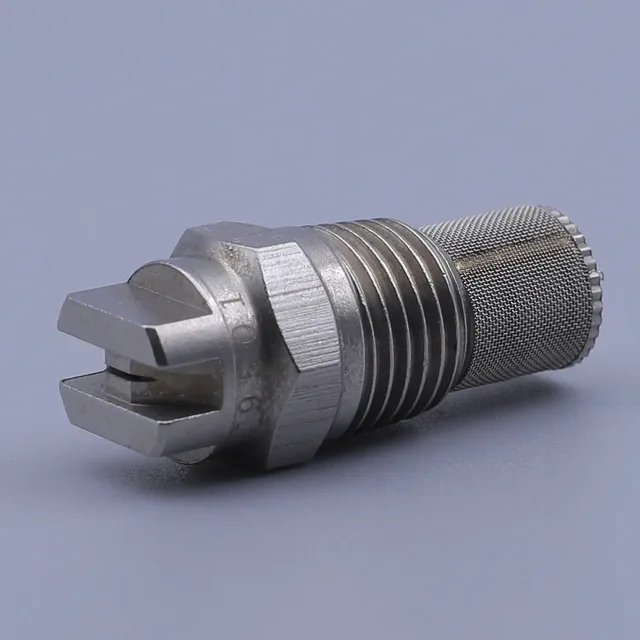
- Filtered versions available where the liquid contains scale or particulates
- Body materials include 303 Stainless Steel, Brass, 316 Stainless Steel, PP, PVC, PVDF, and PTFE to suit different process conditions
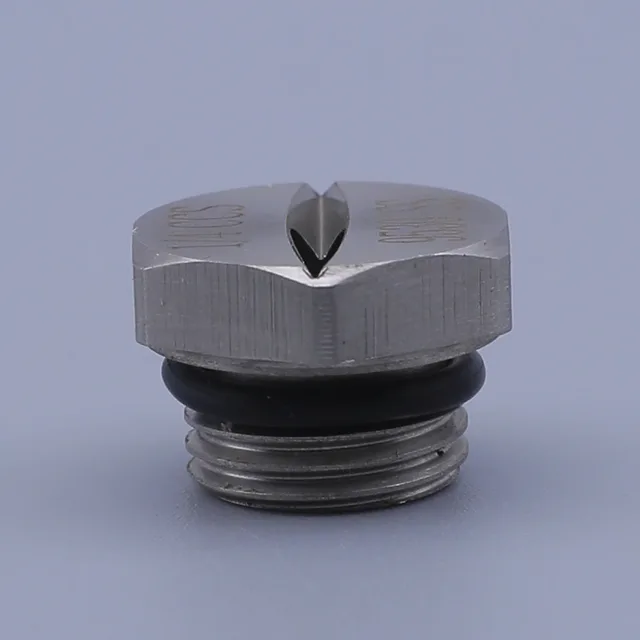
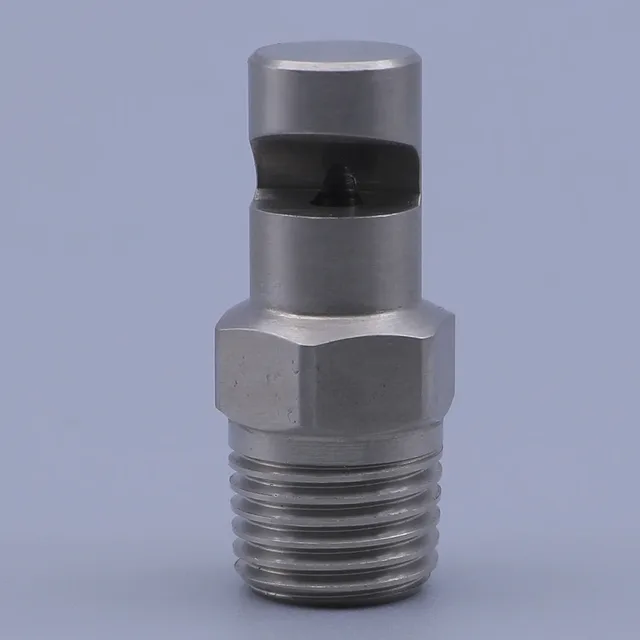
Stainless steel hex nozzle with V-shaped slit tip, black O-ring, and threaded base on a plain background
Application Scenarios
Where This Range Is Installed
- Rinse headers over conveyors where every part must exit with a consistent water film
- Gas washing and scrubbing systems requiring a full curtain of droplets across the duct width
- Cooling and quenching of hot strip or hot components using a fixed spray plane
- Sand, coal, and gravel washing bars operating at high flow with moderate pressure
- Parts washing cabinets where fixtures pass through a fixed spray zone
Industries
Plants That Run These Nozzles
Steel and Metal Treatment
In steel and metal treatment processes, consistent cooling, quenching, degreasing, and chemical washing require precise, durable spray patterns that m
Application detail
Parts Washing and Degreasing
In parts washing and degreasing lines, inconsistent spray patterns or clogged nozzles lead to incomplete cleaning, residue on components, and rework.
Application detail
Mining and Aggregate Washing
In mining and aggregate washing, water is used continuously to separate fine particles, remove dust, and cool hot materials. When nozzles fail, the pr
Application detail
How We Work
Ways Buyers Order From This Range
Nozzle Selection and Sizing
Turn a process description into a nozzle size, a pattern and a material, without needing a part number to start from.
How it works
Header Replacement and Retrofit
Put new heads into an existing spray bar without re-drilling it or stopping the line for longer than a planned outage.
How it works
Related Guides
Background Reading Before You Specify
Questions Buyers Ask
Flat Fan Nozzle Questions
How do I select the right spray angle for my application?
The spray angle depends on the target width and the distance from the nozzle to the surface. A wider angle covers the same width from a shorter standoff. Provide both dimensions and we will confirm the suitable angle and size code.
How much overlap should adjacent nozzles have on a header?
Overlap should be sufficient so the tapered edge of one fan meets the tapered edge of the next. Without this, dry stripes appear between nozzles, which can show as streaking on the washed surface.
Can I replace just the nozzles without changing the existing header?
Yes, typically. Provide the thread type (BSPT or NPT), size, and whether it is male or female, and we will match it so the header does not need to be re-drilled.
Which material is best for long-term use in a washing line?
316 Stainless Steel is recommended for harsh environments with chlorides or aggressive chemicals. 303 Stainless Steel is suitable for general washing duty. Plastics like PP, PVC, PVDF, and PTFE are used where chemical resistance is critical and metal is not suitable.
Can I get samples before placing a full order?
Yes. Trial samples can be sent free of charge and are available within 10 days, allowing you to test one position on the header before committing to a full set.
Get a Flat Fan Nozzle Sized for Your Line
Send the liquid, the pressure at the nozzle, the coverage you need and the thread on your header. Trial samples are free and can be ready within 10 days.