
comparison guide
Flat Fan vs Full Cone vs Hollow Cone Nozzles
Choose the Right Spray Pattern Based on the Process Target
The correct nozzle pattern depends on the shape and movement of the surface being treated. A flat fan is used when the target is a line or moving strip, such as a conveyor belt or hot metal sheet. A full cone covers a round area or volume, like a tank surface or a gas stream in a duct. A hollow cone is best when the liquid must contact a gas, such as in scrubbing or cooling, because it forms smaller droplets with greater surface area.
Flat Fan Nozzles for Linear and Moving Surfaces
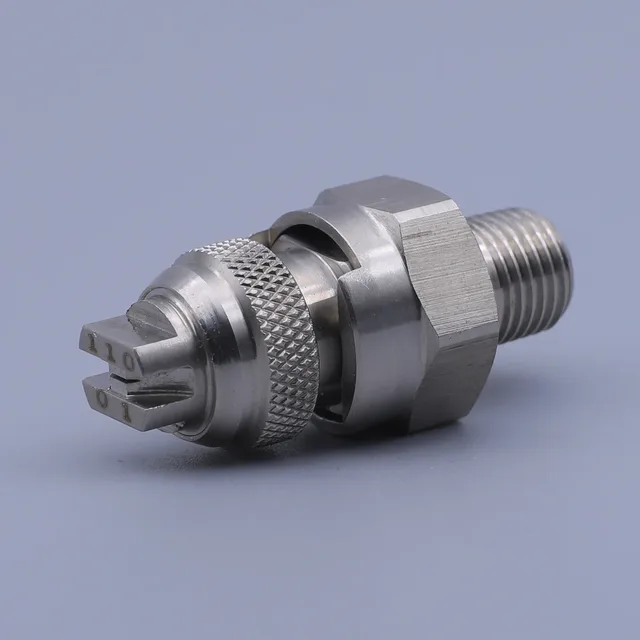
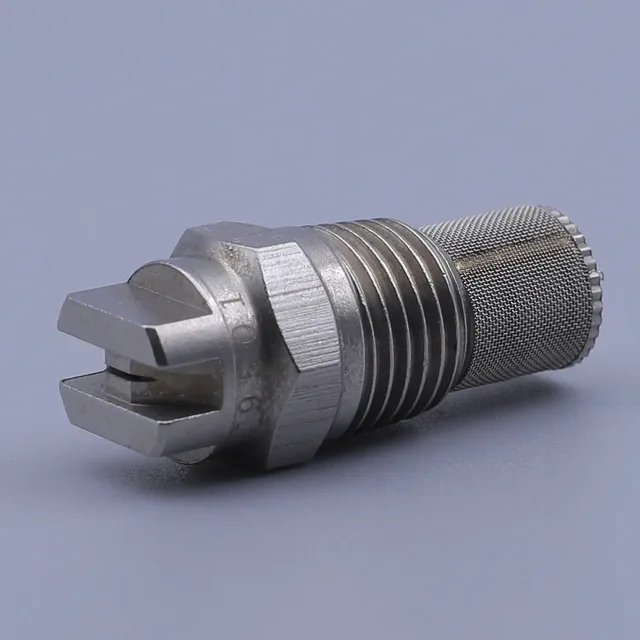
Flat fan nozzles deliver a straight, tapered spray ideal for rinsing, cooling, or washing along a continuous path. They are used in scrubbers, parts washing lines, and cooling systems where a consistent band of liquid must be applied across a moving surface. The spray angle can be adjusted from 0° to 120°, and the nozzle can be mounted with male or female threads in sizes from 1/8″ to 3″ BSPT or NPT.
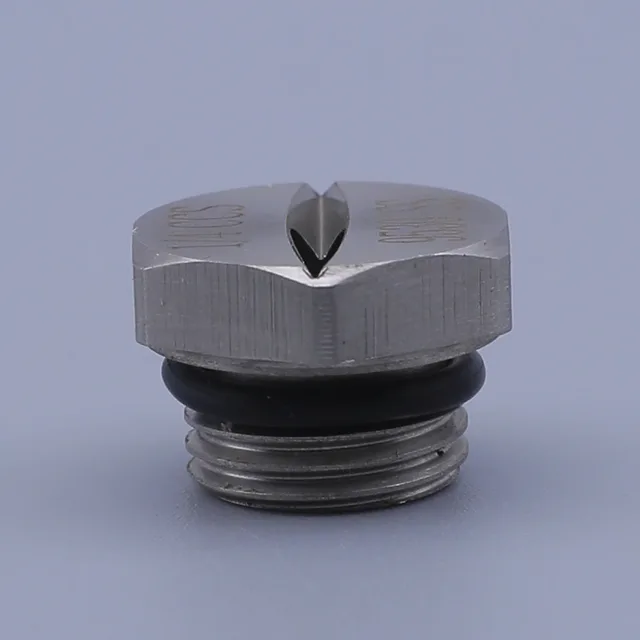
Stainless steel hex nozzle with V-shaped slit tip, black O-ring, and threaded base on a plain background
Full Cone Nozzles for Area and Volume Coverage
Full cone nozzles produce a circular spray pattern that fills a defined area or volume. They are used in tank filling, dust suppression, chemical dosing, and gas cooling. The internal vane design creates the cone, but this also reduces the free passage, making them more prone to blockage when handling dirty or recirculated liquids.
Hollow Cone Nozzles for Gas-Liquid Contact
Hollow cone nozzles form a ring-shaped spray with smaller droplets than full cone nozzles at the same pressure. This increases the surface area of the liquid, which improves heat transfer and particle capture in gas streams. They are commonly used in gas scrubbing, evaporative cooling, and humidification systems where efficient contact between liquid and gas is essential.
Match Material to Liquid and Duty
The body and orifice material must resist the liquid and operating temperature. Standard materials include 303 stainless steel, brass, 316 stainless steel, PP, PVC, PVDF, and PTFE. Choose 316 stainless steel for chloride-rich environments, brass for clean water, and plastics for acids or solvents. Confirm the material against the actual liquid and temperature in your process.
Verify Dimensions and Flow Before Ordering
Nozzle dimensions such as thread size, spray angle, and flow rate are confirmed on enquiry. The flow rate depends on pressure and orifice size, and the spray angle is measured at 3 bar. For exact performance, provide the operating pressure, required coverage, and liquid properties. The supplier can then match the correct model from the available range.
Test Before You Commit
Spray performance on a real line may differ from test bench results due to pressure drop along the header. Install one nozzle at a critical position, run a production cycle, and inspect the coverage. Trial samples are available free of charge and can be ready within 10 days, allowing you to verify fit and function without cost.
Products in This Guide
Parts Referred To Above
Keep Reading
Ranges Industries and Other Guides
Questions Buyers Ask
Questions on This Topic
What is the difference between flat fan, full cone, and hollow cone nozzles?
Flat fan nozzles create a linear spray ideal for moving surfaces like belts or sheets. Full cone nozzles cover a round area or volume, such as in tanks or ducts. Hollow cone nozzles form a ring with small droplets, making them best for gas-liquid contact in scrubbing or cooling.
Can I use a flat fan nozzle for cooling a stationary tank?
No. A flat fan nozzle is designed for linear or moving targets. For cooling a stationary tank, use a full cone or hollow cone nozzle to ensure even coverage across the surface.
What materials are available for flat fan nozzles?
Flat fan nozzles are available in 303 stainless steel, brass, 316 stainless steel, PP, PVC, PVDF, and PTFE. The choice depends on the liquid and temperature in your process.
How long does it take to get a trial sample?
Trial samples for flat fan nozzles can be ready within 10 days and are sent free of charge to verify performance before ordering.
What pressure is used to test the flow rate?
Flow rate is tested at 3 bar pressure. Actual flow will vary based on line pressure at the nozzle location.
Apply This to Your Own Line
Send the duty, the pressure and a photograph of the existing head. We will confirm the pattern, the size and the material.