
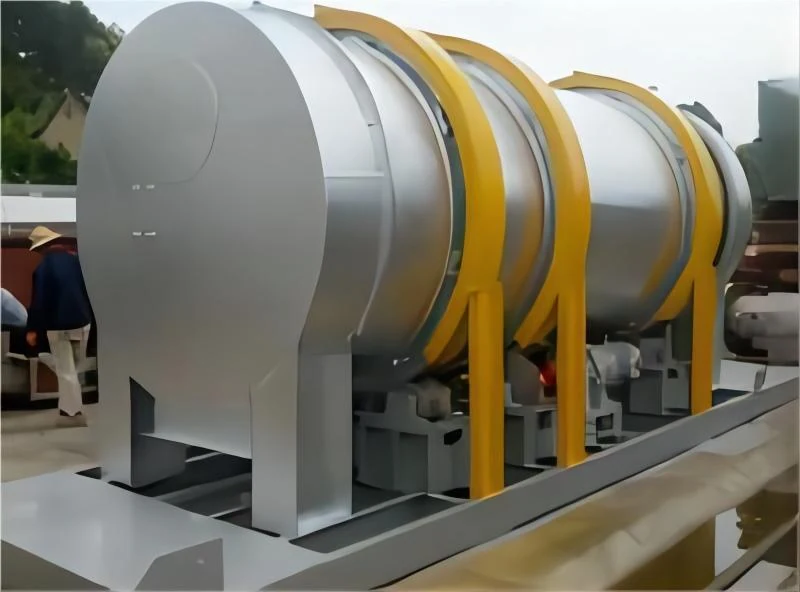
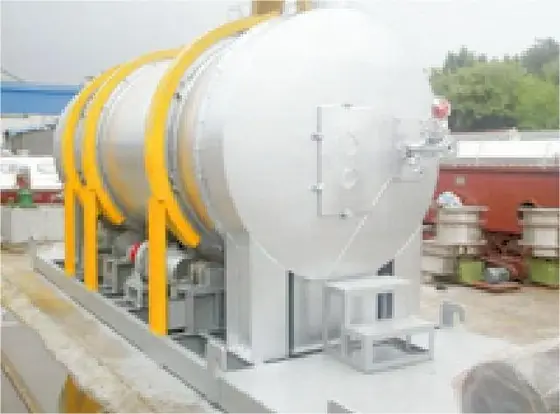
TDG Series Sulphur Drum Granulator
The TDG series granulates molten sulphur inside a rotating cylinder by building each granule up in layers rather than forming it in one step. Lifting plates inside the drum carry powder and granules from the bottom of the cylinder to the top and release them, producing a continuous curtain of falling material. Atomisin...
What This Machine Does
The TDG series granulates molten sulphur inside a rotating cylinder by building each granule up in layers rather than forming it in one step. Lifting plates inside the drum carry powder and granules from the bottom of the cylinder to the top and release them, producing a continuous curtain of falling material. Atomising shower nozzles on internal pipelines spray liquid material and cooling water into that curtain, so every particle passing through receives a thin coat of liquid that is immediately cooled and solidified onto it. Repeating that on every revolution grows the granule to size. The process suits melted materials that are hydrophilic and insoluble in water, that require condensation and solidification, and that have low liquid viscosity with a high melting or softening point, with sulphur as the typical example. Three sizes are offered, at 8 tonnes per hour, 15 tonnes per hour and 22 tonnes per hour, so a line can be matched to the output of a sulphur recovery unit rather than throttled by it.
Why Buyers Choose This Machine
- Layer-by-layer granule growth produces a dense granule rather than a shell that breaks down in handling
- Continuous material curtain from the lifting plates exposes every particle to the spray on each revolution
- Separate liquid and cooling water nozzle systems so coating and cooling are controlled independently
- Three capacities at 8 15 and 22 tonnes per hour to match the output of the upstream recovery unit
- Direct water cooling inside the drum removes heat where the granule is being formed
- Suits low-viscosity melts with a high melting or softening point that solidify quickly on contact
- Continuous rotary operation rather than a batch cycle
Where TDG Series Sulphur Drum Granulator Earns Its Place
Problems It Solves
- Crushed or block sulphur generates dust and fines across the whole handling chain
- Irregular lump product bridges in silos and does not flow in bulk handling equipment
- Weakly formed granules break down in transport and arrive at the customer as fines
- A granulation line sized below the recovery unit throttles the whole plant
- Manual handling of cast sulphur blocks is labour intensive and slow
- Cooling applied after forming rather than during it gives inconsistent solidification
Who It Is For
- Refineries and gas processing plants operating sulphur recovery units
- Chemical producers solidifying molten product for sale in bulk
- Fertiliser producers needing granular sulphur feedstock
- Engineering contractors specifying sulphur solidification and handling plant
- Plant operators scaling up from a smaller granulation route
Application Scenarios
- Granulating molten sulphur from a refinery or gas plant sulphur recovery unit
- Producing a free-flowing granular product for bulk shipping and storage
- Supplying granular sulphur to fertiliser and agrochemical blending operations
- Replacing block casting and crushing on an existing sulphur solidification route
- Granulating other hydrophilic melts that are insoluble in water and solidify on cooling
Technical Detail
Technical Features
- Rotary cylinder with internal lifting plates forming a continuous material curtain
- Internal melted liquid material pipeline with atomised shower nozzles
- Internal cooling water pipeline with its own atomised shower nozzles
- Layered granule build-up on each revolution of the drum
- Continuous rather than batch operation
- Capacities of 8 tonnes per hour 15 tonnes per hour and 22 tonnes per hour
- Suited to hydrophilic melts insoluble in water with low viscosity and high melting or softening point
Specifications
| Machine type | Rotary drum granulator for molten sulphur and similar melts |
|---|---|
| Models | TDG series, 8 T/h, 15 T/h and 22 T/h |
| Capacity | 8 Ton/H / 15 Ton/H / 22 Ton/H |
| Granulation principle | Material curtain from lifting plates sprayed with atomised liquid and cooling water inside a rotating cylinder |
| Internal equipment | Melted liquid material pipeline, cooling water pipeline, atomised shower nozzles, lifting plates |
| Typical applied material | Sulphur |
| Suitable materials | Hydrophilic melts insoluble in water, low liquid viscosity, high melting or softening point |
| Operation | Continuous rotary |
Figures above are taken from the product information we hold. Send us your application and we will confirm the exact specification for the model quoted.
How It Is Built and What Can Be Changed
Operations Performed
- Drum granulation
- Spray coating
- Cooling
- Solidification
Materials Handled
- Molten sulphur
- Cooling water
Quality Control
- Drum rotation drive and lifting plate arrangement checked during assembly
- Atomising nozzle spray pattern verified on both the liquid and cooling water pipelines
- Cylinder alignment and sealing checked before the unit is released
- Capacity confirmed against the 8 15 or 22 tonnes per hour rating during commissioning
- Granule size and density checked on product from the discharge during commissioning
Customisation Options
- Capacity selected at 8 15 or 22 tonnes per hour to match your recovery unit output
- Nozzle arrangement specified for your material viscosity and feed temperature
- Cooling water circuit sized for your available supply and water temperature
- Discharge and downstream conveying interface specified for your existing handling plant
- Supply voltage frequency and control interface configured for your site
How It Compares With the Alternatives
| XAIMC AS15000 sulphur pastillator | The pastillator forms a droplet on a steel belt and gives a very uniform pastille; the drum granulator builds a granule in layers and is offered at higher continuous capacities up to 22 tonnes per hour |
|---|---|
| Block casting and crushing | Crushing produces fines and dust and an irregular size distribution; the drum builds granules to size directly |
| A smaller 8 T/h unit | The 15 and 22 T/h models cost more and need more space, but a granulator sized below the recovery unit output throttles the plant |
| Cooling applied after forming | Here the cooling water is sprayed into the same material curtain as the liquid, so each layer solidifies as it is applied |
Running the Machine
Step 1
Bring the melted material to feed temperature and confirm viscosity is within the specified range
Step 2
Start the drum rotation and confirm the lifting plates are forming a full material curtain
Step 3
Start the cooling water circuit and confirm spray from all cooling nozzles
Step 4
Start the liquid material feed and check the spray pattern across the curtain
Step 5
Check granule size at the discharge and adjust the liquid to cooling water balance to hold it
Step 6
Run continuously, monitoring granule size and moisture at the discharge
Step 7
Shut down by stopping the liquid feed first, letting the drum clear, then stopping the cooling water and rotation
Other Machines in Chemical Machinery
Related Applications and Guides
Chemical and Sulphur Processing
Refineries and chemical plants that handle low melting point materials need them in a form that can be transported packaged and dosed. XAIMC supplies
Questions About TDG Series Sulphur Drum Granulator
What capacities are available?
The TDG series is offered at 8 tonnes per hour, 15 tonnes per hour and 22 tonnes per hour. Tell us your sulphur recovery unit output and we will recommend the size.
How does drum granulation work?
Lifting plates inside the rotating cylinder carry material from the bottom to the top and drop it, forming a continuous curtain. Atomised liquid material and cooling water are sprayed into that curtain, so each granule grows a solidified layer on every revolution.
Can it granulate materials other than sulphur?
It suits melted materials that are hydrophilic and insoluble in water, with low liquid viscosity and a high melting or softening point. Send us your product data and we will confirm.
What granule size does it produce?
Granule size is controlled by the balance between liquid feed and cooling in the drum. Tell us your target size distribution and we will confirm during the technical review.
What utilities does it need?
A cooling water supply and electrical supply, plus your molten material feed. Send us your water temperature and availability and your supply voltage and frequency.
How does it compare with a pastillator?
The AS15000 pastillator forms pastilles on a steel belt and gives a very uniform shape; the TDG drum granulator builds granules in layers and covers higher continuous capacities. Tell us your throughput and product requirement and we will advise.
What are your trade and payment terms?
FOB CFR and CIF are available. Payment is 30 percent by T/T on order and 70 percent before shipment, or an irrevocable L/C at sight.
Request a Quote on the TDG Series Sulphur Drum Granulator
Send us the work you need it to do, the voltage on your site and the port you ship to. We will come back with the model, the tooling and the lead time.