
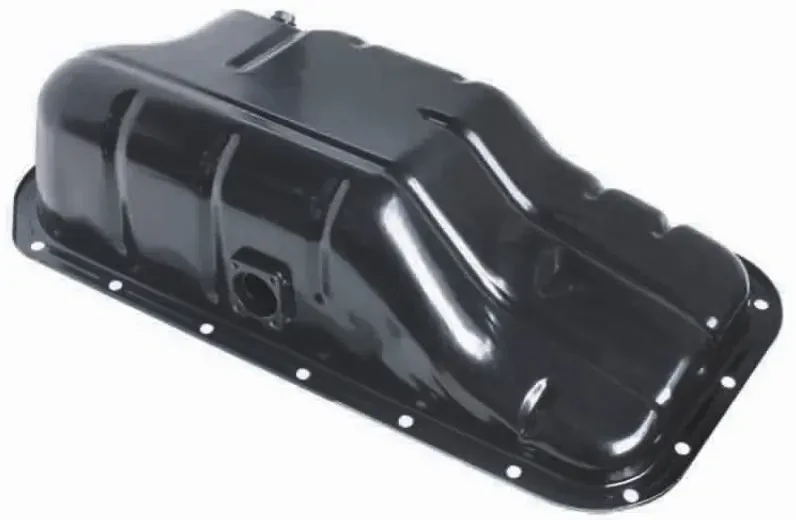
An oil level sensor boss is a machined or formed opening in the side of the pan that carries an electronic level sensor. Two pans with nearly identical numbers are not interchangeable if one has this boss and the other does not — fitting the wrong one leaves either an unsupported sensor or an open hole.
Why the Variant Exists
Electronic oil level monitoring was introduced progressively, by market and by model year, on engines that were otherwise unchanged. Rather than redesign the engine, manufacturers released a second pan carrying the sensor boss and gave it a new suffix. The rest of the pan — profile, flange, drain position — often stayed the same.
That is exactly why it catches people out. The two pans sit next to each other in a catalogue, photograph almost identically, and differ by one feature on a face that does not appear in the photograph.
What the RUIFAN Archive Records
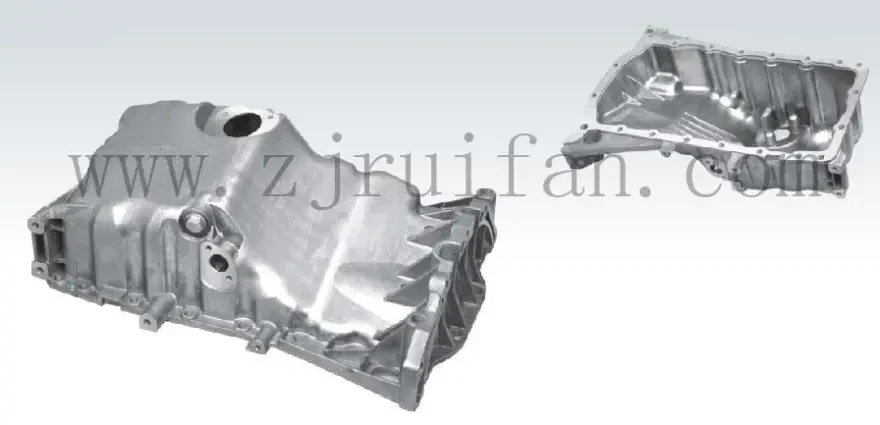
Two catalogue records carry explicit notes on this. The record for OIL PAN 038 103 601NA is noted as aluminum without oil level sensor hole. The record for OIL PAN 038 103 603N is noted as with oil level sensor hole and with AEG engine. Both notes are reproduced on the part pages exactly as the original database stored them.
Where the archive recorded no note, none is shown. An absent note means the original database did not store one, not that the part has no sensor boss.
How to Check Before Ordering
- Look at the side wall of the pan on the vehicle, usually on the same side as the oil filter
- If a sensor is fitted, note the connector type and the boss orientation
- Check the engine code — the archive note for 038 103 603N ties the variant to the AEG engine
- Ask for a photograph of the sensor face, not just the underside, before the order is confirmed
If You Get the Wrong One
There is no good field fix. Blanking a sensor hole leaves a potential leak path in the oil-wetted wall and disables a monitoring function the engine management expects. Drilling a boss into a pan that does not have one is worse. The correct answer is to return it and order the right variant.
More From the Knowledge Centre
What Can Go Wrong With My Oil Pan
Impact damage, worn gaskets and contamination — the three failure modes the original RUIFAN guide identified, with sourcing notes added.
How Will I Know I Have a Bad Oil Pan
How a failing oil pan announces itself, why a dent is usually not an emergency, and when replacement is the right call.
Do They Make Different Oil Pans
Why engine code, sensor-hole configuration and drain-plug position decide fitment, and how to use an OE number properly.
About This Guide
Where does the information in this guide come from?
Content marked as published on the original RUIFAN website is reproduced from the archived site with the date it carried. Everything else is general engineering background written for this site. Company facts, capacities and certifications are only stated where RUIFAN recorded them.
Can RUIFAN help me identify a part I cannot name?
Yes. Send the number on the old part, the vehicle and engine code, and photographs of the flange face and drain boss side. We check it against the 136 catalogue records and tell you if it is there.
Do you publish the catalogue data behind these guides?
Yes. Every reference has its own page carrying the OE number, alternate numbers, notes and application table the original database stored for it.
What if the part I need was never in the catalogue?
The original RUIFAN site stated the factory develops oil pans and other aluminum castings from customer-supplied samples or drawings.
Put This Into an Enquiry
Send the reference, the vehicle and the quantity. We will confirm against the catalogue before quoting.