
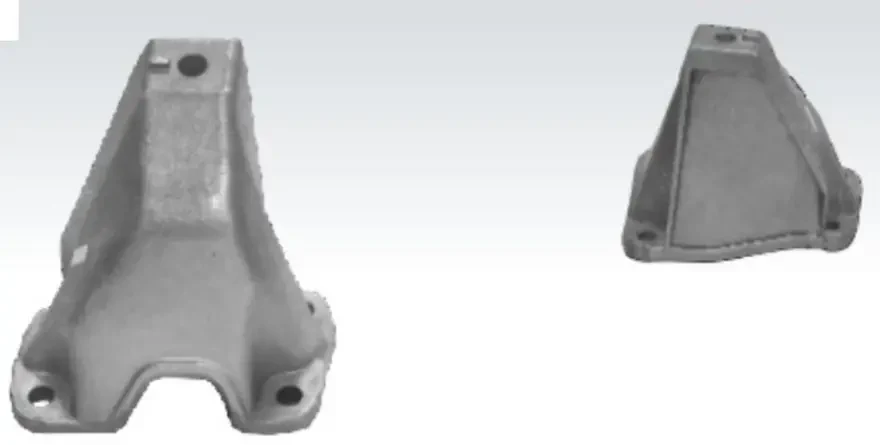
Die casting forces molten aluminum into a steel die under pressure, giving thin walls, tight tolerances and a good surface. Sand casting pours into an expendable mould and suits heavier sections and lower volumes. Gravity casting pours into a permanent metal mould without pressure and sits between the two. All three are listed in the RUIFAN process sheet.
Die Casting
Metal is injected into a hardened steel die at high pressure and solidifies in seconds. The result is dimensionally consistent, has a fine surface finish straight from the die, and can hold thin walls that other methods cannot. The cost sits in the die.
- Best for: high volume, thin wall sections, parts needing minimal machining
- Constraint: entrapped gas limits what can be heat treated or welded
- Tooling: highest cost, longest lead time, longest life
Sand Casting
A pattern forms a cavity in bonded sand, metal is poured under gravity, and the mould is broken to release the part. Because the mould is expendable, geometry that would lock in a permanent die is possible, and thick sections cool slowly enough to feed properly.
- Best for: low to medium volume, heavy sections, large parts, prototypes and long-tail references
- Constraint: rougher surface, wider tolerances, more machining stock needed
- Tooling: lowest cost, fastest to modify
Gravity Casting
Metal is poured into a permanent metal mould under gravity rather than pressure. Slower filling and directional solidification give a denser, sounder casting than die casting in thick sections, with better surface and tolerance than sand.
- Best for: medium volume, sections too thick for die casting, parts that will be heat treated
- Constraint: slower cycle than die casting
- Tooling: mid cost, mid life
| Die | Gravity | Sand | |
|---|---|---|---|
| Typical volume | High | Medium | Low to medium |
| Wall section | Thin | Medium to thick | Thick |
| Surface finish | Best | Good | Rough |
| Tolerance | Tightest | Good | Widest |
| Tooling cost | Highest | Medium | Lowest |
| Suited to long-tail parts | No | Sometimes | Yes |
Why This Matters to a Buyer
The method decides the economics of your programme. A long-tail reference selling fifty pieces a year should not be quoted against die tooling — the tooling will never amortise. A high-volume line quoted as sand castings will cost more in machining than it saves in tooling. Asking which method a quote assumes is a fair question and the answer should be specific.
More From the Knowledge Centre
Oil Pan Sealing Surface and Gasket Basics
Flange flatness, gasket choice and torque sequence — why most replacement pans that leak were fitted, not made, badly.
Sourcing Replacement Oil Pans for Distribution
A buyer's checklist for adding an oil pan programme: number coverage, identification evidence, packing, and the questions to ask before the first container.
What Is an Oil Pan
What an oil pan is, where it sits on the engine and what it does — the original RUIFAN explainer, kept as it was published in 2009.
About This Guide
Where does the information in this guide come from?
Content marked as published on the original RUIFAN website is reproduced from the archived site with the date it carried. Everything else is general engineering background written for this site. Company facts, capacities and certifications are only stated where RUIFAN recorded them.
Can RUIFAN help me identify a part I cannot name?
Yes. Send the number on the old part, the vehicle and engine code, and photographs of the flange face and drain boss side. We check it against the 136 catalogue records and tell you if it is there.
Do you publish the catalogue data behind these guides?
Yes. Every reference has its own page carrying the OE number, alternate numbers, notes and application table the original database stored for it.
What if the part I need was never in the catalogue?
The original RUIFAN site stated the factory develops oil pans and other aluminum castings from customer-supplied samples or drawings.
Put This Into an Enquiry
Send the reference, the vehicle and the quantity. We will confirm against the catalogue before quoting.