
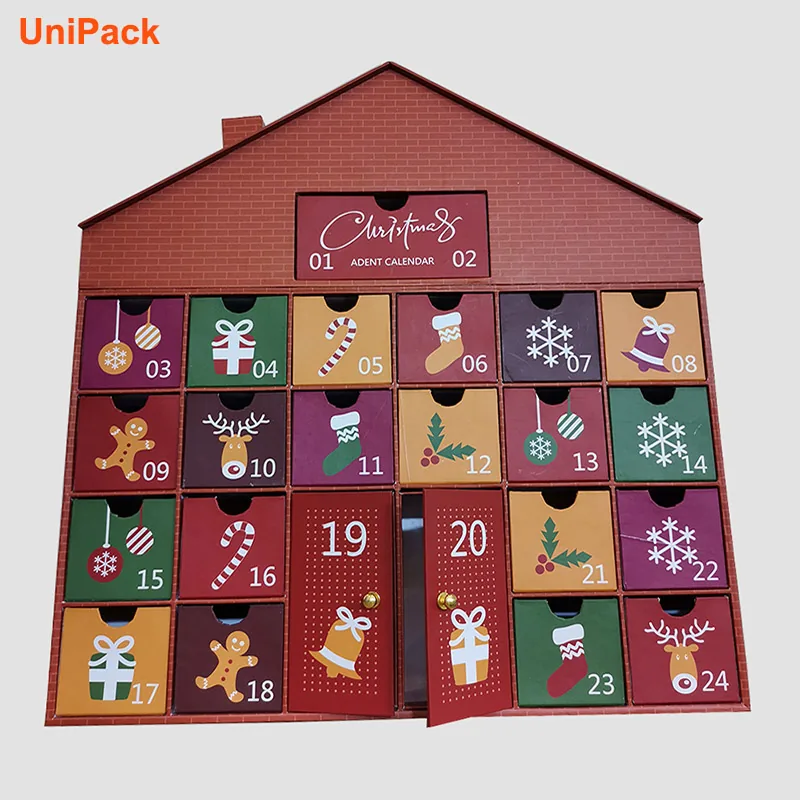
Five Ways to Ready Your Christmas Packaging
Seasonal packaging rarely needs a new structure. The fastest gains come from layers added on top of what you already run, which keeps both cost and lead time under control.
1. Labels and stickers
A printed label transforms the look of a pack without changing the pack itself. Seasonal greetings, a festive illustration or a simple snowflake motif are enough to shift the whole impression.
Because labels are applied late, they let you keep running standard stock boxes and mailers all year and switch to a seasonal look only for the weeks you need it.
Check the adhesive against the surface. Matt-laminated and uncoated boards hold labels differently, and a label that lifts at the corner spoils the effect it was bought to create.
2. Wrapping paper and tissue
Wrap around a product inside a mailer or box adds a moment of anticipation before the item appears. Printed tissue is the cheapest version of this and works in almost any box.
One or two colours on a light stock keeps cost sensible at volume. Full-coverage print on heavy paper rarely repays the extra spend when the paper is opened and discarded.
Avoid metallic and glitter finishes if you want the wrap to remain recyclable. Plain printed paper keeps the message simple.
3. Hangtags and thank-you cards
Swapping a standard hangtag for a seasonal version is one of the smallest changes available, and the tooling is often the same die with new artwork.
A short thank-you card inside the pack acknowledges the customer at the point they open the parcel. It costs very little per unit and is frequently photographed and shared.
Keep the card stock heavy enough to feel deliberate. A flimsy card reads as a leaflet, which is the opposite of the intended effect.
4. Inserts and structure
A die-cut card or moulded pulp insert holds items in place and turns opening into a sequence rather than a rummage. It also reduces movement damage during the busiest shipping weeks of the year.
Mailer boxes, folding cartons, paper boxes and kraft boxes all accept inserts, so the choice can be made on cost and print quality rather than structure alone.
If you ship fragile gifts, specify the insert and the outer shipper together. The two only work as a pair.
5. Ribbon, closures and finishing
Ribbon, a magnetic closure or a simple belly band all signal that the item was prepared rather than packed. These are also the easiest details to add late in a programme.
Match the ribbon colour to the print rather than choosing from a generic seasonal palette, or the pack will look assembled from unrelated parts.
Confirm that hand-finishing labour is included in your quotation. Ribbon tying and hand assembly are real costs at volume and should not surface as a surprise.
Timing the order
Work backwards from the date stock must be in store or in the warehouse, and allow for artwork approval, a physical sample, production and freight. Christmas programmes are typically committed several months out.
Printed paper packaging generally starts at around 3,000 pieces per design, so seasonal variants are easier to justify as labels, tissue and tags rather than as entirely new box runs.
Order a small quantity of each seasonal element early and pack a test parcel. It is the quickest way to see whether the pieces look like one idea or five separate ones.
Takeaways
- Labels, tissue and tags give a seasonal look without new structural tooling.
- Keep seasonal print to one or two colours on light stock to control cost.
- Specify inserts and outer shippers together for fragile gifts.
- Confirm hand-finishing labour is quoted for ribbon and assembly.
- Commit Christmas programmes months ahead of the in-store date.
Ranges Mentioned in This Article
Questions Readers Ask
What is the cheapest way to look festive?
Printed labels and tissue. Both are applied to packaging you already run, need no new structural tooling, and can be limited to the exact number of weeks the seasonal look is required.
Is glitter finishing worth it?
It looks striking but it blocks recycling for the paper it sits on. If your customers ask about recyclability, a small foil accent or a spot varnish gives shine with fewer downsides.
When should seasonal artwork be final?
Early enough to allow sample approval, production and sea freight before the in-store date. Late artwork is the most common single reason a seasonal packaging programme misses its selling window entirely.
Other Articles
Turn This Into a Quotation
Send your dimensions and quantity and we will apply what is in this article to your own specification.