
Tungsten Carbide Nozzles
Nozzles fail where pressure, sand and slurry meet a small orifice. Carbide holds the orifice size far longer than steel, which is why our nozzles go into drill bits, blast rooms and spray systems that would otherwise be re-fitted every few weeks.
Product Overview
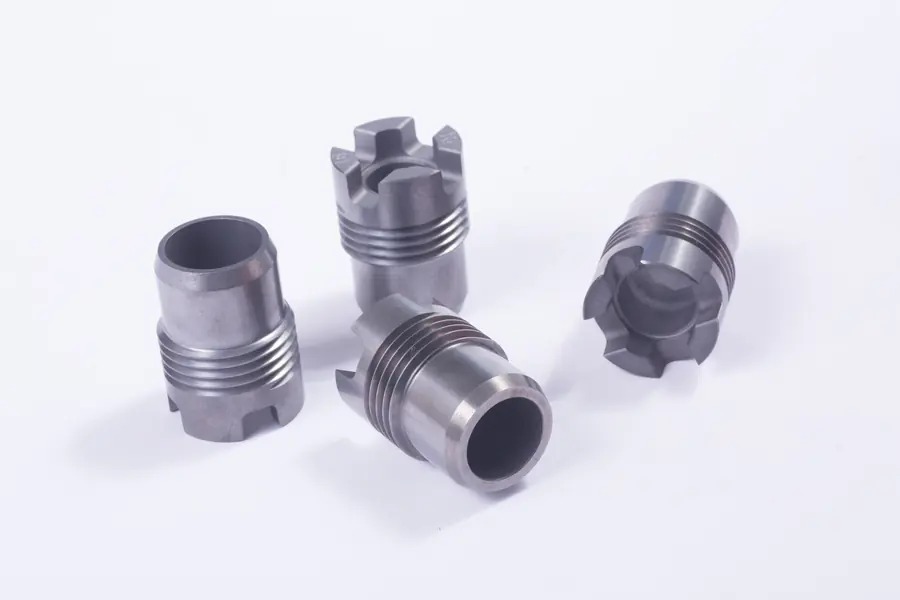
Cemented carbide nozzles are used mainly on PDC drill bits and cone roller bits, where they flush, cool and lubricate the bit tips and clear stone chips from the bottom of the well with drilling fluid. They work under high pressure, vibration, sand and slurry impact during oil and natural gas prospecting, and they have to keep their bore size while doing it.
Alongside downhole nozzles we supply abrasive blast nozzles, threaded nozzles and standard nozzles. The range covers spraying, atomizing, mixing, focusing and cleaning duties. Carbide is also used as kiln furniture in the manufacture of high tension ceramic insulators, construction ceramics, sanitary ware and domestic ceramics, and recrystallized carbide refractory is used in metallurgy and the chemical industries.
Key Benefits
Bore Size Holds
Good wear and impact resistance keeps the orifice within size, so flow rate and jet pattern stay predictable.
Made To Your Thread
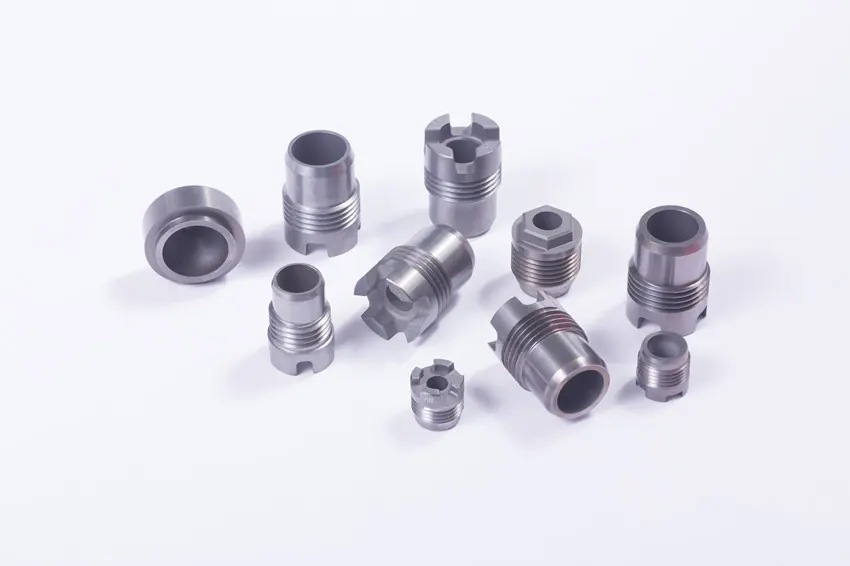
Cross groove, plum blossom, outer and internal hexagonal, and Y-type three groove threads are all part of the standard range.
Solid Or Brazed Construction
The thread can be made from solid cemented carbide, or produced with brazing and setting technology where that suits the assembly better.
Application Scenarios
Where our nozzles are working today.
PDC And Roller Cone Bits
Flushing, cooling and lubricating bit tips and clearing cuttings at the bottom of the hole.
Abrasive Blast Rooms
Blast nozzles with aluminium and POM jackets for demanding cleaning environments.
Press Fracturing
Press fracturing nozzles for the pressures seen in well stimulation work.
Ceramic Kilns
Burner nozzles and kiln furniture for high tension insulators, construction ceramics, sanitary ware and domestic ceramics.
Metallurgy And Chemicals
Recrystallized carbide refractory parts used for their wear and heat behaviour.
Spray And Atomizing
Cost effective solutions for spraying, atomizing, mixing, focusing and cleaning.
Who It Is For
- Drill bit manufacturers fitting nozzles into PDC and roller cone bodies.
- Oilfield service companies that re-nozzle bits between runs.
- Surface preparation and blast equipment builders.
- Ceramic and refractory producers running burner systems.
Problems It Solves
- Steel or ceramic nozzles that wash out and let the jet velocity collapse mid run.
- Blast nozzles that open up quickly and push air consumption past what the compressor can hold.
- Nozzle jackets that crack when the nozzle is dropped or knocked on site.
- Long waits for an odd thread form that no distributor keeps in stock.
Technical Features
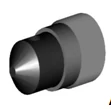
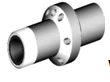
- Standard nozzle styles: shrouded, non-shrouded, flangeless, grooved and extended in tapered, straight and centre jet forms.
- Thread forms: cross groove, plum blossom, outer hexagonal, internal hexagonal and Y-type three groove.
- Cone roller bit nozzles and press fracturing nozzles.
- Venturi blast nozzles for higher production than a straight bore.
- Straight bore blast nozzles for small blast patterns with little overblast.
- Angle nozzles with single, double, triple or quadruple outlets.
- Wet blast nozzles in several sizes.
- Aluminium and POM jackets on abrasive blast nozzles.
Specifications
| Family | Styles | Notes |
|---|---|---|
| Downhole standard | Shrouded, non-shrouded, flangeless, grooved, extended (tapered, straight, centre jet) | Produced to customer request after several years of testing and manufacturing |
| Downhole threaded | Cross groove, plum blossom, outer hexagonal, internal hexagonal, Y-type three groove | Thread in solid carbide, or brazed and set |
| Cone roller bit | Cone roller bit nozzles | For roller cone bit bodies |
| Press fracturing | Press fracturing nozzles | For well stimulation duty |
| Abrasive blast | Venturi, straight bore, angle, wet blast | Aluminium and POM jackets available |
Bore sizes, lengths and thread dimensions are quoted from your drawing or from a sample. There are many sizes and types in production, so send the bit or gun you are fitting and we will recommend, design, manufacture and supply to your requirement.
Materials
Every part is quoted against a grade from the GWM chart. Cobalt and nickel binder grades are both available.
Nozzle grades are chosen for wear and impact together. Ultra fine grain grades such as GW02U and GW03U are the ones we point to first for nozzles and wear-resistant blocks, because the fine structure holds an edge on the orifice. Where the nozzle also has to take knocks, a grade with more binder is the safer choice.
Recommended starting grades for this product: GW02UGW03UGW05UYG6YG8
Manufacturing Process
- Step 01
Powder Blending
WC and binder powders are wet milled in ball mills to the grain size the grade calls for.
- Step 02
Forming
Extrusion, two-way pressing or oil pressing, depending on the section and the length of the part.
- Step 03
Sintering
Vacuum sintering and pressure sintering furnaces. Every order is sinter-HIPped.
- Step 04
Finishing
Blank CNC machining, centreless grinding and cryogenic treatment to the drawing.
Quality Control
- Incoming powder checked before milling so grain size and binder content match the grade.
- Density and hardness measured on sintered parts against the published grade values.
- Metallographic microscope used to check porosity and structure after sintering.
- Dimensions and tolerances verified against the drawing before packing.
Certifications
Chengdu Golden Wolfran Carbide is an ISO certificated enterprise. Copies of the current certificates are sent with the quotation on request, so ask us for the version that applies to your order.
Customization Options
We manufacture small and large scale carbide products to your drawing, supplied either as sintered or precision ground.
Recommend, Design, Manufacture
Send the drawing or the requirement and we will recommend the type, design it, make it and supply it.
Thread And Seat To Sample
Send a used nozzle and we will match the thread, the seat and the bore.
Jacket Material
Abrasive blast nozzles are available with aluminium or POM jackets.
Comparison With Other Products
| Bore style | Blast pattern | Best for |
|---|---|---|
| Long venturi | Wide, high velocity | Better production ability than a straight bore, so it suits large area work |
| Straight bore | Small, tight | Cleaning small areas with little overblast |
| Angle | Directed, one to four outlets | Reaching into corners, tubes and awkward geometry |
| Wet blast | Wet stream | Dust suppressed cleaning, available in several sizes |
Use Guide
Sizing A Downhole Nozzle
Downhole nozzles are chosen from the flow the bit needs, not from the bit diameter. Fix the total flow area first, then decide how many nozzles carry it and what bore each one needs. Tell us the bit type, the pocket size and the flow area you are aiming at and we will work back to a bore.
Fitting And Retaining
A threaded nozzle only performs if it seats square. Clean the pocket, check the seat face for wash, and renew the seal every time the nozzle is changed. Where the thread is brazed and set rather than solid carbide, avoid over-torquing, because the braze joint is the weak point, not the carbide.
When To Retire A Blast Nozzle
Measure the bore with a pin gauge at every shift change. Once the bore has grown by about 1.6 mm over the original size the air consumption has risen enough that the nozzle costs more in compressor time than a replacement costs. Carbide gets you far more hours to that point than an unlined nozzle.
Handling
Jacketed blast nozzles are meant to be dropped occasionally, but a bare carbide insert is not. Keep spare inserts in their packaging until they go into a jacket.
Frequently Asked Questions
What are your carbide nozzles used for?
Mainly on PDC drill bits and cone roller bits, for flushing, cooling and lubricating the bit tips and cleaning stone chips from the well bottom with drilling fluid. We also supply abrasive blast nozzles, threaded and standard nozzles for spraying, atomizing, mixing, focusing and cleaning.
Which thread forms can you make?
Cross groove, plum blossom type, outer hexagonal, internal hexagonal and Y-type with three grooves, as well as cone roller bit nozzles and press fracturing nozzles.
Is the thread solid carbide?
It can be. The thread can be made of solid cemented tungsten carbide, or it can be produced with brazing and setting technology, depending on the design.
Do you make abrasive blast nozzles with jackets?
Yes. We supply tungsten carbide nozzles with aluminium and POM jackets.
Can you work from a sample instead of a drawing?
Yes. Send a used nozzle and the bit or gun it fits, and we will recommend, design, manufacture and supply to that requirement.
Which nozzle style gives the most production in a blast room?
Long venturi style nozzles have a better production ability than straight bore nozzles. Straight bore nozzles are the better choice when you are cleaning small areas and want little overblast.
Related Products
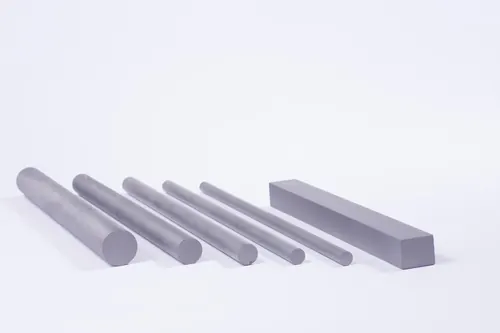
Tungsten Carbide Rods
Rotary tool blanks, solid and coolant channel
View product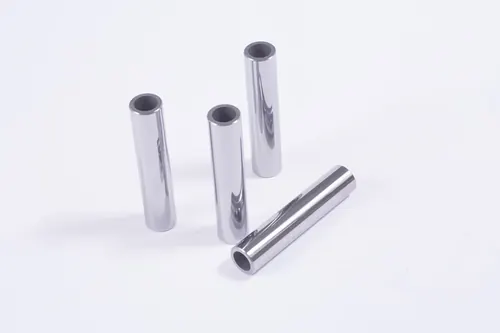
Tungsten Carbide Choke Beans
Flow control liners, seats, points, cages
View product
Tungsten Carbide Gun Drills
Deep hole drill blanks 10.5 to 35 mm
View product
Tungsten Carbide Inserts
Drill bit inserts and PDC substrates
View productRelated Applications
Related Downloads
Send Us The Bit Or The Blast Gun And We Will Match The Nozzle
Drawing, sample or just the bore size and thread. We will recommend a type, quote it and make it. Quotations go out in 24 hours or less.