
Carbide Grade Selection Guide
Sixteen grades, three numbers each. Once you know what the numbers trade against each other, picking a grade takes about two minutes.
Sixteen grades, three numbers each. Once you know what the numbers trade against each other, picking a grade takes about two minutes.
Start With How The Part Fails
There is no best carbide grade, only the grade that suits the way your part is being destroyed. Three failure modes cover almost everything we are asked about.
- Abrasion. The part is slowly losing material and getting smaller. Move towards higher hardness and lower binder.
- Breakage. The part is chipping, cracking or snapping. Move towards higher binder and higher transverse rupture strength.
- Corrosion or magnetic constraints. Move to a nickel bonded grade.
If a part is both wearing and chipping, fix the chipping first. A part that survives long enough to wear out is a part you can then make harder.
What The Three Numbers Mean
Every row of the GWM grade chart carries hardness in HRA, transverse rupture strength in MPa and density in grams per cubic centimetre. They are not independent.
- HRA rises as binder content falls. GW02U with one percent cobalt reaches 95 HRA. YG20 with twenty percent cobalt sits at 86 HRA.
- MPa moves the other way. GW02U reaches 2000 MPa, while GW40U and GW45U reach 4200 MPa.
- Density falls as binder rises, from 15.2 on GW02U to 13.4 on YG20, because the binder is lighter than tungsten carbide. It is also one of the checks we run after sintering.
Grain Size Is The Other Axis
The chart splits into ultra fine grain, sub-fine grain, fine grain and medium grain grades. For the same binder content, a finer grain gives higher hardness and a better edge. That is why the ultra fine GW02U, GW03U and GW05U are the grades we point at for nozzles, wear-resistant blocks, water cutters, reamers and wood and bamboo cutters, where the edge or the orifice has to hold.
A Short Route Through The Chart
| If you need | Look at | Why |
|---|---|---|
| Maximum wear resistance on a nozzle or wear block | GW02U, GW03U | Ultra fine grain, 94.5 to 95 HRA |
| PCB bits, reamers, woodworking cutters | GW05U, GW10U | Ultra fine and sub-fine, good wear resistance with usable toughness |
| Drill bits, milling, boring and carving cutters | GW20U, GW30U | Sub-fine grain; GW30U is also an ideal body for coated tools |
| End mills for hard steels, stainless and titanium | GW40U, GW45U | 4200 MPa, aimed at die steel below 60 HRC |
| Solid carbide drill bits and rotary burrs | YG6X, YG10X | Fine grain with good generality; YG10X is also a coated tool substrate |
| Drawing dies, mould cores, stamping parts | YG15, YG20 | Medium grain, high toughness, 3500 to 3600 MPa |
| Wear parts, tubes, bars, rotary burrs | YG6, YG8 | Medium grain, balanced hardness and toughness |
| Non-magnetic or corrosive service | YN6, YN10 | Nickel binder, non-magnetic, good corrosion resistance |
Binder Choice: Cobalt Or Nickel
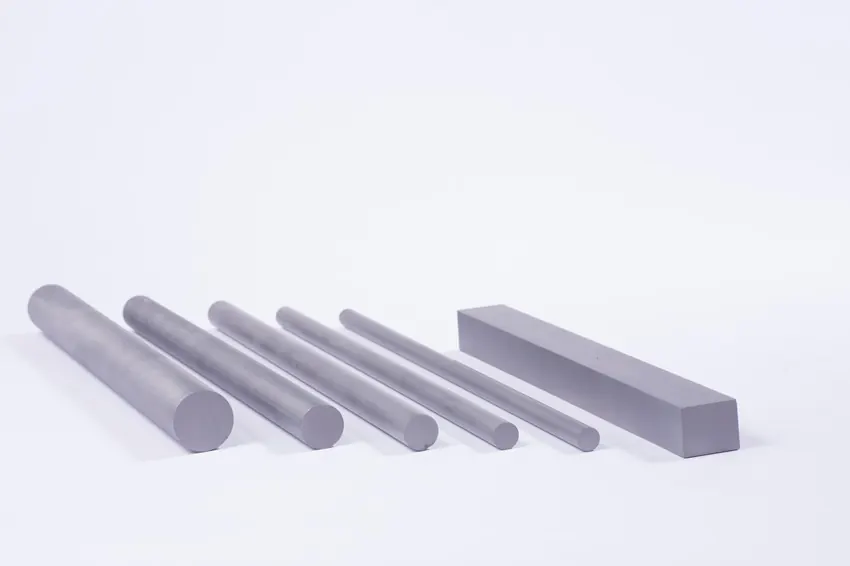
We offer a full range of sintered carbide grades and grain sizes in both cobalt and nickel binders. Cobalt is the default and covers the majority of cutting and drilling work. Nickel is the answer when the part has to work in a non-magnetic environment or when corrosion is part of the problem, which is why YN6 and YN10 exist as a pair at 6 and 10 percent nickel.
Changing Grade Without Changing Tooling
One practical point that saves money: the same press tooling and the same geometry can usually be pressed in a different grade. If a run is failing by breakage rather than wear, moving up the binder scale is far cheaper than redesigning the part. Send us the current grade and the failure and we will suggest the next step.
Frequently Asked Questions
Which grade is hardest?
GW02U at 95 HRA. It also has the lowest transverse rupture strength on the chart at 2000 MPa, so it belongs on parts that wear rather than parts that take impact.
Which grade is toughest?
GW40U and GW45U reach 4200 MPa, the highest transverse rupture strength on the chart. Among the medium grain grades, YG20 reaches 3600 MPa with much lower hardness.
Which grades are recommended for coated tools?
GW30U and YG10X are both described as an ideal body for making coated tools.
What if I do not know which grade to ask for?
Describe the duty and what is failing now. Technical help with grade and preform design is part of the service and costs nothing at the quotation stage.
Keep Reading
Still Not Sure
Send the drawing or describe the duty. Technical help with grade and preform design comes with the quotation, and quotes go out in 24 hours or less.