
Coolant Hole Rod Design Guide
The coolant channel is decided before the flute, not after. Get the order wrong and the hole breaks into the flute on the grinder.
The coolant channel is decided before the flute, not after. Get the order wrong and the hole breaks into the flute on the grinder.
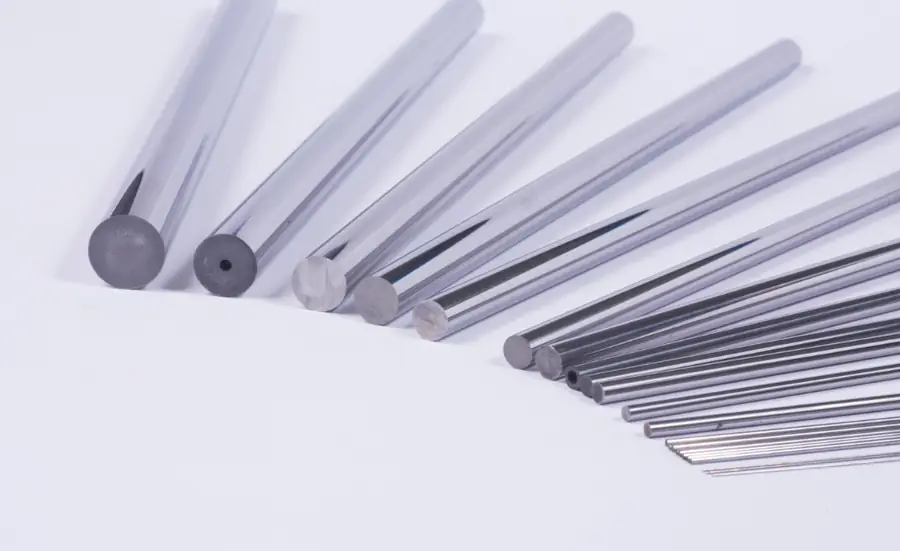
Three Channel Configurations
GWM rotary tool blanks with coolant channels are manufactured in single, twin, straight and helix hole options. In practice that gives three families to choose between.
- Central coolant hole. One axial channel, rods from 3 to 30 mm, hole from 0.5 to 3.0 mm. This is the configuration for single flute and gun style tools and for deep hole reamers.
- Two straight coolant holes. Two parallel channels on a bore circle, rods from 6 to 26 mm. This is the standard for a two flute solid carbide drill.
- Two helical coolant holes. Two channels twisted at 30 degrees so they follow the flute. Made to order.
Reading Bore Circle And Eccentricity
Two numbers in our tables decide whether your flute will break into the channel.
- Bore circle, listed as TK. On twin hole rods it is the diameter of the circle the two holes sit on. A 20 mm rod carries a 6.2 mm bore circle with a tolerance of +0 to −0.4 mm, so the holes may move inward but not outward. That one sided tolerance exists to protect the wall between the hole and the flute.
- Eccentricity. On central hole rods it is how far the channel may sit off the rod axis. It grows with diameter, from 0.10 mm at Ø3 mm to 0.50 mm from Ø18 mm upward.
Take the worst case of both figures, add them to your flute depth, and check the remaining wall thickness on paper before you release the drawing. It is far cheaper than finding out on the grinder.
Allowing Grinding Stock
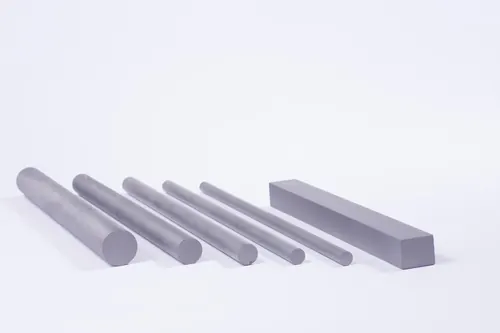
An as sintered rod arrives oversize on purpose. The diameter tolerance in our tables is a plus tolerance, so a rod ordered at Ø12.0 mm with +0.70/+0.35 mm will measure between 12.35 and 12.70 mm. Ground rods skip that step and arrive finished to H6.
| Family | Unground tolerance | Ground finish |
|---|---|---|
| Solid rods | +0.50/+0.25 mm on small sizes up to +0.75/+0.35 mm on large | Available ground |
| Central coolant hole | +0.30/+0.50 mm up to +0.30/+0.80 mm | H6 |
| Two straight holes | +0.30/+0.50 mm up to +0.30/+0.80 mm | H6 |
Length
Solid rods are listed at 310 and 330 mm with a +5.0/+0 mm tolerance. Coolant hole rods are listed at 330 mm with the same length tolerance. Longer rods are cut to order, so send the length with the enquiry rather than assuming the standard.
Picking The Grade
For solid carbide drills, sub-fine grades GW10U, GW20U and GW30U cover most work, and GW30U doubles as a substrate for coated tools. For end mills that will meet hard steels, stainless steel or titanium, GW40U and GW45U carry more binder and survive better. For PCB bits and reamers, the ultra fine GW10U is the grade to start from.
A Checklist Before You Send The Drawing
- Rod diameter and whether you want it ground to H6 or as sintered
- Length, if it is not 330 mm
- Channel type: central, twin straight or helical
- Hole diameter and, for twin hole rods, the bore circle
- Maximum eccentricity you can live with
- Grade, or the workpiece material so we can recommend one
- Quantity, and whether it repeats through the year
Frequently Asked Questions
Which channel type should a two flute drill use?
Two straight coolant holes on a bore circle, which is the configuration our 6 to 26 mm table covers. A helical version is used when the channel has to follow a twisted flute.
What is the eccentricity on a 25 mm central hole rod?
0.50 mm, with a 3.0 mm hole held to plus or minus 0.25 mm.
How much stock is on an as sintered rod?
It is the plus tolerance in the table. A 12 mm rod at +0.70/+0.35 mm will arrive between 12.35 and 12.70 mm.
Are ground rods available in every size?
Ground rods are finished to H6. Tell us the diameter and we will confirm the ground option for that size.
Keep Reading
Still Not Sure
Send the drawing or describe the duty. Technical help with grade and preform design comes with the quotation, and quotes go out in 24 hours or less.