
Gun Drilling Process Guide
A twist drill loses its way past about five times the diameter. Gun drilling was invented for everything beyond that point.
A twist drill loses its way past about five times the diameter. Gun drilling was invented for everything beyond that point.
What Gun Drilling Is
Gun drilling is a kind of special deep hole cutting tool method for the outer cuttings. The angle of the V type is 120 degrees, and for deep hole drilling the V angle goes to 160 degrees. It must be used with a special machine tool, not with a long drill in a machining centre spindle.
The process drills deep holes beyond what is possible with conventional machinery and tooling such as twist drills, by using high pressure coolant for clean chip exhaust even at extreme depths.
Why Not A Twist Drill
With a standard twist drill it is difficult to drill a straight and accurately sized hole of a depth more than about five times the diameter. That is a problem in many manufacturing processes. The classic example is the firearms industry: a barrel has to be very straight and accurately sized, and barrels are far longer than their inside diameter. The .223 inch, that is 5.56 mm, calibre barrel of an M16 rifle is 20 inches or 508 mm long, nearly 90 times the diameter of the bore. The gun drill was developed to drill such long, straight holes.
Three Deep Hole Methods
All three are categorised by how the cutting coolant flushes heat and chips away from the cutting face.
| Method | Coolant and chip path | Diameter limit |
|---|---|---|
| Gun drilling | The cutting tool is a fluted solid rod with a hole bored down the centre. Coolant is pumped through that hole, then flows back outside the drill through the flute, bringing the chips with it. | Common between 3 and 50 mm |
| BTA / STS | The cutting tool is a tube. Coolant is pumped in around the outside of the tool and carries chips out through the centre tube. | Only above 15.6 mm, because tubes have minimum sizes |
| Ejector system | The cutting tool is a tube with another tube nested inside. Coolant flows through the smaller tube to the cutting face, then coolant and chips flow back through the larger tube. | Only above 18.4 mm |
Gun drilling is possible over a range of depths and diameters. For diameters between 1 and 3 mm it can be performed successfully with special equipment. It is a common process between 3 and 50 mm. It is also possible in the 50 to 75 mm range, although it is less efficient there than BTA deep hole drilling.
Where Our Blanks Sit
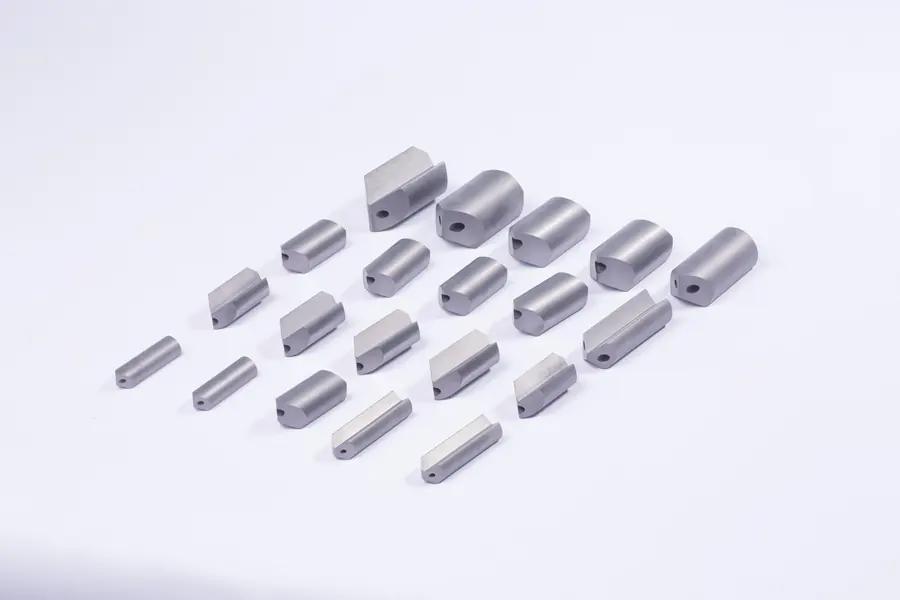
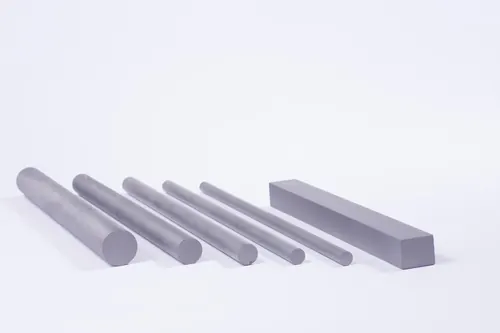
GWM gun drilling is effective in diameters from 10.5 to 35 mm. The finished profile table runs from QZ10036S at 10.5 mm through to the 34 and 35 mm types, with a diameter tolerance of +0.45/−0.10 mm, coolant hole tolerances of ±0.20 mm and a length tolerance of +3.0/+0 mm. The 330 mm double hole blank table covers 10 to 25 mm for shops that grind their own geometry.
Specifying A Blank
- Finished diameter, and how much grinding stock you want on it.
- Overall length. Our blank tables are built around 330 mm.
- Coolant hole diameter and position, listed as d1 and d2 on the blank table and as ΦB and ΦC on the finished profile table.
- Grade. Sub-fine grades in the GW10U to GW30U range cover most drilling duty.
We are an expert in making tungsten carbide gun drills, both blank and finished parts, and we can also produce the gun drill according to your request, so a size that is not in the tables is still a normal enquiry.
Getting The Hole Started
Start in a bushing or a pilot bore. The single flute geometry relies on guide pads riding an existing bore to stay on line. Entering into open material is the quickest way to push a deep hole off centre, and no amount of coolant pressure will pull it back.
Frequently Asked Questions
What V angle does a gun drill use?
The angle of the V type is 120 degrees. For deep hole drilling the V angle goes to 160 degrees.
How deep can a twist drill go before it wanders?
About five times the diameter. Beyond that it becomes difficult to hold a straight, accurately sized hole, which is the reason the gun drill exists.
What diameter range does gun drilling cover?
It is a common process between 3 and 50 mm. Between 1 and 3 mm it can be done with special equipment, and between 50 and 75 mm it is possible but less efficient than BTA drilling.
Do I need a special machine?
Yes. Gun drilling must be used with a special machine tool, because the coolant pressure and flow are as much part of the process as the tool geometry.
Still Not Sure
Send the drawing or describe the duty. Technical help with grade and preform design comes with the quotation, and quotes go out in 24 hours or less.