
Logistics guide
How Decorative Lighting Should Be Packed, And Why Drop Testing Matters
Glass, crystal and stone are most of this catalogue, and they break in transit for reasons that have nothing to do with the freight forwarder. Packaging engineering is the whole answer.
Decorative lighting is a bad thing to ship. It is fragile, it is awkwardly shaped, it is light for its volume, and a large part of its value is in a surface finish that scuffs. Every one of those is a packaging problem rather than a freight problem, which means it is solved in the factory or not at all.
What a drop test actually proves
Our packaging has passed the e-commerce drop test. That matters because parcel networks handle cartons individually and roughly, in a way palletised sea freight does not: a single carton is thrown, dropped on a corner and stacked under heavier goods. Packaging engineered for pallet freight frequently fails in a parcel network, which is why a product that ships fine to a distributor's warehouse can generate constant breakage claims the moment it is sold online.
The three failure modes
| Failure | Cause | Prevention |
|---|---|---|
| Glass and crystal fracture | Corner impact transmitted through rigid internal packing | Suspended or cushioned internal packing that lets the product decelerate |
| Finish scuffing | Components moving against each other inside the carton | Individual wrapping of plated and painted parts, not just the fixture as a whole |
| Crushing | Void space in the carton and stacking in transit | Correct carton grade and no unfilled voids |
Container loading on light, bulky goods
Decorative lighting cubes out long before it weighs out, which means a container is full of air well before it reaches its weight limit. The practical consequence is that the model mix decides the freight cost per unit far more than the total weight does, and that a mixed order planned as one shipment loads far better than three separate orders. Send the full model list and quantities and the loading can be worked properly rather than estimated.
Lead times, published honestly
- Sample order: 7 to 10 days
- New production order: 45 to 60 days
- Repeat order against an existing item number: 30 to 45 days
- Sea freight and customs clearance are additional and depend on your destination
Before it ships
A dedicated QC inspects the goods you ordered and shares a photo inspection report with you before shipment. On a category where finish variation and natural material variation are both real, that report is the last point at which a problem costs a reprint rather than a container.
If your warehouse needs specific carton marking or labelling, say so at the order stage. Adding it after production means relabelling by hand.
FAQ
Questions On This Guide
Can you ship a single unit by courier?
Yes. Our packaging has passed the e-commerce drop test, which is precisely the case it was designed for.
Do you quote FOB or CIF?
Tell us which you need at the quotation stage and we will price accordingly.
How many units fit in a container?
It depends entirely on the model mix, because these goods cube out rather than weigh out. Send the model list and we will work the actual loading.
What are your payment terms?
T/T, L/C at sight, Ali Trade Assurance, PayPal, Western Union and MoneyGram. Other terms can be negotiated.
Related products
Products Referenced In This Guide
Product groups
Ranges This Guide Covers
73 products
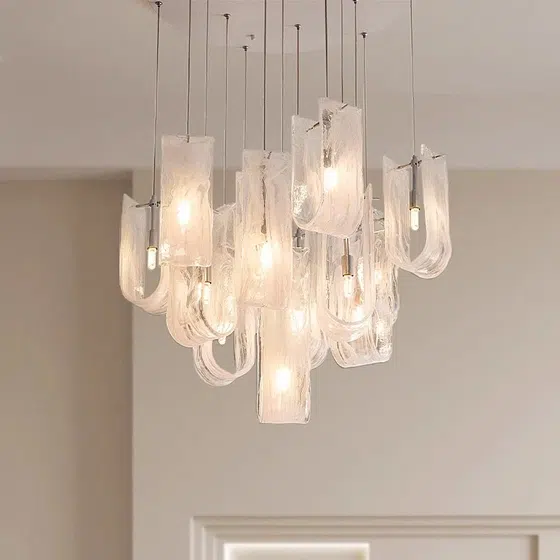
Chandeliers
Glass, crystal, copper and iron chandeliers on G9, G4, E14 and LED sources, built for lobbies, stairwells and rooms with height to fill.
43 products
Glass Pendant Lights
Blown and bent glass shades on iron and plated iron frames, on E14, E12, E27 and G9 bases, in clear, amber and coloured finishes.
27 products
Natural Stone Pendant Lights
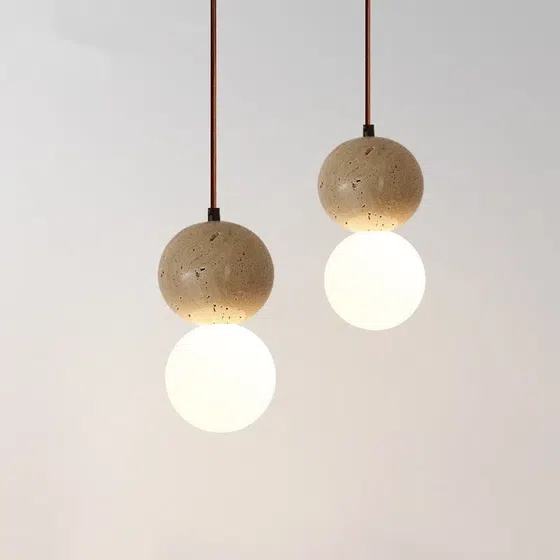
Yellow travertine and stone shades on wood and metal hardware, lit by LED, G9 and E27 sources, where the stone glows rather than reflects.
Turn This Into A Specification
Send us the project and we will translate it into item numbers, a lead time and a container plan.