Knowledge Center
Sheet Protector Thickness And Finish Explained
Sheet protectors are one of the highest volume repeat lines in office stationery, which means small specification differences turn into large cost and quality differences across a year. Three things decide it: thickness, finish and punch.
Thickness
Thickness is the first thing a buyer should fix, because it drives both the feel of the product and the price more than anything else.
Too thin and the protector curls in the binder, tears at the punch holes and lets pages slide out. Too thick and the binder holds fewer pages and the unit cost rises without the user noticing a benefit. The right answer depends on how often the pages are turned: a reference manual on a shop floor needs a heavier film than a set of pages filed once and rarely opened.
We check sheet thickness on incoming material before cutting, and hold it against the approved sample on every reorder. If you send us a physical sample of what you sell now, we can match it rather than working from a number alone.
Matt Or Glossy
Glossy film looks brighter on a shelf and shows printed colour more strongly. Matt film scatters light, which keeps a printed page readable under office ceiling lighting where a glossy sheet would reflect.
For anything that will be read regularly under artificial light, matt wins. For retail display where the pack has to catch the eye, glossy usually wins. Embossed finishes sit between the two and hide surface scuffing well.
Both finishes are produced on the same body, so a range can be split by finish and sold at two price points.
Punch Pattern
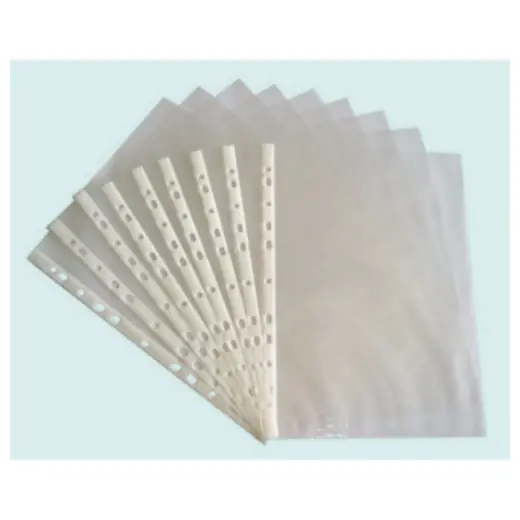
A protector that is out of punch pitch drags on the ring mechanism and eventually tears. The safest approach is to send us the binder the protector has to fit, or its specification, rather than naming a punch pattern.
Where the item is handled daily, a reinforced spine is worth the small extra cost. It is the strip along the punched edge that fails first.
Retail Packing
Sheet protectors are usually sold in multipacks, so the pack is part of the product. Multipack counts, polybags, header cards and barcodes are made up at the factory to your retail specification and approved on the sample rather than added later.