
How To Size LED Flood Lights Using Lux At Distance
Why wattage is the wrong starting point, and how to use published illuminance figures instead.
In This Guide
Lumens Leave The Fitting Lux Arrives At The Ground
Luminous flux in lumens describes what the fitting emits in total. Illuminance in lux describes how much of that lands on a surface at a given distance.
The second number is the one that determines whether a yard is usable at night, and it is the one most flood light listings omit.
The Inverse Square Reality
Light from a point source falls off with the square of the distance. Double the mounting height and the illuminance directly below falls to roughly a quarter.
This is why a flood light that performs well at three metres can be useless at six, and why mounting height belongs in the specification conversation from the start.
Using Published Illuminance Figures
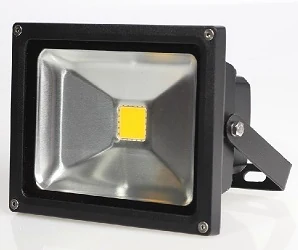
Our fixed and PIR flood light ranges publish average illuminance at measured distances - for example at one, two, three metres and beyond depending on the model.
That lets you work backwards. Decide the illuminance the task needs, establish the mounting height available, then choose the wattage whose published figure meets it at that distance rather than guessing from the power rating.
Rough Illuminance Targets
General outdoor circulation and pathways are commonly designed around 20 to 50 lux. A car park or yard where vehicles move is usually specified higher, and a loading bay where people work higher still.
These are conventions rather than regulations, and local standards will override them. Use them to size the first iteration and check against the applicable standard for the site.
Coverage Versus Intensity
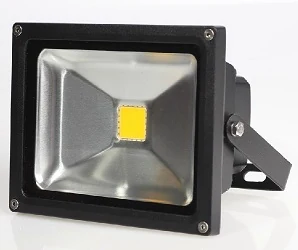
One powerful flood light produces a bright centre and dark edges. Several smaller units spaced across the area produce even coverage at similar total power.
For security applications even coverage is usually more valuable than peak intensity, because shadows are where the risk sits.
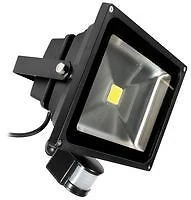
For sensor-triggered installations, plan the detection zones as carefully as the light distribution - a light that comes on after someone has already crossed the area has not done its job.
Product ranges covered in this guide
Products Discussed In This Guide
Questions About This Topic
How many flood lights do I need for a yard?
Send us the area dimensions and the mounting height available. We will work from the published illuminance figures rather than from wattage.
Is a 50W flood light five times brighter than a 10W?
Roughly, in total lumens - our published figures run from around 760 to 860 lumens at 10W to around 4350 to 4500 at 50W. But the illuminance at a given point depends on distance and beam distribution as well.
Should I use one big flood light or several small ones?
Several smaller units almost always give better coverage for security. One large unit suits lighting a specific object such as a facade or a sign.
Other Guides In The Knowledge Centre
How To Choose The Right LED Lamp Base For Your Market
E27, E26, B22, E14, GU10 and MR16 explained, with the export mistakes that cost importers money.
Buying GuideLumens Not Watts How To Compare LED Bulbs Properly
Why wattage stopped being a measure of brightness, and what to ask a supplier instead.
Buying GuideLED Colour Temperature Explained From 2400K To 6500K
What kelvin values actually mean, where each band belongs, and how to avoid a room full of returns.
Design GuideHave A Specification Question
Send it by email with the application and the quantity. A written answer from someone who knows the range beats an hour of searching.