
How To Choose The Right LED Lamp Base For Your Market
E27, E26, B22, E14, GU10 and MR16 explained, with the export mistakes that cost importers money.
In This Guide
Why The Base Decides The Order
The lamp base is the only part of a bulb specification that cannot be compromised. Wattage can be argued about and colour temperature can be negotiated, but a lamp with the wrong base is unsellable stock.
It is also the specification most often assumed rather than confirmed. A buyer who has always shipped E27 orders E27 for a Commonwealth market and discovers that half the fittings are bayonet.
The Screw Bases: E27, E26 And E14
E27 and E26 are both Edison screw bases and they look almost identical. E27 has a 27mm diameter thread and is the European standard; E26 has a 26mm thread and is the North American standard. The one millimetre difference is less important than the voltage and certification regime that goes with each market.
E14 is the small Edison screw used in chandeliers, wall sconces and small decorative fittings. It is not a reduced-output version of E27 - it is a different fitting size, and the lamp shapes that use it are usually candle, flame tip or small globe.
The Bayonet Base: B22
B22 is the bayonet cap used in the United Kingdom, Ireland, India, Australia, New Zealand and much of the Commonwealth. The lamp pushes in and twists rather than screwing.
If you are shipping into any of those markets, B22 is not an optional variant. It is the default, and E27 is the exception.
Spotlight Bases: GU10 And MR16
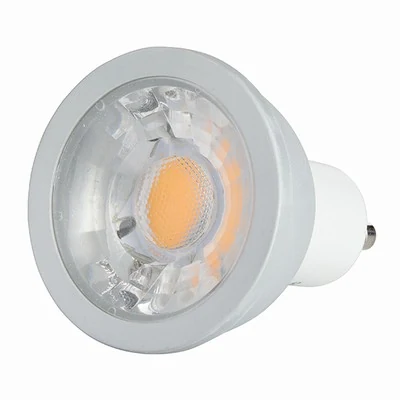
GU10 is a mains-voltage twist-lock base used in track and recessed display lighting. The lamp runs directly on mains, so there is no transformer in the circuit.
MR16 is a low-voltage bi-pin base, normally 12V, which means there is a transformer somewhere. Fitting a mains lamp into an MR16 holder, or the reverse, is the single most common spotlight ordering error.
Both are made as 6W COB spotlights in our range, and the beam angle is ordered as a separate part number rather than adjusted on site.
How To Get This Right On An Export Order
Ask the destination question first. Before anything else in the specification, establish which country the goods are being sold into and what the installed base of fittings looks like there.
Order more than one base where the market is mixed. Most of our bulb range is offered in E27, E26 and B22 from the same production line, so covering two socket standards does not mean two suppliers.
Confirm the base on the part number, not in the email body. A part number that encodes the base removes the argument later.
Product ranges covered in this guide
Products Discussed In This Guide
Questions About This Topic
Can I use an E26 lamp in an E27 fitting?
They will often physically engage, but the lamp is certified for the market its base belongs to. For an export order, specify the base that matches the destination rather than relying on a loose fit.
Which base should I order for the UK?
B22 bayonet is the traditional UK standard, although E27 is now common in newer fittings. If you are supplying replacement stock, survey the actual fittings before ordering.
Do you supply the same lamp in more than one base?
Yes. Most of the bulb range is offered in E27, E26 and B22, and the candle and small filament shapes in E14. The options are listed in each product's specification table.
Other Guides In The Knowledge Centre
Lumens Not Watts How To Compare LED Bulbs Properly
Why wattage stopped being a measure of brightness, and what to ask a supplier instead.
Buying GuideLED Colour Temperature Explained From 2400K To 6500K
What kelvin values actually mean, where each band belongs, and how to avoid a room full of returns.
Design GuideCRI And Why Colour Rendering Decides Retail Lighting
What Ra means, which numbers matter in shops and hotels, and where a low CRI lamp costs you sales.
Design GuideHave A Specification Question
Send it by email with the application and the quantity. A written answer from someone who knows the range beats an hour of searching.