Water Pressure Forming
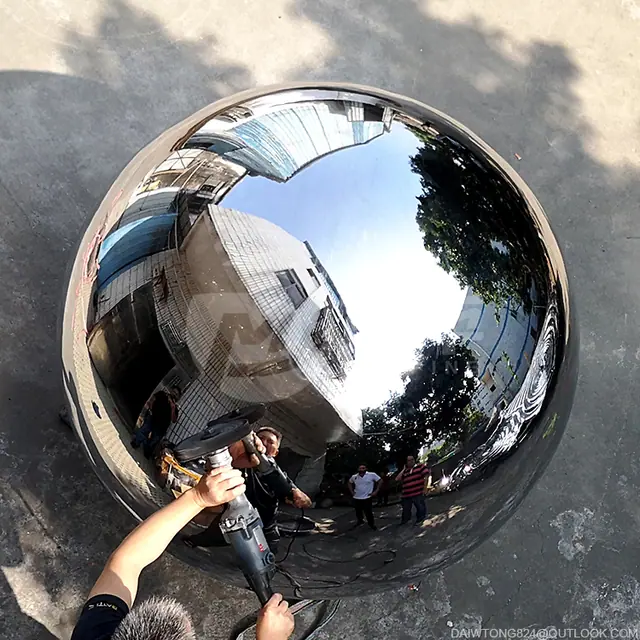
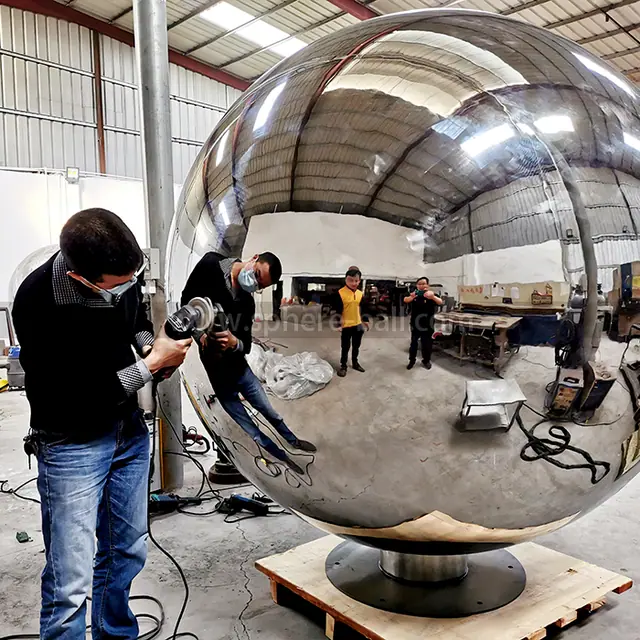
Technicians calculate the specific developed data for each welding sheet. The sheet is bent into a leaf shape, then welded into an approximate spherical cube, then expanded into a true sphere under water pressure. Finally the weld seam is ground off and the ball is mirror polished.
There is no standard die limiting this method, so any size can be made on demand. This is why large diameters that no supplier stocks can still be produced to a drawing.
Mould Pressing
Sheet is shaped by deforming it against a mould. Two hemispheres are then welded together, the seam is ground back and the ball is mirror polished or brushed. This route covers 5 mm to 500 mm diameter with 0.6 mm to 6 mm thickness, and drilling and tapping can be added to your drawing.
Spinning
Two hemispheres are metal spun, welded together, ground and polished. This produces the thickest steel ball option we offer.
Judging the Result
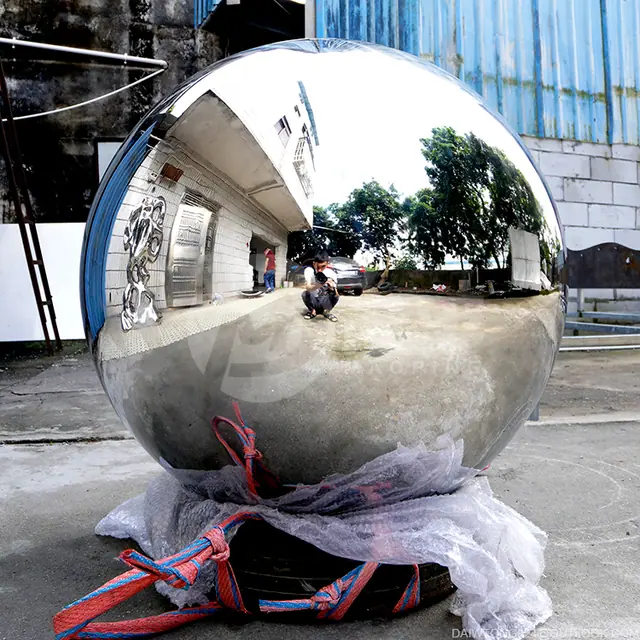
A polished surface is judged on three things. Whether the surface is smooth with uniform reflection, whether the reflected object is clear and visible, and whether the reflected object is deformed.
The weld line matters most. It is the joint between two panels and it is highly demanding on smoothness. If it is not handled well the piece reads as a divided mirror and a straight reflected line is broken into two parts.
Specification Reference
| Sphere diameter | 19 mm to 5000 mm |
|---|---|
| Wall thickness | 0.6 mm to 6 mm |
| Stainless grades | AISI 201, 304, 316, 316L |
| Other metals | Carbon steel, brass, copper, aluminium, corten steel |
| Finishes | Mirror polish, Mill finish, Brushed, Electroplating, Sandblasting, Etching, Silk printing, Spray painted RAL colour |
| Forming | Water pressure forming, mould pressing, spinning |
| Freight limit | 7 feet by conventional freight |