
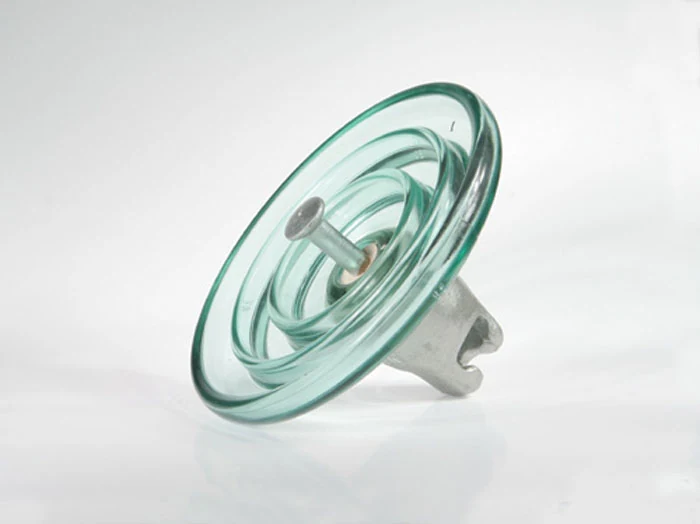
Standard Profile
U70BS · 70 kN
A 70 kN standard profile disc with 127 mm spacing, 255 mm diameter and 320 mm creepage, weighing 3.6 kg. The volume workhorse for…
Creepage 320 mm
Ø 255 mm
Coupling 16
The production of toughened glass insulators is a precise high-temperature process that creates a surface-compressive stress layer. That layer is what gives the disc its mechanical strength, its electrical insulation stability and its thermal shock resistance.
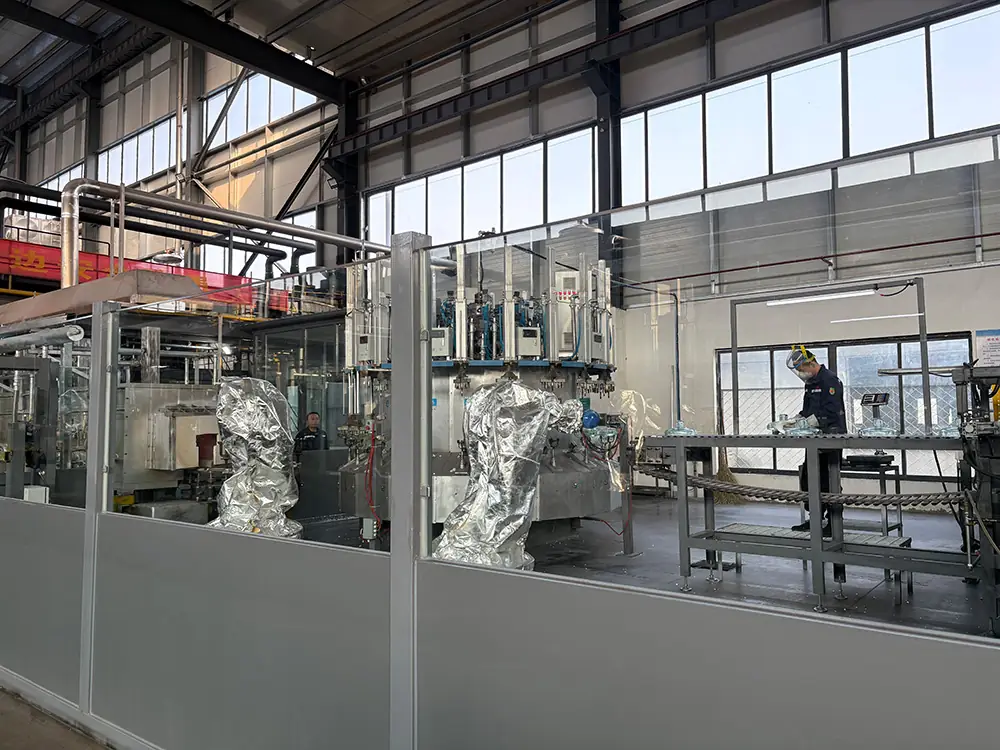
Every property you specify on a datasheet is created at a specific stage of manufacture. Uniform wall thickness is decided during press moulding. Mechanical failing load is decided during toughening. Whether a defective unit reaches your tower is decided during the thermal shock test. A supplier who does not control all three stages in-house is passing that risk to you.
Raw material preparation and batching, melting and refining, press moulding, homogenization soaking, toughening, thermal shock testing, metal fitting assembly, final inspection and testing, then packaging and storage. Each stage is covered in detail on our manufacturing page.
After toughening, shells are heated to around 300 degrees C and plunged into cold water, a temperature drop of roughly 420 degrees C. Any shell carrying internal stress or an inclusion shatters. Survivors proceed and the broken glass is recycled as cullet. A second thermal shock test follows in accordance with IEC 60383-1 and GB/T 1001.1 to screen out units with insufficient tempering stress or internal microcracks.
The shell is heated close to its softening point and then quenched with high-pressure air. The surface cools fast and the core cools slowly, leaving the surface in compression at roughly 100 to 200 MPa and the core in tension. The result is four to five times the mechanical strength of ordinary glass, and it is also why a damaged disc self-destructs instead of cracking quietly.
A 70 kN standard profile disc with 127 mm spacing, 255 mm diameter and 320 mm creepage, weighing 3.6 kg. The volume workhorse for…
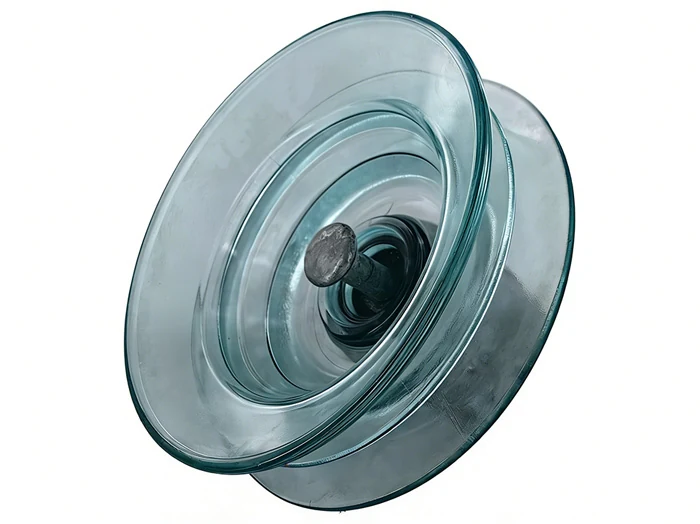
A 160 kN three-alternating disc with 155 mm spacing, 330 mm diameter and 550 mm creepage, weighing 8.9 kg. The longest creepage…
Standard, anti-fog, aerodynamic or alternating. The right answer depends on whether your deposit is a wet conductive film or a dry adherent powder.
The case for toughened glass comes down to one operational fact. A failed glass disc is visible from the ground and a failed porcelain disc is not.
Self-destruction is not a defect in the product, it is the product telling you something. Here is what causes it, what rate is normal, and why it is an advantage.
Under normal operating and maintenance conditions the service life is generally 30 to 50 years.
Regular visual inspection, cleaning in heavily polluted areas, and timely replacement of broken insulators. No complicated preventive tests are required.
Yes. We recommend anti-pollution or anti-fog glass insulators with increased creepage distance, specially designed for coastal, industrial and high-pollution environments.
Yes. We can provide customized products optimized for high-altitude conditions with enhanced insulation performance.
Send us the route conditions and we will translate this into a specific model, creepage figure and string configuration.