What Beam Angle Actually Describes
Beam angle is the cone over which the fitting delivers most of its light. A 15° head concentrates output into a tight pool; a 60° head spreads the same output over a much larger area at a much lower intensity. Nothing is gained or lost in total light - it is only a question of where it goes.
The practical consequence is simple. Doubling the beam angle roughly quadruples the lit area, so the light level on the target falls by about three quarters. That is why a 30 W flood can look weaker on a shelf than a 12 W spot.
Start From Ceiling Height Not From Wattage
The first question is how far the light has to travel. A 2.7 m domestic ceiling gives roughly 1.5 m from the fitting to a table; a 4.5 m mall ceiling gives 3.5 m or more to the floor.
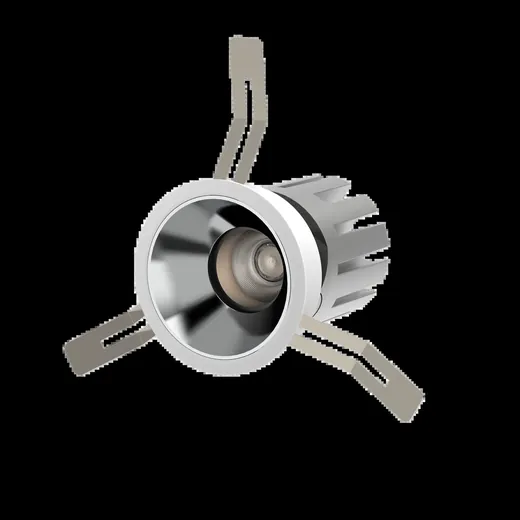
As the distance grows, the beam has to narrow to keep the same intensity on the target. This is the reason the S1 Series 8 W heads offer 5°, 8° and 10° options: not because the room is dark, but because the ceiling is tall and the target is small.
A Working Table By Application
The catalogue's beam options map onto applications fairly cleanly:
5° to 10° for tall retail ceilings, single objects, long-throw accent work. 15° for jewellery, watches, cosmetics and any small high-value display. 24° for the standard retail accent beam onto a shelf or a plinth. 36° to 38° for general accent and light circulation. 50° to 60° for ambient light, corridors, open-plan offices and guest rooms.
Mixing Angles On One Ceiling
A common mistake is specifying one beam angle for a whole floor. Contrast is what makes a retail interior work, and contrast comes from variation: narrow beams on the merchandise, wide beams on the circulation route between.
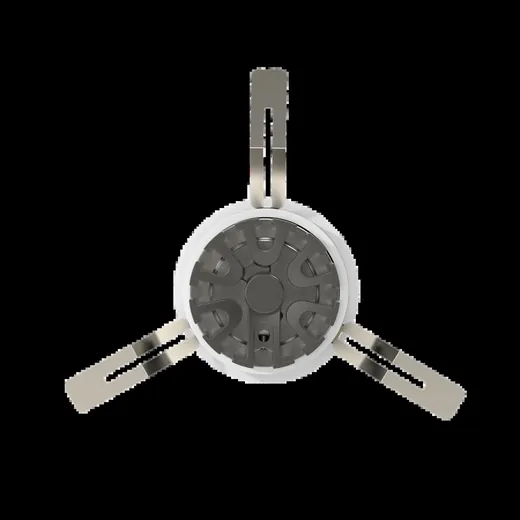
Because our spotlight families share cutout sizes, this can be done without changing the ceiling. The same Ø75 mm hole can take a 15° head over a display and a 50° head two metres away over the walkway.
Check The Reflector Too
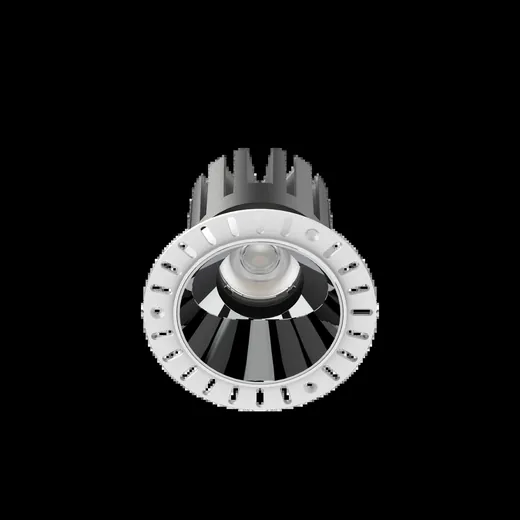
Beam angle and glare are related. A narrow beam from a shallow fitting with a bright reflector can be more uncomfortable than a wide beam from a deep one with a gun black reflector, because the aperture itself becomes a visible bright source.
When a fitting will sit in someone's eyeline - a hotel bedroom, a waiting room, an office with screens - pair the beam choice with a dark reflector finish.