
Blender Assembly
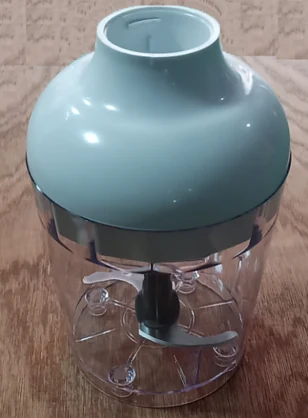
A multi-part appliance assembly: a transparent bowl, a coloured lid and a blade carrier, each with its own tool and all of them having to fit each other.
The problem
Individually, three moulded parts can all be in tolerance.
Individually, three moulded parts can all be in tolerance. Assembled, they can still rock, leak or refuse to lock, because nobody owned the stack-up between three separate tools.
When an assembly is quoted as one project, the mating features are dimensioned against each other rather than each against its own drawing, and shrinkage per material is applied part by part before any steel is cut.
How this part is tooled
The assembly shown combines a clear ribbed bowl, an opaque coloured upper housing and a central blade carrier with a drive coupling. Three parts, three materials, three different shrink rates, and a set of features that have to seal and rotate against each other.
The clear bowl is the constraining part. It needs a polished cavity, it shows weld lines, and it is the part whose shrinkage is hardest to predict because transparent grades behave differently from the filled or pigmented grades used for the housing.
Taking the assembly as one scope also means the trial is meaningful. Parts are trialled and measured together, so the first sample report answers the question that matters, which is whether the assembly works, not whether each part matches its own print.
Part and tooling data
| Part type | Three-part appliance assembly |
|---|---|
| Process | Plastic injection moulding, one tool per component |
| Components shown | Transparent bowl, coloured upper housing, blade carrier |
| Critical interfaces | Bowl-to-housing seal, blade carrier drive coupling |
| Surface | Mirror polish on the clear bowl, gloss on the housing |
| Material | Per your drawing or part specification, per component |
| Cavitation | Quoted per component to your annual volume |
| Trial | Components trialled and measured as an assembly |
Values marked “per your drawing” are set from your data at quotation stage. TJ-Teck does not publish assumed dimensions for a customer part.
Typical applications
- Kitchen and food preparation appliances
- Small motorised household appliances
- Laboratory mixing vessels
- Any multi-part moulded assembly with a rotating interface
Industries
Engineering that applies here
Frequently asked questions
Can you quote only some of the tools in an assembly?
Yes, but say which mating parts already exist and send samples of them, so the new tools are dimensioned against the real parts rather than against a drawing.
How is shrinkage handled across different materials?
Each component gets its own shrink factor for its specified material, applied at 3D mould design stage. The factors used are stated in the mould design release.
Do you supply first article measurement?
A measurement report against your drawing is issued with the trial samples. Tell us which dimensions are critical and they are called out separately.
Related parts
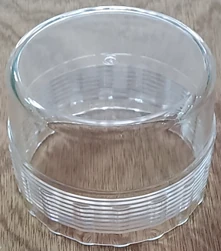
Thread Clear Part
A transparent moulded cup with fine external ribbing and a threaded feature, run in a mirror-polished cavity where every tool mark ends up visible in the wall.
View part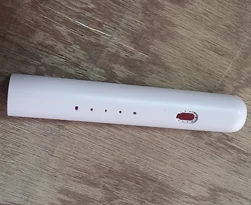
Toothbrush Handle
A slim handheld handle with moulded button apertures and an indicator window, the classic case for a two-shot over-mould once a soft grip is added.
View part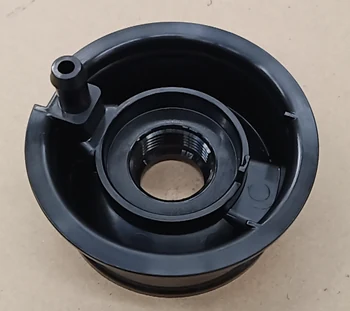
Cap with Threads
Plastic moulded part with a thread structure: an internally threaded cap with a moulded spout, released by an unscrewing mould rather than a split core.
View partQuotation for the blender assembly
Attach 2D and 3D data, tell us the annual volume and the material, and a quotation comes back in 1-3 working days.