
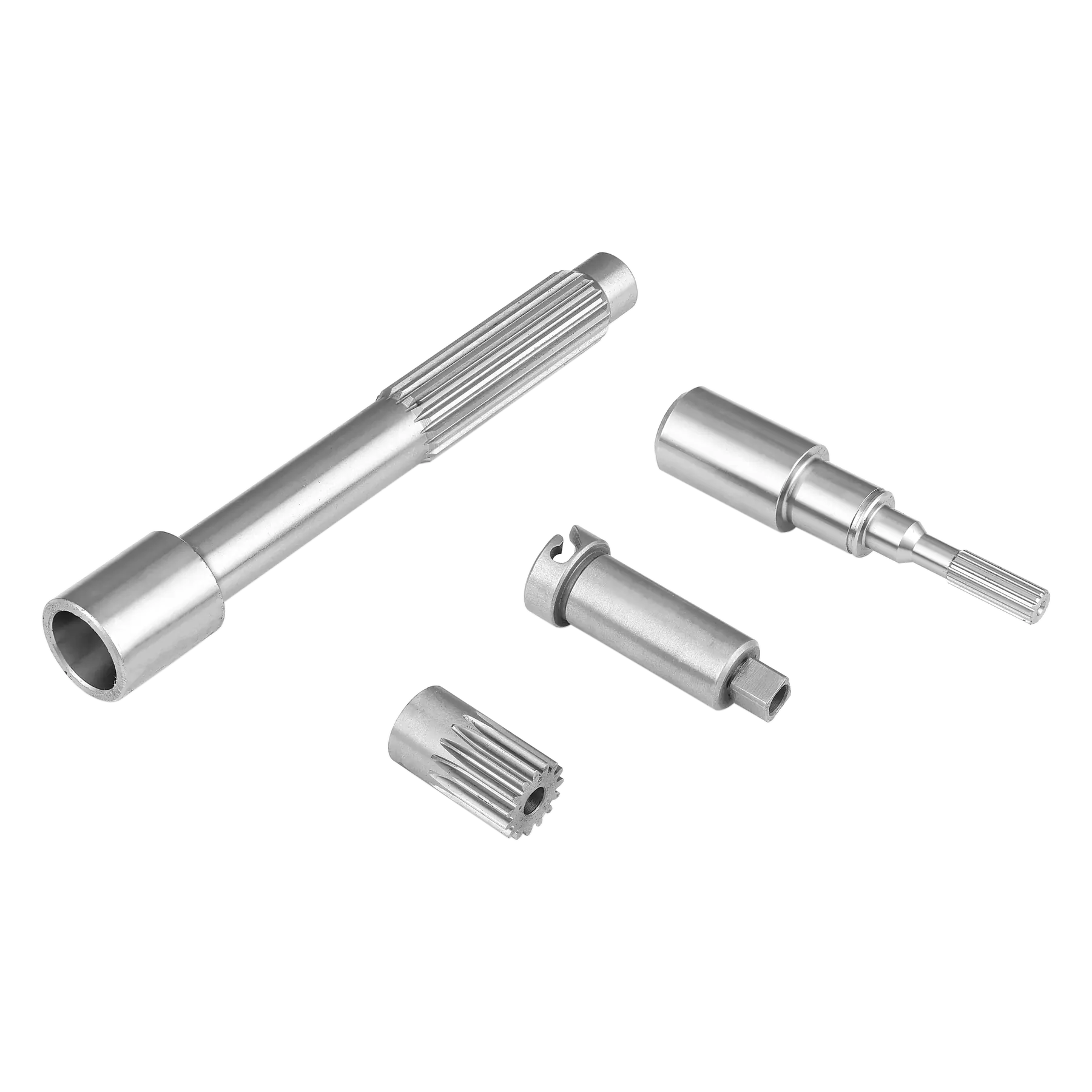
Splined Shaft And Collet Set
A splined shaft and the collets that run on it, cut in the same plant so the spline fit is checked on real parts
Spline Fits Are Verified, Not Assumed
A spline drawing tells you the nominal form. Whether the collet slides freely under load is something you only learn by putting the two parts together. Machining both here means that check happens before the parts ship, not on your assembly line.
The set covers a splined shaft, the collets that engage it and the adapters that connect the assembly to whatever drives it.
Why Matched Spline Supply Works Better
Fit Checked On Real Parts
Shaft and collet are engaged and checked for free movement before release.
Same Cutting Data
Both halves are cut from one set of spline parameters, so nothing is lost in translation.
One Responsibility
If the pair does not fit, there is no argument between two suppliers.
Application Scenarios
- Sliding drive couplings in small machinery
- Quick-change tooling interfaces
- Telescoping drive shafts
- Indexing mechanisms needing angular repeatability
Who It Is For
- Designers of sliding or telescoping drives
- Buyers currently splitting spline work between two suppliers
- Engineers with collets that bind under torque
- Toolmakers needing small quantities of matched pairs
Spline Problems We See Most
- Collets that slide freely unloaded and bind under torque
- Two suppliers interpreting the same spline drawing differently
- Fits that only fail once the parts are plated
- Long qualification cycles on a simple sliding joint
Paired Inspection
Engagement is trialled, and the result is reported with the sample.
Single Data Set
One set of spline parameters drives both programs.
Finish Allowed For
Plating or coating thickness is taken into account before cutting.
Technical Features
- Male spline cut to the customer form
- Matching female collet or sleeve
- Adapters and end fittings from the same family
- Engagement trial on sample parts
- Consistent material and finish across the set
Specifications
| Supply Format | Matched spline pair plus adapters |
|---|---|
| Typical Materials | Free-cutting steel or stainless steel |
| Primary Processes | CNC turning, milling, form cutting |
| Spline Form | To customer drawing |
| Fit Verification | Engagement trialled on sample parts |
| Tolerance | To customer drawing, confirmed at quotation |
| Sample Lead Time | Within 30 days of drawing approval |
Spline data comes from your drawings. Fit clearances depend on the duty you describe.
Materials We Run
- Free-cutting steel for general drive work
- Case-hardening steel where the spline sees repeated engagement
- SUS304 stainless for corrosion-exposed assemblies
- Bronze collets where a sacrificial wear part is wanted
Manufacturing Process
Review Both Drawings
Spline data on the shaft and the collet are reconciled first.
Machine The Pair
Both halves are produced in the same window from one data set.
Trial Engagement
Parts are assembled and checked for free sliding movement.
Finish And Pack
Any coating is applied with the fit allowance included.
Quality Control
- Spline form checked on a profile projector
- Engagement and sliding force trialled on sample pairs
- Diameters and lengths measured on every lot
- Re-check after plating where a coating is applied
- ISO 9001 system since 2009
Customization Options
- Spline form, count and length of engagement
- Collet wall thickness and slot pattern
- Adapter interfaces at both ends
- Heat treatment on either half
- Matched sets numbered and bagged together
Splines Against Keys And Pins
| Keyed shaft | A spline shares torque over many teeth, so the shaft can be smaller for the same load. |
|---|---|
| Pinned joint | Allows axial sliding under load, which a pin cannot. |
| Polygon drive | Polygon profiles are easier to grind but harder to change once tooled; splines suit small-series work. |
Getting A Spline Pair Made
Send Both Drawings
Shaft and collet together, so the data can be reconciled.
State The Sliding Duty
Sliding under load needs more clearance than a static fit.
Name The Finish
Any coating has to be allowed for before cutting.
Ask For The Trial Report
We record the engagement check with the sample shipment.
Splined Shaft And Collet Set — FAQ
Can you machine both halves of the spline?
Yes, and that is how we prefer to take this work. Making the shaft and the collet from one data set removes the interpretation differences that cause most spline fit problems.
How do you check the fit?
Sample parts are assembled and checked for free sliding movement, and the result is reported with the sample shipment. Profile projection confirms the form itself.
Does plating affect a spline fit?
Yes, noticeably, because the coating goes onto every flank. Where a coating is specified we allow for it before cutting and re-check the pair after plating.
Can you harden the spline?
Case hardening is subcontracted and managed by us. On sliding splines it is often worth it, but it can move the part, so we discuss the sequence before agreeing.
Do you supply the pair as a numbered set?
Matched pairs can be bagged and numbered together where the fit is critical. Tell us at quotation so the handling is costed in.
Related Products
Related Guides
Send Both Halves Of The Spline
Attach the shaft and collet drawings and tell us whether the joint slides under load. We come back with price and the fit we intend to hold.