
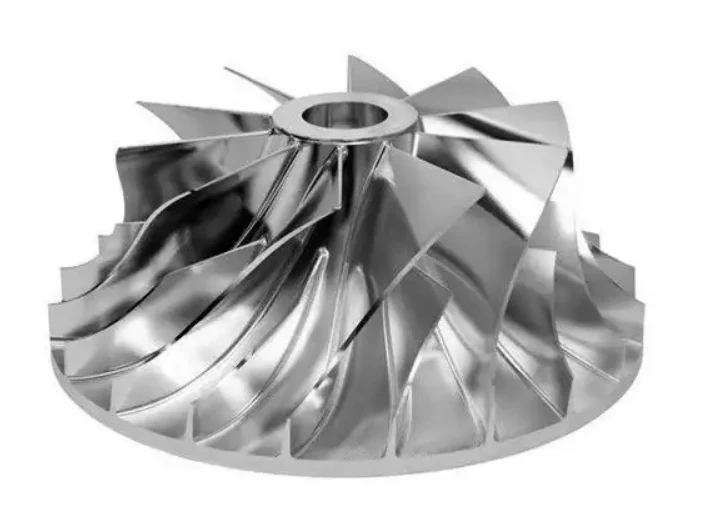
CNC Machined Compressor Impeller
A bladed impeller cut from solid stock on multi-axis equipment, so the blade profile is the one on your model and not the one the casting allowed
Blades Cut From Solid Rather Than Cast And Cleaned Up
Every blade on this impeller is milled from a solid billet. The hub bore, the back face and the blade surfaces all come from the same CAD model, which means the passage area between blades is what the aerodynamicist asked for instead of whatever the casting and the fettler left behind.
It is the part in our range that shows the multi-axis side of the workshop most clearly: the same building that bar-feeds small shafts also runs milling work where the tool has to reach between thin curved blades without touching the neighbour.
Why Machined Impellers Get Specified
Model-Faithful Passages
Blade thickness and passage area match the CAD model, so test results map onto the simulation.
No Pattern Cost
Design changes cost programming time, not a new casting pattern, which suits development and low volumes.
Homogeneous Material
Cut from wrought stock, so there is no porosity waiting to be found during balancing.
Application Scenarios
- Prototype and small-series turbomachinery
- Test rigs where blade geometry is being iterated
- Replacement impellers for equipment out of production
- Low-volume industrial blowers and pumps
Who It Is For
- Development teams iterating blade geometry between tests
- Equipment builders with volumes too low to justify a casting pattern
- Service departments replacing an obsolete cast impeller
- Engineers who need traceable wrought material rather than a casting
The Casting Problems This Route Avoids
- Pattern and tooling cost before the first test piece exists
- Porosity discovered at balancing, after the machining is paid for
- Blade profiles that drift from the model between foundry batches
- Long foundry lead times on a part that is still changing
Straight From CAD
The 3D model drives the toolpaths, so a revision is a reprogram not a retool.
Wrought Stock
Material comes with a mill certificate and no internal voids.
Repeatable
The archived program reproduces the same geometry on the next order.
Technical Features
- Full blade set milled from solid billet
- Hub bore and back face machined for balancing
- Blade root fillets cut rather than blended by hand
- Geometry driven directly by the customer 3D model
- Surface finish controlled by step-over rather than polishing
Specifications
| Part Type | Bladed compressor impeller |
|---|---|
| Manufacturing Route | Machined from solid, multi-axis milling |
| Input Data | 3D model required; 2D drawing for tolerances and datums |
| Typical Material | Aluminium alloy or stainless steel |
| Balancing | On request, to a customer-nominated grade |
| Tolerance | To customer drawing and model |
| Inspection | Dimensional check against the model datums |
| Sample Lead Time | Within 30 days of data approval |
Blade geometry comes from your model. We publish no stock impeller sizes because every one of these is cut to a customer design.
Materials We Run
- Aluminium alloys for light rotating assemblies
- Stainless steel where the gas stream is wet or corrosive
- Customer-nominated wrought bar or billet
- Mill certificates supplied when the drawing asks for them
Manufacturing Process
Model Review
We check blade thickness and tool access before quoting.
Turn The Blank
Hub, bore and back face are turned so the part has clean datums.
Multi-Axis Milling
Blade surfaces and roots are cut with the part indexed.
Deburr And Verify
Edges are broken by hand and the part is measured from the datums.
Quality Control
- Toolpath simulated against the model before cutting metal
- First article measured from the drawing datums
- Blade thickness spot-checked at defined stations
- Bore and back face checked for run-out before packing
- ISO 9001 system, in place since the company was certified in 2009
Customization Options
- Blade count and profile from your model
- Hub bore, keyway or spline
- Material substitution after a weight or corrosion review
- Balancing to a nominated grade
- Protective packing for single high-value pieces
Machined Against Cast And Printed Impellers
| Investment cast impeller | No pattern cost and no porosity, but higher cost per piece once volumes are large and the design has frozen. |
|---|---|
| Additively manufactured impeller | Better surface finish and material properties straight off the machine, without the post-processing an printed part needs. |
| Fabricated welded impeller | One-piece construction removes weld distortion and the inspection that comes with it. |
What We Need Before Quoting An Impeller
Send The 3D Model
STEP or Parasolid. The model is the geometry of record for the blades.
Add A 2D Print
Datums, bore tolerance and any balancing requirement live on the drawing.
State The Duty
Speed, gas and temperature guide the material recommendation.
Confirm Quantity
One-off, pilot batch or repeat series changes how we fixture it.
CNC Machined Compressor Impeller — FAQ
Can you machine an impeller from a 3D model alone?
We can cut the blade geometry from the model, but we still ask for a 2D drawing that states the datums, the bore tolerance and any balancing requirement. Without that there is nothing to inspect the finished part against.
Do you balance the impeller?
Balancing is available on request to the grade you nominate. Tell us the service speed and the standard you work to and we will include it in the quotation.
Which is cheaper, machining or casting?
For prototypes and small series, machining is almost always cheaper because there is no pattern to pay for. Casting overtakes it once the design is frozen and the quantity is high enough to amortise the tooling.
What is the thinnest blade you can cut?
It depends on blade height and material, because the limit is deflection under the cutter rather than the tool diameter. Send the model and we will tell you before you commit.
Can you reproduce an impeller from a sample?
We can measure a physical sample and produce a model from it, but the result is a copy of a worn part unless you can supply the original data. We will always say which of the two you are getting.
Related Products
Related Guides
Send The Impeller Model For Review
Upload the STEP file and the duty point over WhatsApp or email. We come back with machinability notes, material options and a price.