
Vibration and Tensioning Solutions
Choosing between rubber suspension units, oscillating mountings and tensioner devices for machine frames, axles and chain drives.
Torsional rubber springs replace a coil spring, a pivot bearing and a damper with one maintenance free element. The engineering question is not whether they work, it is which housing profile, which core geometry and which working temperature band suits the motion your machine actually makes.
Where Sourcing Breaks and How It Is Closed
A unit chosen for steady deflection behaves badly when the motion alternates across the neutral position.
DK-A is built for alternating motion over the neutral element position, while DR and DK series units suit suspension travel in one main direction.
The mounting interface on the frame is fixed and the element has to suit it, not the other way round.
Steel tube profiles are available for plug-in connection, light metal profiles for lighter frames, and steel profiles from size 60 upward where the load requires it.
Vibration isolation collapses when an element is loaded well outside its band.
Oscillating mountings cover 7 sizes from 50 N to 10000 N per element at natural frequencies of approximately 2 to 3 Hz, so the element is matched to the load rather than the space.
A long chain or belt drive needs more compensation than a single standard tensioner gives.
The NR-B boomerang type is built for tensioning very long chain and belt drives with triple compensation, NR-F mounts from the front only on blind hole frames, and NR is the standard component.
An element rated for the wrong temperature band hardens or softens in service.
Working temperature runs from -40 C to +80 C on NR and NR-B and from -30 C to +90 C on NR-F, with Rubmix 10 rubber quality in the tensioner devices.
Outdoor frames corrode at the element interface before the rubber ever fails.
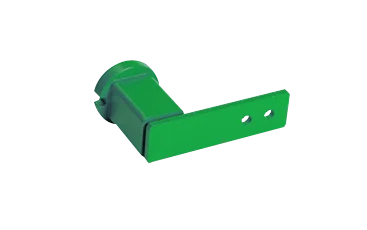
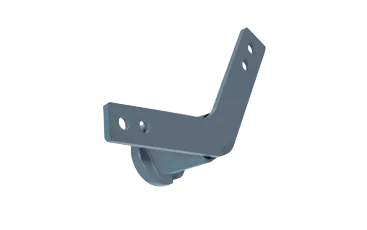
Steel parts are supplied painted: green on NR and NR-F, grey printed on NR-B, and yellow protection paint on the DR and DK suspension units.
Categories Involved
Tensioner Devices
Rubber suspension tensioner devices configured with powder metallurgy housings, steel inner cores, and Rubmix 10 inserts
3 part numbers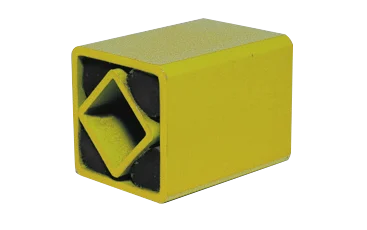
Rubber Suspension Units
Rubber suspension units manufactured with steel inner cores and light metal or steel housings across plug-in and alterna
5 part numbers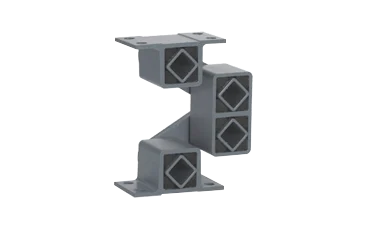
Oscillating Mountings
Oscillating mountings covering 7 sizes from 50 N to 10000 N per element with natural frequencies around 2 to 3 Hz for vi
1 part numbersProducts in This Route
NR Standard Tensioner Device
Types NR is a standard tensioner device manufactured with a powder metallurgy housing, a steel inner core, and Rubmix…
View specificationsNR-B Boomerang Tensioner Device
Types NR-B tensioner devices are built for tensioning very long chain and belt drives using a boomerang configuration…
View specifications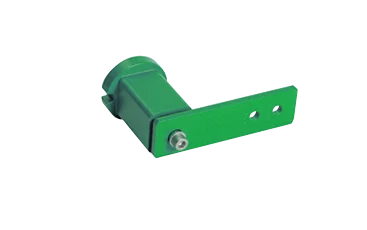
NR-F Front Mounting Tensioner Device
Types NR-F front mounting tensioner devices provide chain and belt tensioning on frames where rear access is…
View specificationsAB Oscillating Mounting
Type AB oscillating mountings are elastic suspension elements engineered for high vibration isolation and low…
View specificationsDR-S Rubber Suspension Unit
The DR-S is a rubber suspension unit engineered with a steel housing, a steel inner core, and a steel tube intended…
View specifications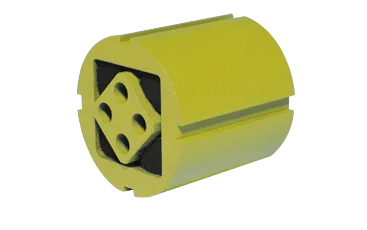
DK-A Rubber Suspension Unit
DK-A rubber suspension units are engineered for alternating motions that pass over the neutral element position in…
View specificationsVibration and Tensioning Solutions Questions
What is the load range of the oscillating mountings?
7 sizes from 50 N to 10000 N per element, at natural frequencies of approximately 2 to 3 Hz.
Which tensioner suits a very long chain drive?
The NR-B boomerang type, which is built for the tensioning of very long chain and belt drives with triple compensation.
What if the frame only allows access from the front?
The NR-F front mounting device is designed for installation on blind hole frames with fixation from the front only, using a hex socket screw of quality 12.9.
What working temperatures are the tensioner devices rated for?
NR and NR-B run from -40 C to +80 C and NR-F runs from -30 C to +90 C.
What is inside the tensioner housing?
A housing made of powder metallurgy, a steel inner core and Rubmix 10 rubber inserts.
Vibration and Tensioning Solutions
Send the drawing, the part list or the worn sample and this route starts at the review stage.